QUESTION IMAGE
Question
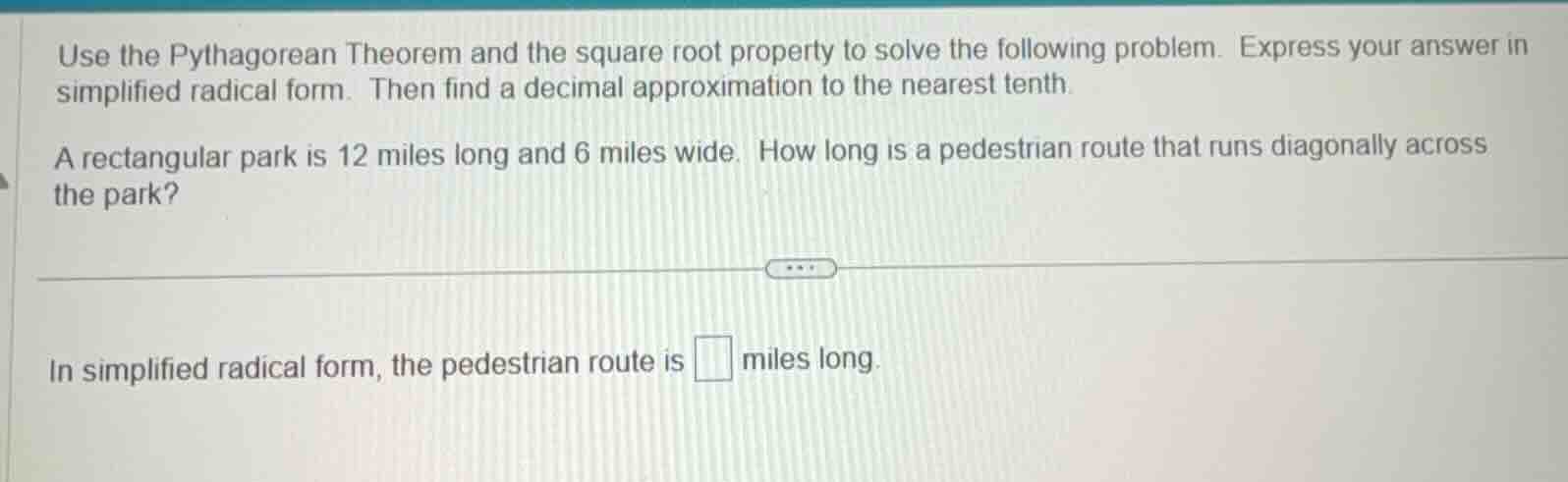
use the pythagorean theorem and the square root property to solve the following problem. express your answer in simplified radical form. then find a decimal approximation to the nearest tenth.
a rectangular park is 12 miles long and 6 miles wide. how long is a pedestrian route that runs diagonally across the park?
in simplified radical form, the pedestrian route is \\(\square\\) miles long.
Step1: Apply Pythagorean Theorem
Let \(a=12\), \(b=6\), \(c\) = diagonal.
$$c^2 = a^2 + b^2$$
$$c^2 = 12^2 + 6^2$$
Step2: Calculate squared values
$$c^2 = 144 + 36$$
$$c^2 = 180$$
Step3: Simplify radical
$$c = \sqrt{180} = \sqrt{36 \times 5} = 6\sqrt{5}$$
Step4: Decimal approximation
$$6\sqrt{5} \approx 6 \times 2.236 \approx 13.4$$

Snap & solve any problem in the app
Get step-by-step solutions on Sovi AI
Photo-based solutions with guided steps
Explore more problems and detailed explanations
In simplified radical form, the pedestrian route is \(6\sqrt{5}\) miles long.
The decimal approximation to the nearest tenth is 13.4 miles.