QUESTION IMAGE
Question
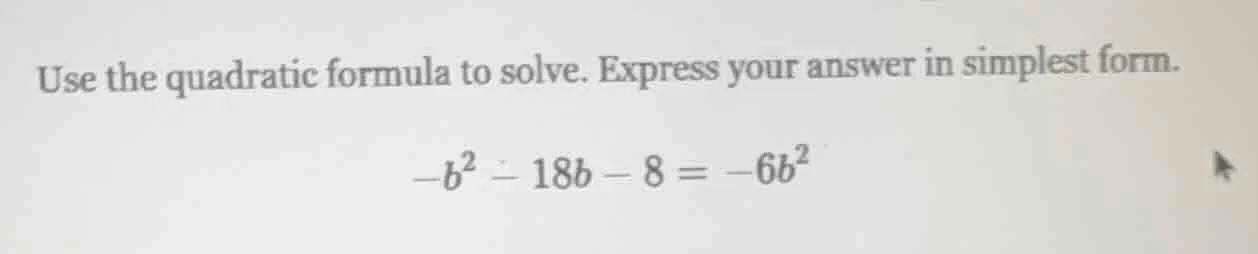
use the quadratic formula to solve. express your answer in simplest form.
$-b^{2}-18b - 8=-6b^{2}$
Step1: Rearrange the equation to standard quadratic form \(ax^2 + bx + c = 0\)
First, we add \(6b^2\) to both sides of the equation \(-b^2 - 18b - 8 = -6b^2\) to get:
\(-b^2 + 6b^2 - 18b - 8 = 0\)
Combining like terms, we have \(5b^2 - 18b - 8 = 0\). Here, \(a = 5\), \(b = -18\), and \(c = -8\).
Step2: Recall the quadratic formula
The quadratic formula is \(x=\frac{-B\pm\sqrt{B^2 - 4AC}}{2A}\) (in our case, the variable is \(b\), so we can write \(b=\frac{-B\pm\sqrt{B^2 - 4AC}}{2A}\) where \(A = a\), \(B = b\), \(C = c\) from the standard form \(Ax^2+BX + C = 0\)).
Substituting \(A = 5\), \(B=- 18\), and \(C = -8\) into the quadratic formula:
First, calculate the discriminant \(D=B^2 - 4AC\).
\(D=(-18)^2-4\times5\times(-8)\)
\(= 324 + 160\)
\(= 484\)
Then, find the square root of the discriminant: \(\sqrt{D}=\sqrt{484} = 22\)
Now, substitute into the quadratic formula:
\(b=\frac{-(-18)\pm22}{2\times5}=\frac{18\pm22}{10}\)
Step3: Find the two solutions
For the plus sign:
\(b=\frac{18 + 22}{10}=\frac{40}{10}=4\)
For the minus sign:
\(b=\frac{18-22}{10}=\frac{-4}{10}=-\frac{2}{5}\)

Snap & solve any problem in the app
Get step-by-step solutions on Sovi AI
Photo-based solutions with guided steps
Explore more problems and detailed explanations
The solutions are \(b = 4\) and \(b=-\frac{2}{5}\)