QUESTION IMAGE
Question
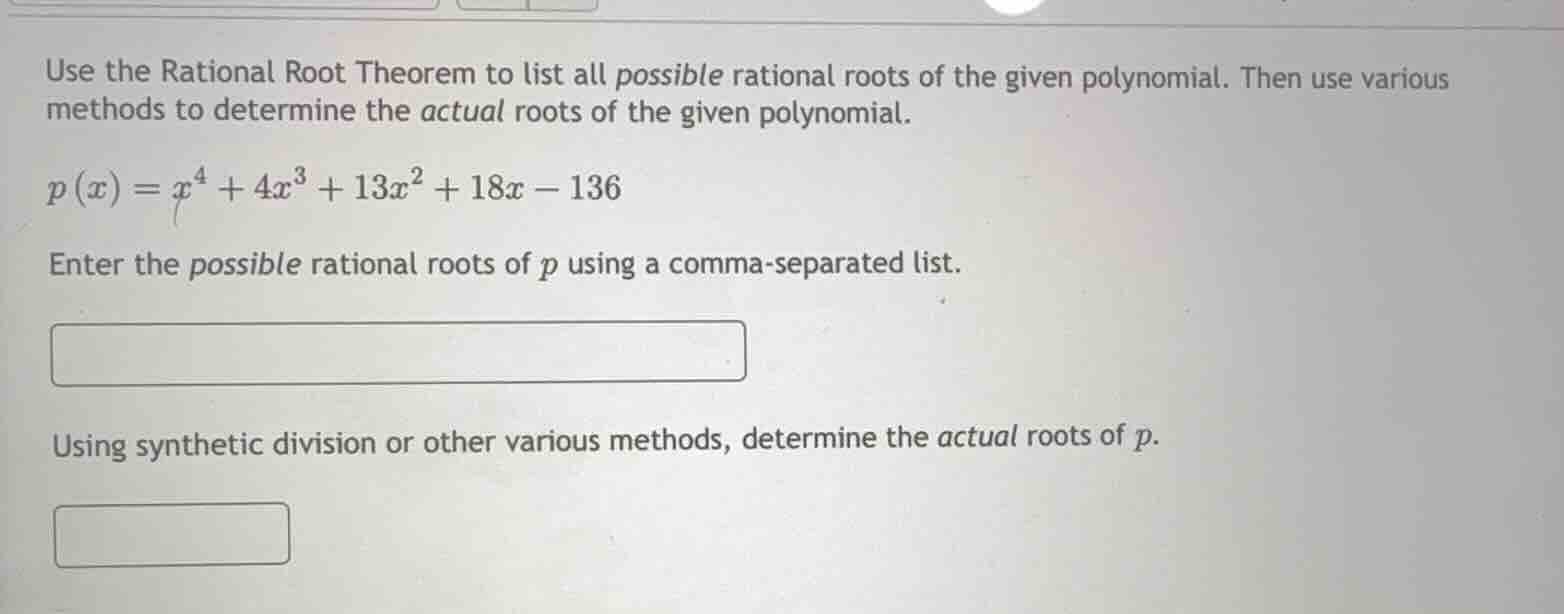
use the rational root theorem to list all possible rational roots of the given polynomial. then use various methods to determine the actual roots of the given polynomial.
$p(x)=x^4 + 4x^3 + 13x^2 + 18x - 136$
enter the possible rational roots of $p$ using a comma-separated list.
using synthetic division or other various methods, determine the actual roots of $p$.
Step1: Identify constant & leading coeff
Constant term: $-136$, Leading coefficient: $1$
Step2: List factors of both values
Factors of $136$: $\pm1, \pm2, \pm4, \pm8, \pm17, \pm34, \pm68, \pm136$
Factors of $1$: $\pm1$
Step3: Apply Rational Root Theorem
Possible rational roots: $\frac{\text{Factors of }-136}{\text{Factors of }1} = \pm1, \pm2, \pm4, \pm8, \pm17, \pm34, \pm68, \pm136$
Step4: Test $x=2$ via synthetic division
Remainder = 0, so $x=2$ is a root.
Step5: Factor polynomial to cubic
$p(x)=(x-2)(x^3+6x^2+25x+68)$
Step6: Test $x=-4$ on cubic
Remainder = 0, so $x=-4$ is a root.
Step7: Factor to quadratic
$p(x)=(x-2)(x+4)(x^2+2x+17)$
Step8: Solve quadratic with quadratic formula
For $x^2+2x+17=0$, $a=1, b=2, c=17$
$x=\frac{-b\pm\sqrt{b^2-4ac}}{2a}=\frac{-2\pm\sqrt{4-68}}{2}=\frac{-2\pm\sqrt{-64}}{2}=-1\pm4i$

Snap & solve any problem in the app
Get step-by-step solutions on Sovi AI
Photo-based solutions with guided steps
Explore more problems and detailed explanations
Possible rational roots: $-136, -68, -34, -17, -8, -4, -2, -1, 1, 2, 4, 8, 17, 34, 68, 136$
Actual roots: $2, -4, -1+4i, -1-4i$