QUESTION IMAGE
Question
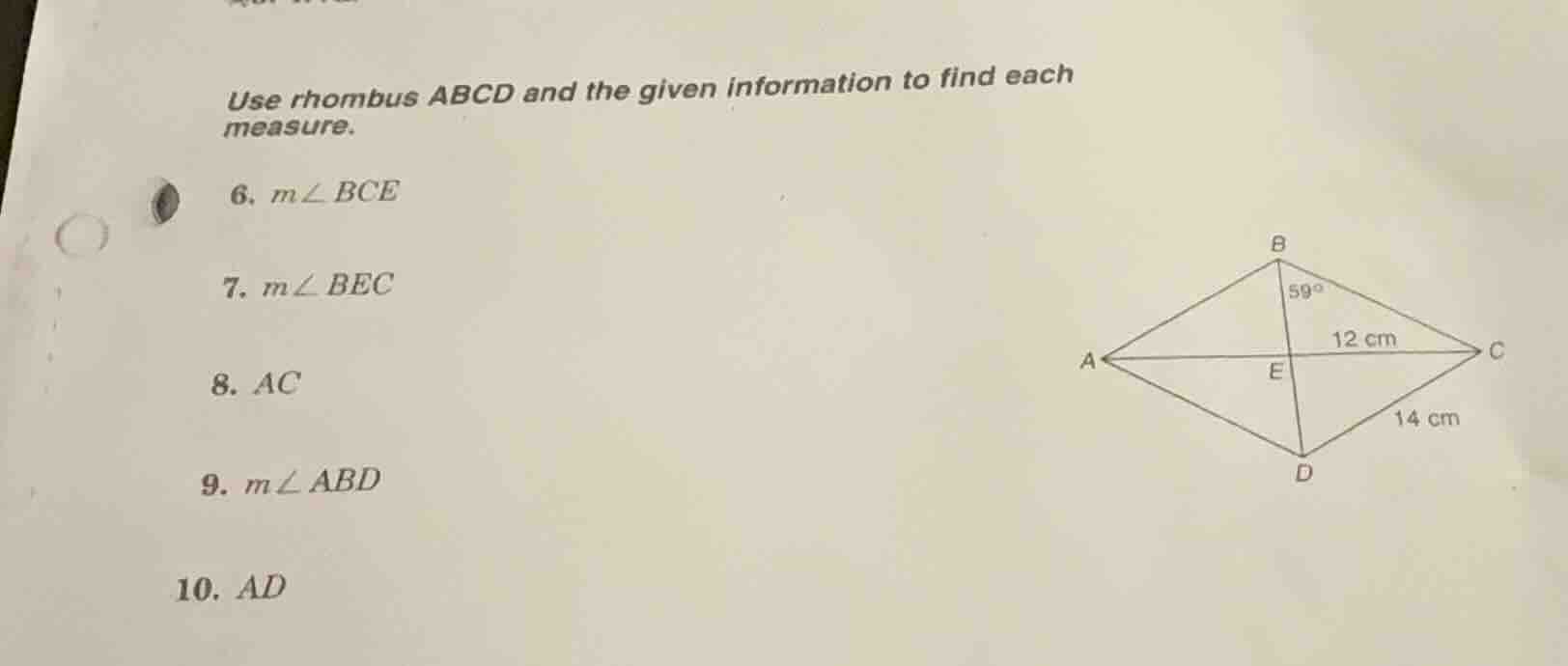
use rhombus abcd and the given information to find each measure.
- ( mangle bce )
- ( mangle bec )
- ( ac )
- ( mangle abd )
- ( ad )
(there is a rhombus abcd with diagonals ac and bd intersecting at e. in triangle bec, angle at b is 59°, ec is 12 cm, and cd is 14 cm.)
Problem 6: \( m\angle BCE \)
Step 1: Recall Rhombus Diagonals Property
In a rhombus, diagonals bisect the angles. Also, diagonals of a rhombus are perpendicular bisectors of each other? Wait, no, actually, diagonals of a rhombus bisect the vertex angles. Wait, looking at the diagram, triangle \( BCE \): we know \( \angle BEC \) is related? Wait, no, first, in a rhombus, all sides are equal. Wait, the given angle at \( B \) between the diagonal and side is \( 59^\circ \)? Wait, the diagram shows \( \angle EBC = 59^\circ \), and \( BC = 14 \) cm, \( EC = 12 \) cm? Wait, no, \( AC \) is split into \( AE \) and \( EC \), but in a rhombus, diagonals bisect each other? Wait, no, diagonals of a rhombus bisect each other at right angles? Wait, no, diagonals of a rhombus are perpendicular bisectors? Wait, no, diagonals of a rhombus bisect the angles and bisect each other, and are perpendicular. Wait, let's correct: In a rhombus, diagonals are perpendicular (so \( \angle BEC = 90^\circ \)? Wait, no, maybe I misremember. Wait, properties of a rhombus: 1. All sides are equal. 2. Diagonals bisect the angles. 3. Diagonals are perpendicular bisectors of each other (so they intersect at right angles). Wait, so \( \angle BEC = 90^\circ \)? But let's check problem 6: \( m\angle BCE \). Let's look at triangle \( BCE \). We know \( BC = 14 \) cm, \( EC = 12 \) cm? Wait, no, the diagram shows \( AC \) is a diagonal, with \( EC = 12 \) cm? Wait, maybe \( AC \) is split into \( AE \) and \( EC \), but in a rhombus, diagonals bisect each other, so \( AE = EC \)? Wait, no, diagonals bisect each other, so if \( EC = 12 \) cm, then \( AC = 24 \) cm (problem 8). But for problem 6: \( \angle BCE \). Let's consider triangle \( BCE \). We know \( \angle EBC = 59^\circ \), and if diagonals are perpendicular, then \( \angle BEC = 90^\circ \), so in triangle \( BCE \), angles sum to \( 180^\circ \). So \( m\angle BCE = 180^\circ - 90^\circ - 59^\circ = 31^\circ \). Wait, let's confirm:
Step 1: Diagonals in rhombus are perpendicular.
So \( \angle BEC = 90^\circ \) (since diagonals intersect at right angles).
Step 2: In \( \triangle BCE \), sum of angles is \( 180^\circ \).
Given \( \angle EBC = 59^\circ \), \( \angle BEC = 90^\circ \), so \( m\angle BCE = 180^\circ - 90^\circ - 59^\circ = 31^\circ \).
Step 1: Recall rhombus diagonals property.
In a rhombus, diagonals are perpendicular bisectors of each other, so they intersect at right angles.
Step 2: Therefore, \( \angle BEC = 90^\circ \).
Step 1: Diagonals of a rhombus bisect each other.
So the diagonal \( AC \) is split into two equal parts by the intersection point \( E \).
Step 2: Given \( EC = 12 \) cm, so \( AC = 2 \times EC \).
\( AC = 2 \times 12 = 24 \) cm.

Snap & solve any problem in the app
Get step-by-step solutions on Sovi AI
Photo-based solutions with guided steps
Explore more problems and detailed explanations
\( 31^\circ \)