QUESTION IMAGE
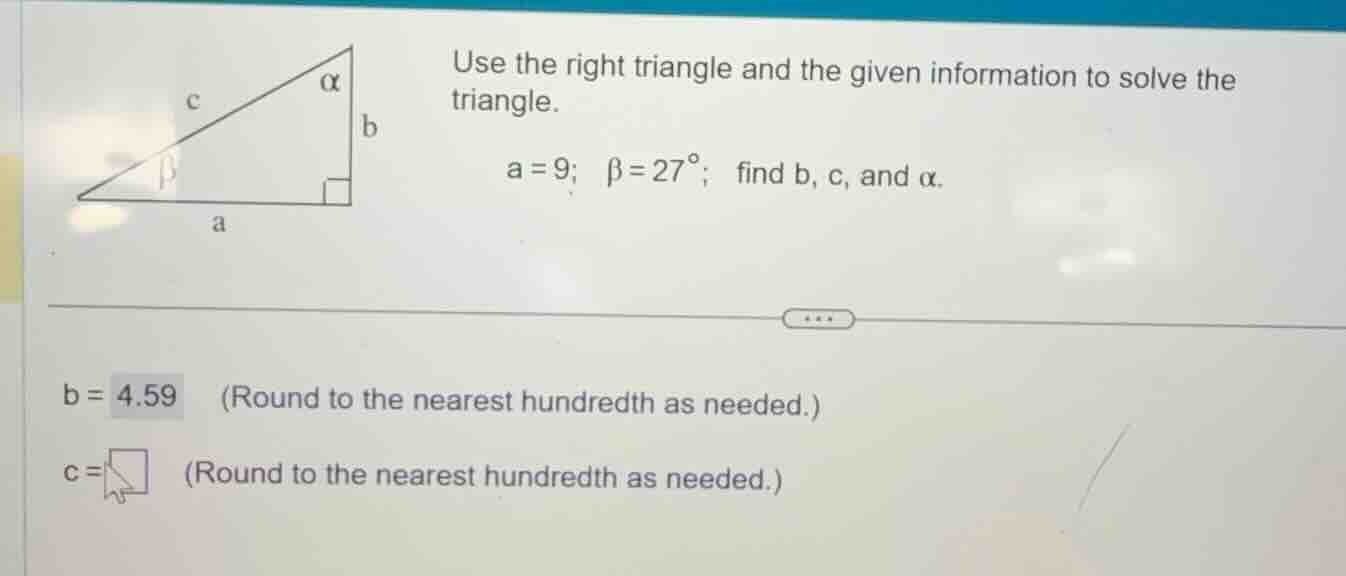
Question
use the right triangle and the given information to solve the triangle.
a = 9; \beta = 27^{\circ}; find b, c, and \alpha.
b = 4.59 (round to the nearest hundredth as needed.)
c = \square (round to the nearest hundredth as needed.)
Step1: Find angle α
In a right triangle, the sum of the acute angles is \(90^\circ\). So \(\alpha + \beta = 90^\circ\). Given \(\beta = 27^\circ\), we have \(\alpha = 90^\circ - 27^\circ = 63^\circ\).
Step2: Find side c (hypotenuse)
We know \(a = 9\) (adjacent to \(\beta\)) and we can use the cosine function: \(\cos\beta=\frac{a}{c}\), so \(c = \frac{a}{\cos\beta}\). Substituting \(a = 9\) and \(\beta = 27^\circ\), \(\cos(27^\circ)\approx0.8910\), then \(c=\frac{9}{0.8910}\approx10.10\) (or we can also use Pythagorean theorem later, but trigonometric function is direct here). Alternatively, using Pythagorean theorem after finding b: we know \(a = 9\), \(b\approx4.59\), so \(c=\sqrt{a^{2}+b^{2}}=\sqrt{9^{2}+4.59^{2}}=\sqrt{81 + 21.0681}=\sqrt{102.0681}\approx10.10\).

Snap & solve any problem in the app
Get step-by-step solutions on Sovi AI
Photo-based solutions with guided steps
Explore more problems and detailed explanations
\(c\approx10.10\), \(\alpha = 63^\circ\), \(b\approx4.59\) (already given for b, and we found \(\alpha = 63^\circ\), \(c\approx10.10\))
For the value of \(c\) specifically, the answer is \(\boxed{10.10}\) (rounded to the nearest hundredth).