QUESTION IMAGE
Question
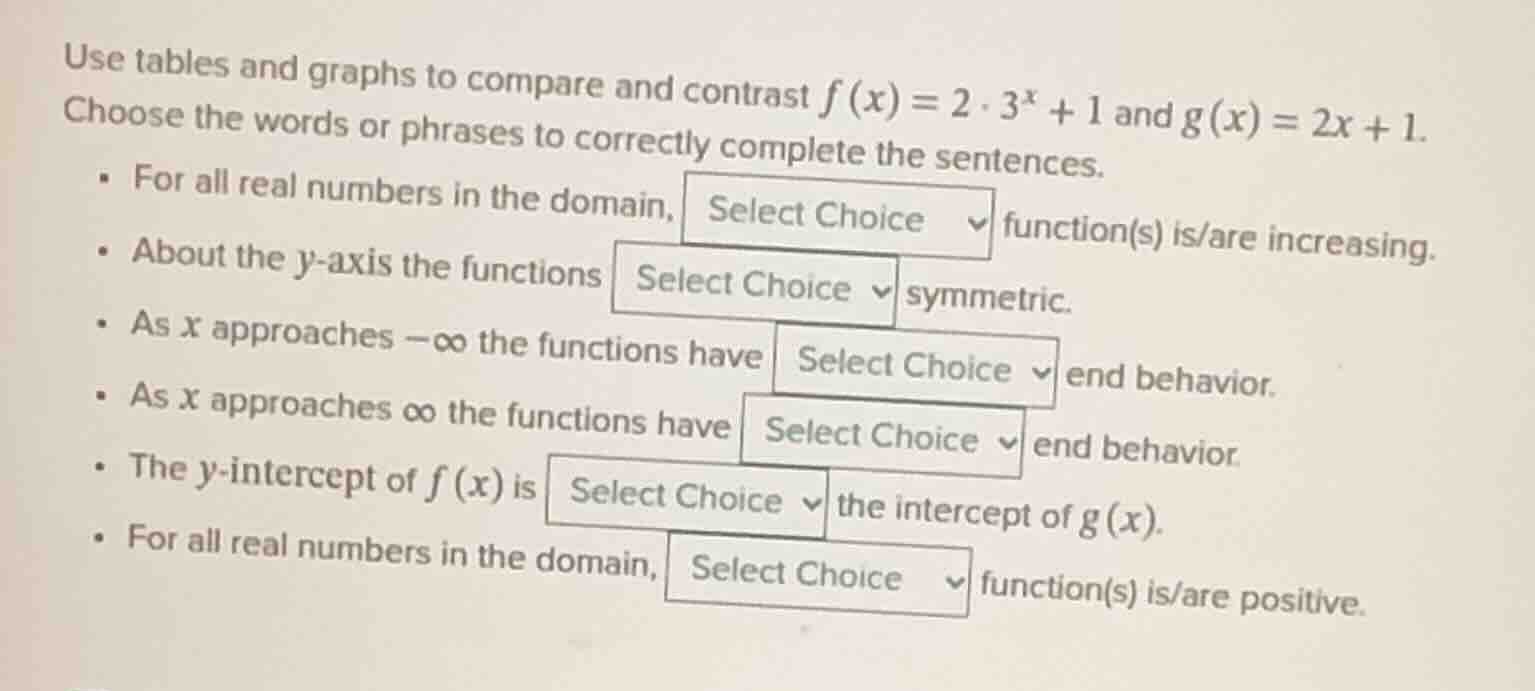
use tables and graphs to compare and contrast $f(x) = 2 \cdot 3^x + 1$ and $g(x) = 2x + 1$.
choose the words or phrases to correctly complete the sentences.
- for all real numbers in the domain, select choice function(s) is/are increasing.
- about the $y$-axis the functions select choice symmetric.
- as $x$ approaches $-\infty$ the functions have select choice end behavior.
- as $x$ approaches $\infty$ the functions have select choice end behavior.
- the $y$-intercept of $f(x)$ is select choice the intercept of $g(x)$.
- for all real numbers in the domain, select choice function(s) is/are positive.
Step1: Analyze increasing behavior
For $f(x)=2\cdot3^x + 1$: The derivative $f'(x)=2\cdot3^x\ln3>0$ for all real $x$, so it is always increasing.
For $g(x)=2x + 1$: The slope is $2>0$, so it is always increasing.
Step2: Check y-axis symmetry
A function is symmetric about the y-axis if $f(-x)=f(x)$.
For $f(x)$: $f(-x)=2\cdot3^{-x}+1=\frac{2}{3^x}+1
eq f(x)$
For $g(x)$: $g(-x)=-2x + 1
eq g(x)$
Neither function satisfies the condition.
Step3: End behavior as $x\to-\infty$
For $f(x)$: $\lim_{x\to-\infty}2\cdot3^x + 1=0 + 1=1$
For $g(x)$: $\lim_{x\to-\infty}2x + 1=-\infty$
Their end behaviors differ.
Step4: End behavior as $x\to\infty$
For $f(x)$: $\lim_{x\to\infty}2\cdot3^x + 1=\infty$
For $g(x)$: $\lim_{x\to\infty}2x + 1=\infty$
Their end behaviors are the same.
Step5: Compare y-intercepts
Y-intercept occurs at $x=0$.
$f(0)=2\cdot3^0 + 1=2+1=3$
$g(0)=2\cdot0 + 1=1$
$3>1$, so $f(x)$'s intercept is greater than $g(x)$'s.
Step6: Analyze positivity over domain
For $f(x)=2\cdot3^x + 1$: $3^x>0$ for all real $x$, so $2\cdot3^x + 1>1>0$ always.
For $g(x)=2x + 1$: Set $2x+1<0$, solve $x<-\frac{1}{2}$, so it is negative when $x<-\frac{1}{2}$.
Only $f(x)$ is always positive.

Snap & solve any problem in the app
Get step-by-step solutions on Sovi AI
Photo-based solutions with guided steps
Explore more problems and detailed explanations
- For all real numbers in the domain, both function(s) is/are increasing.
- About the y-axis the functions are not symmetric.
- As $x$ approaches $-\infty$ the functions have different end behavior.
- As $x$ approaches $\infty$ the functions have the same end behavior.
- The y-intercept of $f(x)$ is greater than the intercept of $g(x)$.
- For all real numbers in the domain, only $f(x)$ function(s) is/are positive.