QUESTION IMAGE
Question
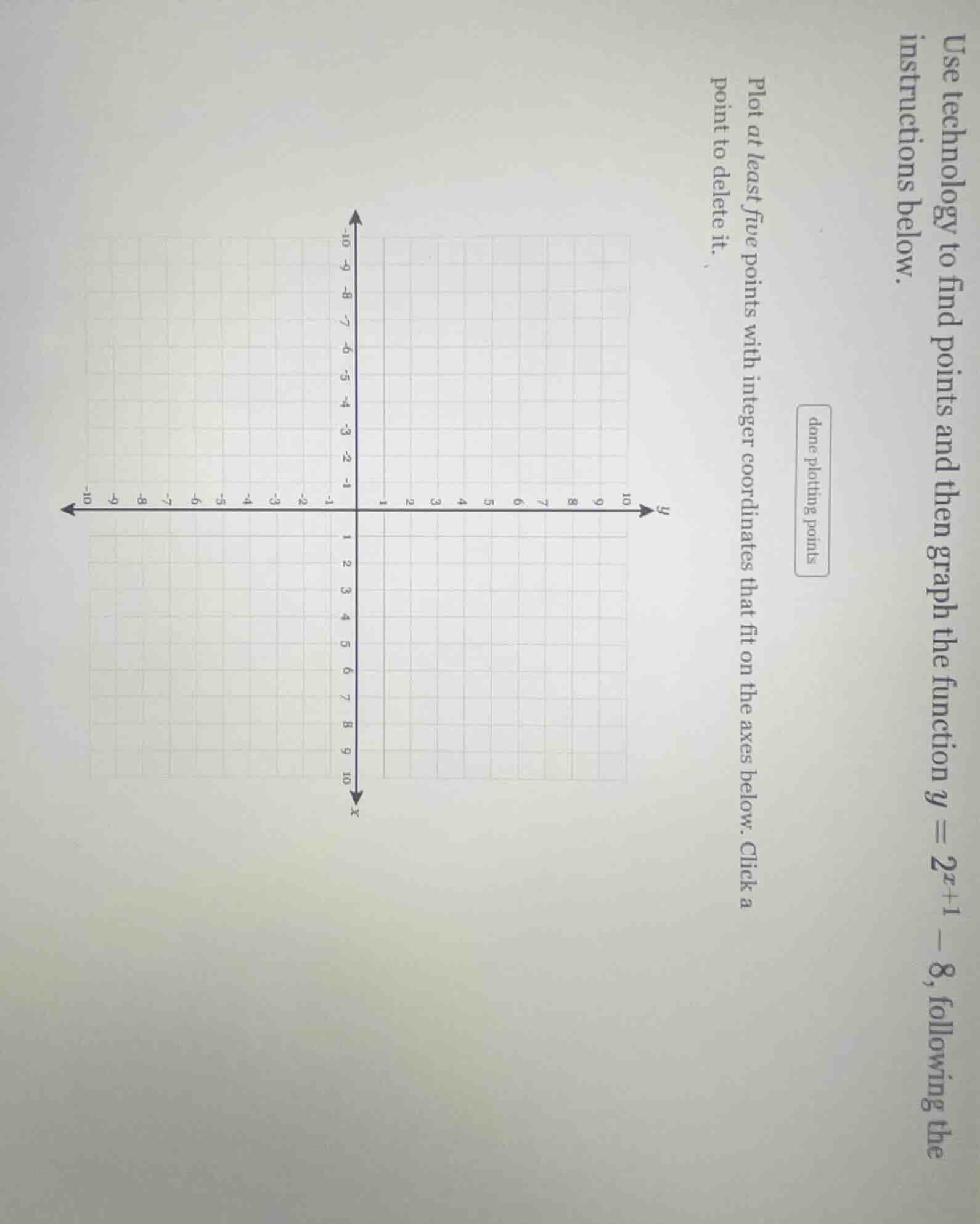
use technology to find points and then graph the function $y = 2^{x + 1}-8$, following the instructions below. plot at least five points with integer coordinates that fit on the axes below. click a point to delete it. done plotting points
Step1: Choose integer x-values
Let's pick \( x = -3, -2, -1, 0, 1 \) (and more if needed) to find corresponding y-values using the function \( y = 2^{x + 1}-8 \).
Step2: Calculate y for \( x = -3 \)
Substitute \( x = -3 \) into the function:
\( y = 2^{-3 + 1}-8 = 2^{-2}-8 = \frac{1}{4}-8 = -\frac{31}{4} = -7.75 \)? Wait, no, wait—wait, \( 2^{-2} = \frac{1}{4} \), so \( \frac{1}{4}-8 = -7.75 \)? But we need integer coordinates? Wait, maybe I made a mistake. Wait, let's re - check. Wait, the function is \( y = 2^{x + 1}-8 \). Let's try \( x = 2 \): \( 2^{3}-8 = 8 - 8 = 0 \). \( x = 1 \): \( 2^{2}-8 = 4 - 8 = -4 \). \( x = 0 \): \( 2^{1}-8 = 2 - 8 = -6 \). \( x = -1 \): \( 2^{0}-8 = 1 - 8 = -7 \). \( x = 3 \): \( 2^{4}-8 = 16 - 8 = 8 \). Ah, I see, I messed up \( x=-3 \). Let's correct:
For \( x = -1 \):
\( y = 2^{-1 + 1}-8 = 2^{0}-8 = 1 - 8 = -7 \). So point \( (-1, -7) \).
For \( x = 0 \):
\( y = 2^{0 + 1}-8 = 2^{1}-8 = 2 - 8 = -6 \). So point \( (0, -6) \).
For \( x = 1 \):
\( y = 2^{1 + 1}-8 = 2^{2}-8 = 4 - 8 = -4 \). So point \( (1, -4) \).
For \( x = 2 \):
\( y = 2^{2 + 1}-8 = 2^{3}-8 = 8 - 8 = 0 \). So point \( (2, 0) \).
For \( x = 3 \):
\( y = 2^{3 + 1}-8 = 2^{4}-8 = 16 - 8 = 8 \). So point \( (3, 8) \).
Wait, these have integer coordinates. Let's verify:
- When \( x=-1 \), \( y = 2^{0}-8 = 1 - 8=-7 \) (integer coordinates: \( (-1, -7) \))
- When \( x = 0 \), \( y = 2^{1}-8 = 2 - 8=-6 \) ( \( (0, -6) \))
- When \( x = 1 \), \( y = 2^{2}-8 = 4 - 8=-4 \) ( \( (1, -4) \))
- When \( x = 2 \), \( y = 2^{3}-8 = 8 - 8 = 0 \) ( \( (2, 0) \))
- When \( x = 3 \), \( y = 2^{4}-8 = 16 - 8 = 8 \) ( \( (3, 8) \))
These points have integer coordinates. Now, to plot them:
- \( (-1, -7) \): Move 1 unit left on the x - axis and 7 units down on the y - axis.
- \( (0, -6) \): On the y - axis, 6 units down.
- \( (1, -4) \): 1 unit right on x, 4 units down on y.
- \( (2, 0) \): 2 units right on x, on the x - axis (y = 0).
- \( (3, 8) \): 3 units right on x, 8 units up on y.
After plotting these points, we can see the shape of the exponential function \( y = 2^{x + 1}-8 \), which is an exponential curve shifted left by 1 unit and down by 8 units. The general shape of \( y = 2^{x} \) is an increasing exponential curve, and this function has a horizontal asymptote at \( y=-8 \) (as \( x
ightarrow-\infty \), \( 2^{x + 1}
ightarrow0 \), so \( y
ightarrow - 8 \)).

Snap & solve any problem in the app
Get step-by-step solutions on Sovi AI
Photo-based solutions with guided steps
Explore more problems and detailed explanations
The points with integer coordinates are \( (-1, -7) \), \( (0, -6) \), \( (1, -4) \), \( (2, 0) \), \( (3, 8) \) (and more can be calculated, e.g., \( x = 4 \) gives \( y = 2^{5}-8 = 32 - 8 = 24 \), point \( (4, 24) \); \( x=-2 \) gives \( y = 2^{-1}-8 = 0.5 - 8=-7.5 \) (not integer), \( x=-3 \) gives \( y = 2^{-2}-8 = 0.25 - 8=-7.75 \) (not integer)). To graph the function, plot these points and draw a smooth curve through them, noting the horizontal asymptote at \( y = - 8 \).