QUESTION IMAGE
Question
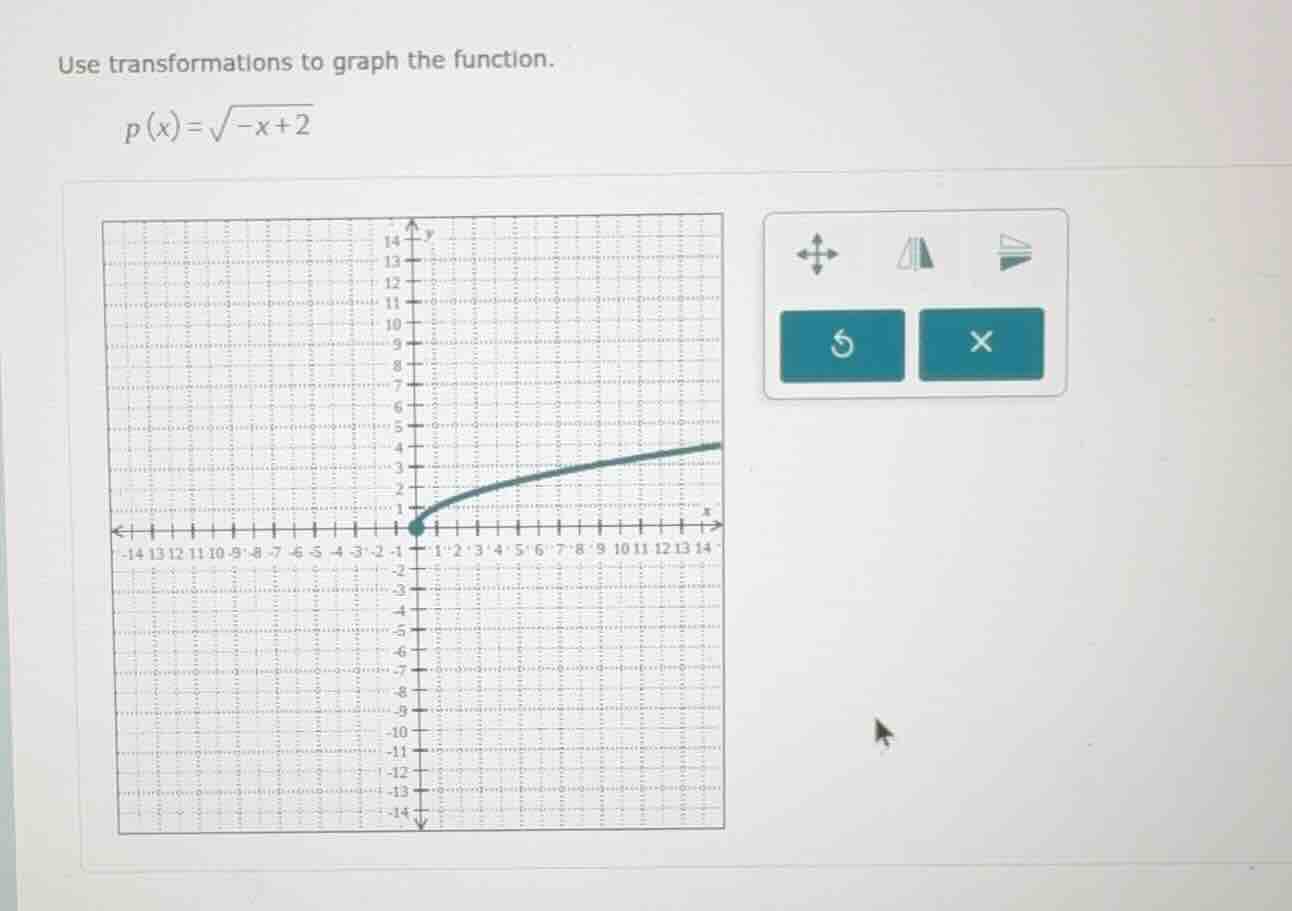
use transformations to graph the function.\\( p(x)=sqrt{-x + 2} \\)
Step1: Identify the parent function
The parent function for square root functions is \( y = \sqrt{x} \), which has a domain \( x \geq 0 \) and starts at the point \( (0, 0) \), increasing slowly.
Step2: Analyze the transformations in \( p(x) = \sqrt{-x + 2} \)
First, rewrite the function inside the square root to identify horizontal transformations. Let's rewrite \( -x + 2 \) as \( -(x - 2) \). So, \( p(x)=\sqrt{-(x - 2)} \).
Transformation 1: Horizontal reflection
The negative sign inside the square root (affecting the \( x \)-term) indicates a reflection over the \( y \)-axis. For the parent function \( y = \sqrt{x} \), a reflection over the \( y \)-axis would change it to \( y=\sqrt{-x} \). This reflection will flip the graph across the \( y \)-axis, so the domain of \( y = \sqrt{-x} \) becomes \( -x \geq 0 \) or \( x \leq 0 \), and it starts at \( (0, 0) \) but decreases to the left (or increases to the right? Wait, no: for \( y = \sqrt{-x} \), when \( x = 0 \), \( y = 0 \); when \( x=-1 \), \( y = \sqrt{1}=1 \); when \( x = -4 \), \( y=\sqrt{4}=2 \). So it's a curve starting at \( (0, 0) \) and moving to the left (as \( x \) decreases, \( y \) increases).
Transformation 2: Horizontal shift
The \( (x - 2) \) inside the square root (after factoring out the negative sign) indicates a horizontal shift. The general form for a horizontal shift is \( y = f(x - h) \), which shifts the graph \( h \) units to the right if \( h>0 \), and \( |h| \) units to the left if \( h < 0 \). Here, we have \( y=\sqrt{-(x - 2)} \), so \( h = 2 \). This means we shift the graph of \( y=\sqrt{-x} \) 2 units to the right.
Let's find the new starting point (the vertex) after the shift. The vertex of \( y=\sqrt{-x} \) is at \( (0, 0) \). Shifting 2 units to the right: the \( x \)-coordinate increases by 2, so the new vertex is at \( (2, 0) \)? Wait, no. Wait, let's re - evaluate.
Wait, let's find the domain of \( p(x)=\sqrt{-x + 2} \). We need \( -x+2\geq0 \), so \( -x\geq - 2 \), and multiplying both sides by - 1 (and reversing the inequality sign) gives \( x\leq2 \). So the domain is \( x\leq2 \), and the starting point (where the square root is zero) is when \( -x + 2=0\Rightarrow x = 2 \), and \( p(2)=\sqrt{0}=0 \). So the vertex is at \( (2, 0) \).
Now, let's track the transformations from the parent function:
- Start with \( y=\sqrt{x} \) (domain \( x\geq0 \), vertex \( (0,0) \), increasing to the right).
- Reflect over the \( y \)-axis: \( y = \sqrt{-x} \) (domain \( x\leq0 \), vertex \( (0,0) \), increasing to the left (since as \( x \) becomes more negative, \( -x \) becomes more positive, so \( y \) increases)).
- Shift 2 units to the right: replace \( x \) with \( x - 2 \) in \( y=\sqrt{-x} \), so \( y=\sqrt{-(x - 2)}=\sqrt{-x + 2} \). Shifting the graph of \( y=\sqrt{-x} \) (which has vertex at \( (0,0) \) and domain \( x\leq0 \)) 2 units to the right will move the vertex to \( (2, 0) \), and the domain becomes \( x-2\leq0\Rightarrow x\leq2 \), which matches our earlier calculation.
Step3: Graphing the transformations step - by - step
- Graph the parent function \( y=\sqrt{x} \): Plot the point \( (0, 0) \), and a few other points like \( (1, 1) \), \( (4, 2) \), \( (9, 3) \), and draw the curve starting at \( (0, 0) \) and increasing to the right.
- Reflect over the \( y \)-axis: Take the graph of \( y=\sqrt{x} \) and flip it across the \( y \)-axis. So the point \( (1, 1) \) on \( y=\sqrt{x} \) becomes \( (-1, 1) \) on \( y=\sqrt{-x} \); the point \( (4, 2) \) becomes \( (-4, 2) \), and the vertex remains…

Snap & solve any problem in the app
Get step-by-step solutions on Sovi AI
Photo-based solutions with guided steps
Explore more problems and detailed explanations
To graph \( p(x)=\sqrt{-x + 2} \) using transformations:
- Start with the parent function \( y = \sqrt{x} \) (domain \( x\geq0 \), vertex \( (0,0) \), increasing to the right).
- Reflect over the \( y \)-axis: Transform \( y = \sqrt{x} \) to \( y=\sqrt{-x} \) (domain \( x\leq0 \), vertex \( (0,0) \), increasing to the left as \( x \) decreases).
- Shift 2 units to the right: Transform \( y=\sqrt{-x} \) to \( y=\sqrt{-(x - 2)}=\sqrt{-x + 2} \). This shifts the vertex from \( (0,0) \) to \( (2,0) \) and the domain to \( x\leq2 \).
Plot key points (e.g., \( (2,0) \), \( (1,1) \), \( (-2,2) \)) and draw the curve starting at \( (2,0) \), curving upward as \( x \) decreases (consistent with the square root shape after reflection and shift).
The final graph of \( p(x)=\sqrt{-x + 2} \) has a vertex at \( (2, 0) \), a domain of \( x\leq2 \), and is a reflection of \( y = \sqrt{x} \) over the \( y \)-axis followed by a 2 - unit right shift.