QUESTION IMAGE
Question
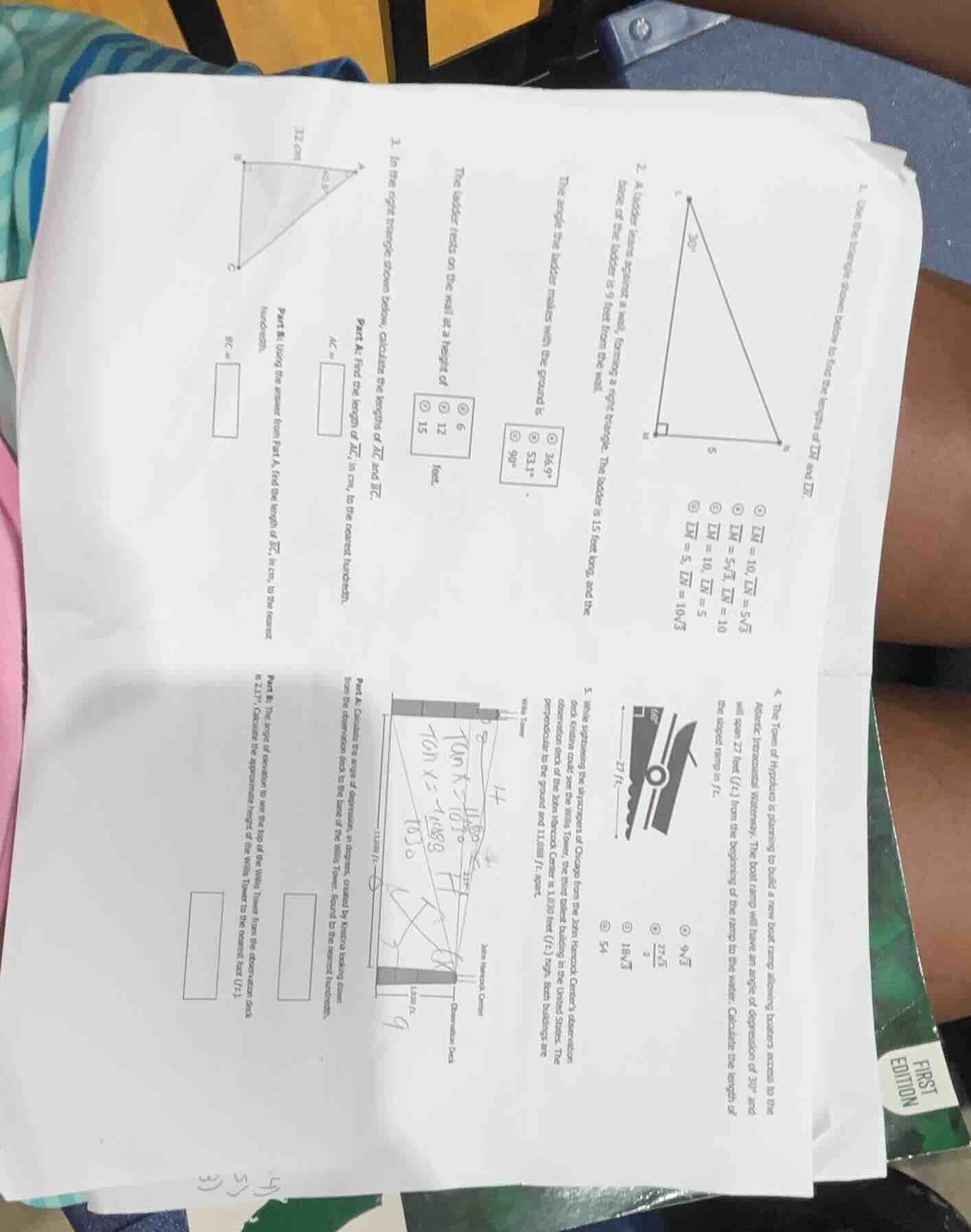
- use the triangle shown below to find the lengths of \\( \overline{lm} \\) and \\( \overline{ln} \\).
- a ladder leans against a wall, forming a right triangle. the base of the ladder is 9 feet from the wall. the ladder is 15 feet long, and the
- the angle the ladder makes with the ground is: \\( \bigcirc 36.9^\circ \bigcirc 53.1^\circ \bigcirc 90^\circ \\)
- the ladder rests on the wall at a height of: \\( \bigcirc 6 \bigcirc 12 \bigcirc 15 \\) feet.
- in the right triangle shown below, calculate the lengths of \\( \overline{ac} \\) and \\( \overline{bc} \\).
- part a: find the length of \\( \overline{ac} \\), in cm, to the nearest hundredth. \\( ac = \square \\)
- part b: using the answer from part a, find the length of \\( \overline{bc} \\), in cm, to the nearest hundredth. \\( bc = \square \\)
- the town of hypoluxo is planning to build a new boat ramp allowing boaters access to the atlantic intracoastal waterway. the boat ramp will have an angle of depression of \\( 30^\circ \\) and will span 27 feet (ft) from the beginning of the ramp to the water. calculate the length of the inclined ramp in ft. \\( \bigcirc 9\sqrt{3} \bigcirc \frac{27\sqrt{3}}{3} \bigcirc 18\sqrt{3} \bigcirc 54 \\)
- while sightseeing the skyscrapers of chicago from the john hancock center’s observation deck, one of the john hancock center’s visitors sees a tall building at the nearby chicago’s tribune tower. the observation deck of the john hancock center is 1108 feet (ft) high. both buildings are perpendicular to the ground and 1108 ft apart. (diagram included with tower heights and distances)
- part a: calculate the angle of depression, in degrees, created by the horizon looking down to the observation deck at the base of the willis tower. round to the nearest hundredth. \\( \square \\)
- part b: the angle of elevation to the top of the willis tower from the observation deck is \\( 8.217^\circ \\). calculate the approximate height of the willis tower to the nearest foot (ft). \\( \square \\)
Let's solve problem 2 first (the ladder problem with a 30° angle, right triangle, base \( s = 5 \) feet? Wait, no, looking at the diagram: right triangle with right angle at \( N \), angle at \( L \) is 30°, base \( MN = 5 \)? Wait, the options are about \( LN \), \( LM \), etc. Wait, maybe it's a 30-60-90 triangle. Let's re-express:
In a 30-60-90 triangle, the sides are in the ratio \( 1 : \sqrt{3} : 2 \), where the side opposite 30° is the shortest (let's say length \( x \)), opposite 60° is \( x\sqrt{3} \), hypotenuse is \( 2x \).
Looking at the diagram: right angle at \( N \), angle at \( L \) is 30°, so angle at \( M \) is 60°. Let's assume \( MN \) is adjacent to 30°, \( LN \) is opposite 30°? Wait, no, let's check the options. The options are:
- \( LN = 10 \), \( LM = 5\sqrt{3} \)
- \( LM = 10 \), \( LN = 5 \)
- \( LM = 10 \), \( LN = 5\sqrt{3} \)
- \( LN = 5 \), \( LM = 10\sqrt{3} \)
Wait, maybe \( MN = 5 \) (the base, adjacent to 30°). Wait, in a 30-60-90 triangle, hypotenuse is twice the shorter leg. If angle at \( L \) is 30°, then the side opposite 30° is \( MN \)? No, wait, angle at \( L \) is 30°, so the side opposite is \( MN \), adjacent is \( LN \), hypotenuse is \( LM \).
Wait, no: in triangle \( LNM \), right-angled at \( N \), angle at \( L \) is 30°, so:
- \( \angle L = 30^\circ \)
- \( \angle N = 90^\circ \)
- \( \angle M = 60^\circ \)
So side opposite \( \angle L \) (30°) is \( MN \), side opposite \( \angle M \) (60°) is \( LN \), hypotenuse is \( LM \).
In a 30-60-90 triangle, hypotenuse \( LM = 2 \times MN \) (since \( MN \) is opposite 30°). If \( MN = 5 \) (from the diagram, the base is 5), then hypotenuse \( LM = 2 \times 5 = 10 \). Then the side \( LN \) (opposite 60°) is \( MN \times \sqrt{3} = 5\sqrt{3} \). So \( LM = 10 \), \( LN = 5\sqrt{3} \), which is one of the options (third option: \( LM = 10 \), \( LN = 5\sqrt{3} \)).
Let's verify:
- Hypotenuse \( LM = 10 \) (twice \( MN = 5 \))
- \( LN = MN \times \sqrt{3} = 5\sqrt{3} \) (opposite 60°)
Yes, that fits the 30-60-90 triangle ratios. So the correct option is \( LM = 10 \), \( LN = 5\sqrt{3} \).
Now, problem 4: The Town of Hypotenuse is planning a boat ramp. The ramp makes a 30° angle with the water, and the vertical rise is 27 feet. Find the length of the ramp (hypotenuse).
In a right triangle, \( \sin(\theta) = \frac{\text{opposite}}{\text{hypotenuse}} \). Here, \( \theta = 30^\circ \), opposite side (rise) = 27 ft, hypotenuse (ramp length) = \( x \).
So \( \sin(30^\circ) = \frac{27}{x} \)
Since \( \sin(30^\circ) = \frac{1}{2} \),
\( \frac{1}{2} = \frac{27}{x} \)
Solving for \( x \): \( x = 27 \times 2 = 54 \) ft? Wait, no, wait the options are \( 9\sqrt{3} \), \( \frac{27\sqrt{3}}{3} \) (which is \( 9\sqrt{3} \)? No, wait the options are:
- \( 9\sqrt{3} \)
- \( \frac{27\sqrt{3}}{3} \) (simplifies to \( 9\sqrt{3} \))
- \( 18\sqrt{3} \)
- \( 54 \)
Wait, maybe it's a 30° angle, so \( \sin(30^\circ) = \frac{\text{opposite}}{\text{hypotenuse}} \), so hypotenuse = \( \frac{\text{opposite}}{\sin(30^\circ)} = \frac{27}{\frac{1}{2}} = 54 \). So the length of the ramp is 54 ft.
Now, problem 3: Right triangle with hypotenuse 32 cm, angle at A is 30°? Wait, the diagram shows a right triangle with hypotenuse 32 cm, angle at A is 30°? Let's check Part A: Find length of \( AC \) and \( BC \).
Assuming right angle at B, so triangle \( ABC \), right-angled at B, hypotenuse \( AC = 32 \) cm? Wait, no, the diagram has \( AB = 32 \) cm? Wait, the user's image: "32 cm" is the length of one side, angle at A is 30°. Let's assume right angle at C.…
Step1: Identify the triangle type
The triangle is a 30-60-90 right triangle (right angle at \( N \), \( \angle L = 30^\circ \)).
Step2: Recall 30-60-90 side ratios
In a 30-60-90 triangle, sides are in the ratio \( 1 : \sqrt{3} : 2 \), where:
- Shorter leg (opposite 30°): \( x \)
- Longer leg (opposite 60°): \( x\sqrt{3} \)
- Hypotenuse: \( 2x \)
Step3: Assign \( x \)
Let \( MN \) (opposite 30°) be \( x = 5 \) (from diagram or problem context).
Step4: Calculate hypotenuse \( LM \)
Hypotenuse \( LM = 2x = 2 \times 5 = 10 \).
Step5: Calculate longer leg \( LN \)
Longer leg \( LN = x\sqrt{3} = 5\sqrt{3} \).

Snap & solve any problem in the app
Get step-by-step solutions on Sovi AI
Photo-based solutions with guided steps
Explore more problems and detailed explanations
The correct option is \( LM = 10 \), \( LN = 5\sqrt{3} \) (assuming the option is phrased as such, e.g., "LM = 10, LN = 5√3").