QUESTION IMAGE
Question
be used.
- buzón
- cheque
- cobra
- correo
- cuadra
- dirección
- echa
- esquina
- estampilla
- firma
- pagar en efectivo
- sobre
martín no puede
; por
eso saca un
. martín
primero llena el cheque con la fecha, los
números y el nombre de la compañía de
luz y luego lo
con su
nombre y apellidos. pone el cheque en el
y lo cierra. luego
escribe la
de la
compañía de luz y pone una
en el sobre. después,
martín sale de su casa, camina una
hasta la
y
el
sobre al
.
To solve this fill - in - the - blank problem, we analyze the context and the meaning of each word:
1. First blank:
The context is about Martin not being able to pay in a certain way. "pagar en efectivo" (pay in cash) makes sense here as the subsequent action is writing a cheque. So the first blank is "pagar en efectivo".
2. Second blank:
Since he can't pay in cash, he takes out a "cheque" (cheque). So the second blank is "cheque".
3. Third blank:
After filling the cheque, he needs to "firma" (sign) it with his name and surname. So the third blank is "firma".
4. Fourth blank:
He puts the cheque in an "sobre" (envelope). So the fourth blank is "sobre".
5. Fifth blank:
He writes the "dirección" (address) of the electricity company on the envelope. So the fifth blank is "dirección".
6. Sixth blank:
He puts an "estampilla" (stamp) on the envelope. So the sixth blank is "estampilla".
7. Seventh blank:
He walks a "cuadra" (block) from his house. So the seventh blank is "cuadra".
8. Eighth blank:
He walks to the "esquina" (corner). So the eighth blank is "esquina".
9. Ninth blank:
He "echa" (puts) the envelope. So the ninth blank is "echa".
10. Tenth blank:
He puts the envelope in the "buzón" (mailbox). So the tenth blank is "buzón".
The filled - in text is:
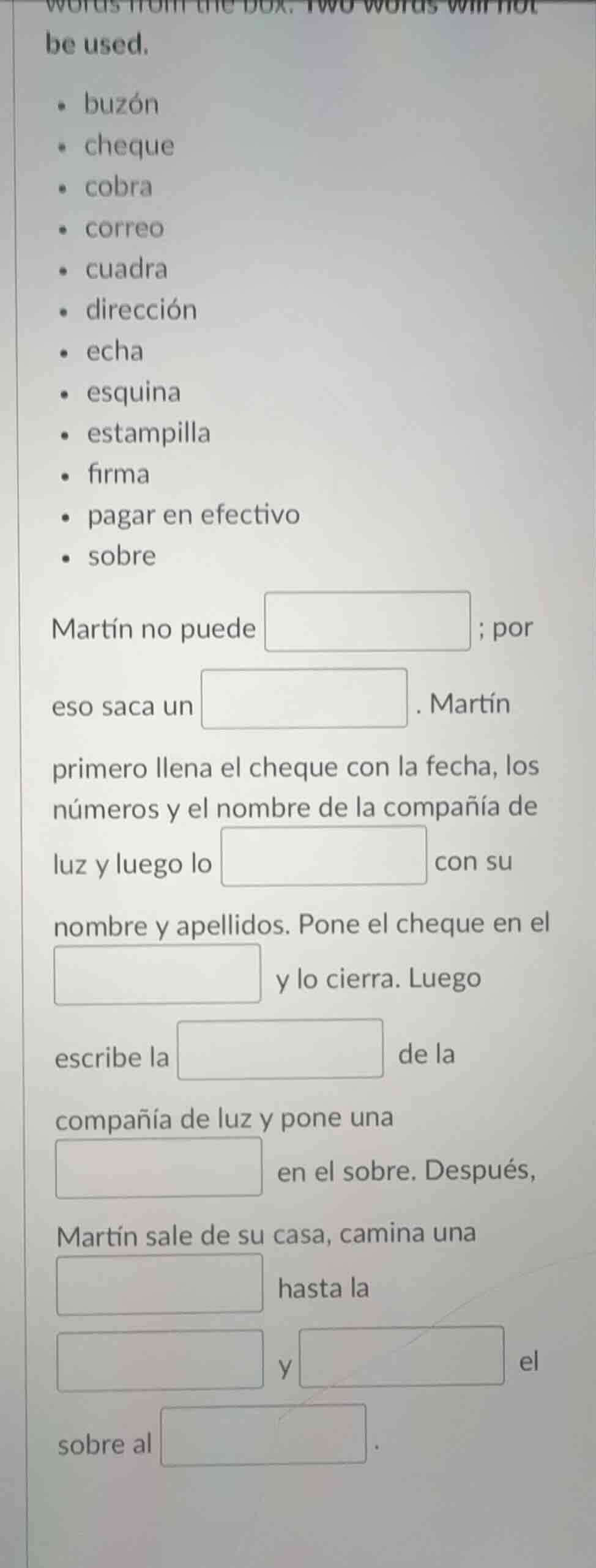
Martín no puede $\boldsymbol{\text{pagar en efectivo}}$; por eso saca un $\boldsymbol{\text{cheque}}$. Martín primero llena el cheque con la fecha, los números y el nombre de la compañía de luz y luego lo $\boldsymbol{\text{firma}}$ con su nombre y apellidos. Pone el cheque en el $\boldsymbol{\text{sobre}}$ y lo cierra. Luego escribe la $\boldsymbol{\text{dirección}}$ de la compañía de luz y pone una $\boldsymbol{\text{estampilla}}$ en el sobre. Después, Martín sale de su casa, camina una $\boldsymbol{\text{cuadra}}$ hasta la $\boldsymbol{\text{esquina}}$ y $\boldsymbol{\text{echa}}$ el sobre al $\boldsymbol{\text{buzón}}$.

Snap & solve any problem in the app
Get step-by-step solutions on Sovi AI
Photo-based solutions with guided steps
Explore more problems and detailed explanations
To solve this fill - in - the - blank problem, we analyze the context and the meaning of each word:
1. First blank:
The context is about Martin not being able to pay in a certain way. "pagar en efectivo" (pay in cash) makes sense here as the subsequent action is writing a cheque. So the first blank is "pagar en efectivo".
2. Second blank:
Since he can't pay in cash, he takes out a "cheque" (cheque). So the second blank is "cheque".
3. Third blank:
After filling the cheque, he needs to "firma" (sign) it with his name and surname. So the third blank is "firma".
4. Fourth blank:
He puts the cheque in an "sobre" (envelope). So the fourth blank is "sobre".
5. Fifth blank:
He writes the "dirección" (address) of the electricity company on the envelope. So the fifth blank is "dirección".
6. Sixth blank:
He puts an "estampilla" (stamp) on the envelope. So the sixth blank is "estampilla".
7. Seventh blank:
He walks a "cuadra" (block) from his house. So the seventh blank is "cuadra".
8. Eighth blank:
He walks to the "esquina" (corner). So the eighth blank is "esquina".
9. Ninth blank:
He "echa" (puts) the envelope. So the ninth blank is "echa".
10. Tenth blank:
He puts the envelope in the "buzón" (mailbox). So the tenth blank is "buzón".
The filled - in text is:
Martín no puede $\boldsymbol{\text{pagar en efectivo}}$; por eso saca un $\boldsymbol{\text{cheque}}$. Martín primero llena el cheque con la fecha, los números y el nombre de la compañía de luz y luego lo $\boldsymbol{\text{firma}}$ con su nombre y apellidos. Pone el cheque en el $\boldsymbol{\text{sobre}}$ y lo cierra. Luego escribe la $\boldsymbol{\text{dirección}}$ de la compañía de luz y pone una $\boldsymbol{\text{estampilla}}$ en el sobre. Después, Martín sale de su casa, camina una $\boldsymbol{\text{cuadra}}$ hasta la $\boldsymbol{\text{esquina}}$ y $\boldsymbol{\text{echa}}$ el sobre al $\boldsymbol{\text{buzón}}$.