QUESTION IMAGE
Question
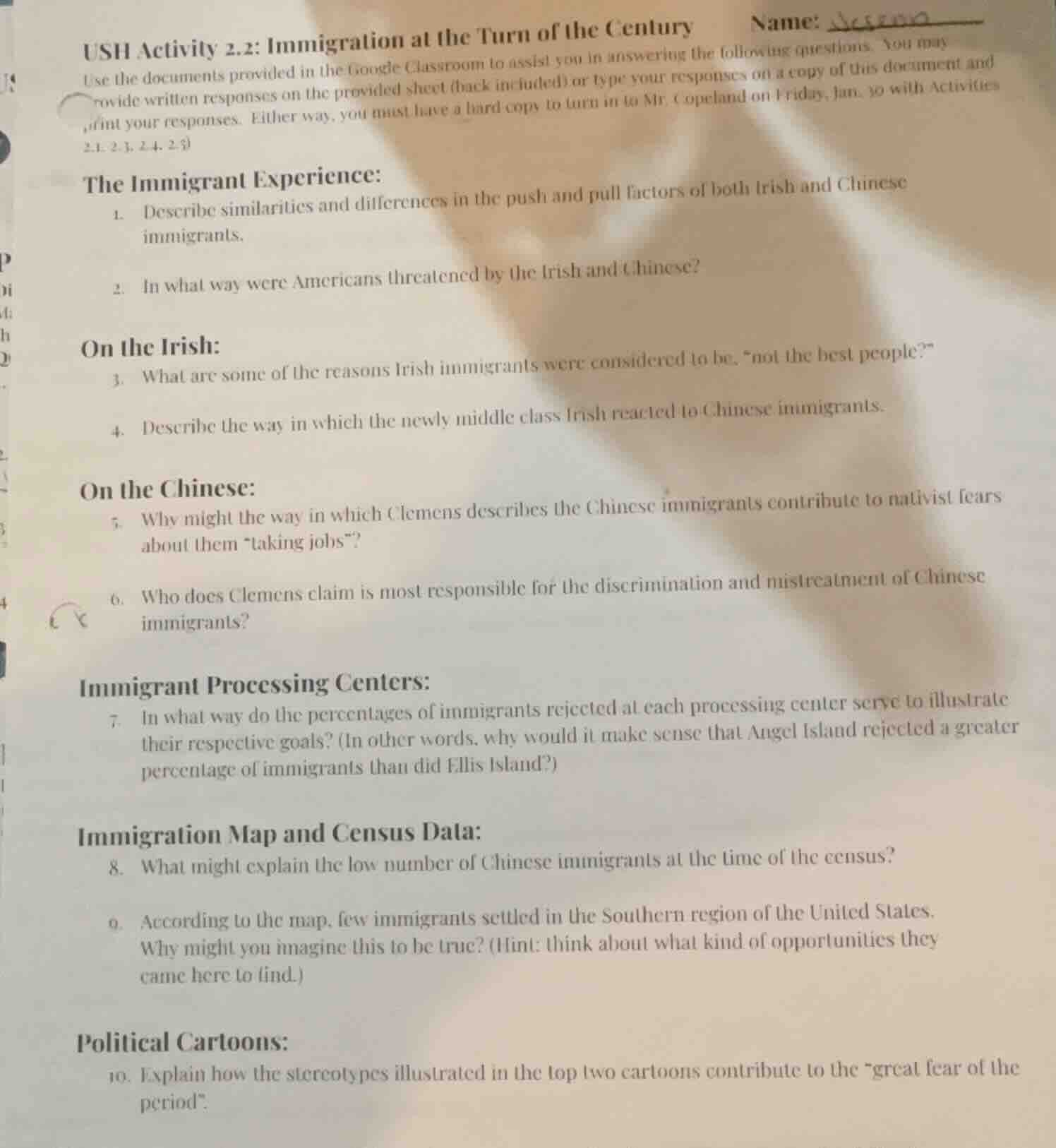
ush activity 2.2: immigration at the turn of the century
name:
use the documents provided in the google classroom to assist you in answering the following questions. you may provide written responses on the provided sheet (back included) or type your responses on a copy of this document and print your responses. either way, you must have a hard copy to turn in to mr. copeland on friday, jan. 30 with activities 2.1, 2.3, 2.4, 2.5!
the immigrant experience:
- describe similarities and differences in the push and pull factors of both irish and chinese immigrants.
- in what way were americans threatened by the irish and chinese?
on the irish:
- what are some of the reasons irish immigrants were considered to be,
ot the best people?\
- describe the way in which the newly middle class irish reacted to chinese immigrants.
on the chinese:
- why might the way in which clemens describes the chinese immigrants contribute to nativist fears about them “taking jobs”?
- who does clemens claim is most responsible for the discrimination and mistreatment of chinese immigrants?
immigrant processing centers:
- in what way do the percentages of immigrants rejected at each processing center serve to illustrate their respective goals? (in other words, why would it make sense that angel island rejected a greater percentage of immigrants than did ellis island?)
immigration map and census data:
- what might explain the low number of chinese immigrants at the time of the census?
- according to the map, few immigrants settled in the southern region of the united states. why might you imagine this to be true? (hint: think about what kind of opportunities they came here to find.)
political cartoons:
- explain how the stereotypes illustrated in the top two cartoons contribute to the “great fear of the period”.
- Similarities/Differences in Push/Pull Factors:
Push factors: Irish faced famine (Potato Famine) and poverty; Chinese faced poverty, political unrest, and famine in southern China. Pull factors: Both sought economic opportunity (jobs in railroads, factories, mining) and escape from hardship. A key difference: Irish also sought escape from British political oppression, while many Chinese initially intended to earn money and return to China.
- American Threat Perception:
Many native-born Americans saw both groups as economic competitors, willing to work for lower wages and undercutting native workers. They also viewed the Irish as culturally incompatible (Catholic, different customs) and the Chinese as racially "foreign" and unwilling to assimilate, fearing they would take over jobs and alter American culture.
- Irish as "Not the Best People":
They were poor, unskilled, Catholic (a religious minority facing prejudice), and often arrived in overcrowded, unhealthy conditions. Nativists saw them as dependent, prone to crime, and a burden on public services.
- Middle-Class Irish Reaction to Chinese:
To distance themselves from anti-immigrant prejudice, middle-class Irish often adopted nativist views and discriminated against Chinese immigrants. They competed for jobs and social status, and some joined anti-Chinese movements to prove their "Americanism."
- Clemens' Description and Nativist Fears:
If Clemens described Chinese immigrants as hardworking, willing to accept extremely low wages, and taking on jobs that native workers rejected, this reinforced nativist fears that Chinese immigrants would take jobs by undercutting wages, making it impossible for native workers to compete.
- Clemens' Blame for Chinese Mistreatment:
Mark Twain (Clemens) blamed political leaders, business owners who exploited Chinese labor, and nativist politicians who stoked anti-Chinese sentiment for discrimination against Chinese immigrants.
- Rejection Rates at Processing Centers:
Ellis Island (for European immigrants) had lower rejection rates because it focused on basic health checks and entry for workers needed for industrialization. Angel Island (for Asian immigrants) had higher rejection rates due to restrictive laws like the Chinese Exclusion Act, which targeted Asian immigrants with stricter screening, longer detentions, and more barriers to entry, reflecting nativist policies to limit Asian immigration.
- Low Chinese Census Numbers:
The Chinese Exclusion Act of 1882 banned most Chinese immigration, and many Chinese immigrants were temporary laborers who returned to China. Additionally, some Chinese immigrants avoided census counts due to fear of discrimination or deportation.
- Few Immigrants in the South:
The South's economy was based on sharecropping and agriculture, which offered little opportunity for unskilled immigrant workers. The region also had a rigid racial hierarchy, and nativist sentiment, along with limited industrial jobs, discouraged immigrants from settling there.
- Stereotypes in Cartoons and "Great Fear":
Cartoons often depicted Irish as drunk, violent, and subversive, and Chinese as exotic, unassimilable, and job-stealing. These stereotypes reinforced nativist fears that immigrants would undermine American values, take jobs, and disrupt social order, fueling the "great fear" of immigrant influence on American society.

Snap & solve any problem in the app
Get step-by-step solutions on Sovi AI
Photo-based solutions with guided steps
Explore more problems and detailed explanations
- Push factors: Irish (famine, British oppression, poverty); Chinese (poverty, political unrest, famine). Pull factors: Both sought economic opportunity; Irish also sought political freedom.
- Americans saw them as economic competitors (willing to work for low wages) and feared cultural/racial assimilation threats.
- They were poor, unskilled, Catholic, and seen as a public burden.
- Middle-class Irish adopted nativist views and discriminated against Chinese to prove their "Americanism."
- If Clemens emphasized their willingness to work for low wages, it reinforced fears they would take jobs from native workers.
- Clemens blamed political leaders, exploitative business owners, and nativist politicians.
- Ellis Island had looser screening to welcome European industrial workers; Angel Island enforced restrictive laws (like the Chinese Exclusion Act) with stricter screening to limit Asian immigration.
- The Chinese Exclusion Act, temporary labor migration, and fear of discrimination led to low census counts.
- The South's agricultural economy offered few industrial jobs, and rigid racial hierarchies discouraged immigrant settlement.
- Cartoons portrayed Irish as violent/drunk and Chinese as job-stealing/unassimilable, reinforcing fears of immigrant disruption to American society and jobs.