QUESTION IMAGE
Question
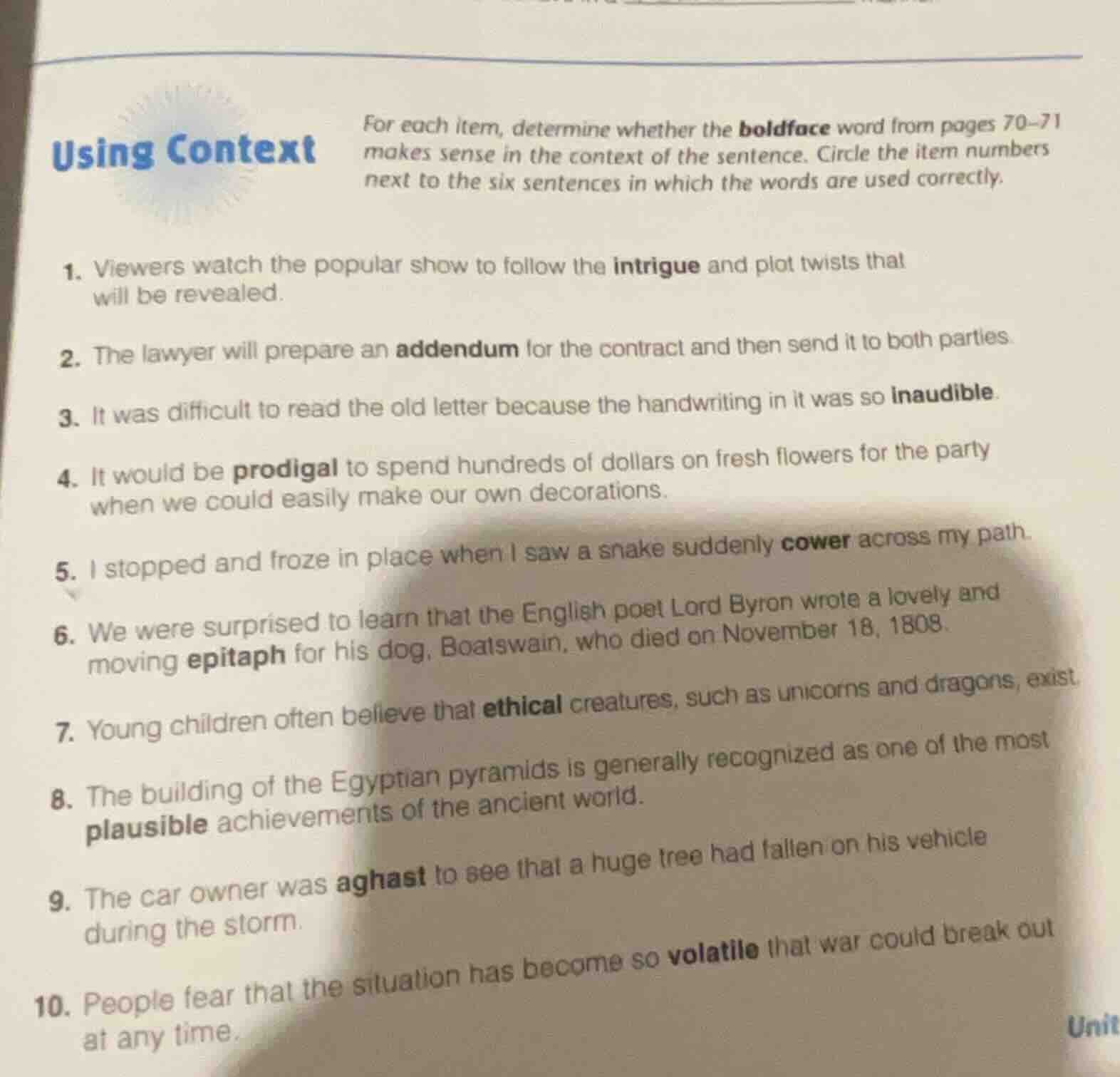
using context
for each item, determine whether the boldface word from pages 70–71 makes sense in the context of the sentence. circle the item numbers next to the six sentences in which the words are used correctly.
- viewers watch the popular show to follow the intrigue and plot twists that will be revealed.
- the lawyer will prepare an addendum for the contract and then send it to both parties.
- it was difficult to read the old letter because the handwriting in it was so inaudible.
- it would be prodigal to spend hundreds of dollars on fresh flowers for the party when we could easily make our own decorations.
- i stopped and froze in place when i saw a snake suddenly cower across my path.
- we were surprised to learn that the english poet lord byron wrote a lovely and moving epitaph for his dog, boatswain, who died on november 18, 1808.
- young children often believe that ethical creatures, such as unicorns and dragons, exist.
- the building of the egyptian pyramids is generally recognized as one of the most plausible achievements of the ancient world.
- the car owner was aghast to see that a huge tree had fallen on his vehicle during the storm.
- people fear that the situation has become so volatile that war could break out at any time.
Response
To solve this, we analyze each sentence for the correct use of the boldface word:
1. "intrigue"
- Meaning: Fascinating or mysterious quality.
- Context: Viewers follow the intrigue (mystery) and plot twists of a show. Correct.
2. "addendum"
- Meaning: An addition to a document (like a contract).
- Context: A lawyer prepares an addendum for a contract. Correct.
3. "inaudible"
- Meaning: Not able to be heard.
- Context: Handwriting is “inaudible”—but “inaudible” refers to sound, not writing. Incorrect (should be “illegible” for writing).
4. "prodigal"
- Meaning: Wasteful or extravagant.
- Context: Spending hundreds on flowers (wasteful, since decorations can be homemade). Correct.
5. "cower"
- Meaning: To shrink or hide in fear.
- Context: A snake “cower across my path”—“cower” is a human/animal fear response, not a movement like “cross.” Incorrect (should be “slither” or similar).
6. "epitaph"
- Meaning: A commemorative inscription (often for the dead).
- Context: Lord Byron wrote an epitaph for his dog (who died). Correct (epitaphs can be for pets).
7. "ethical"
- Meaning: Related to morality/ethics.
- Context: “Ethical creatures” (unicorns/dragons)—“ethical” does not describe imaginary beings. Incorrect (should be “mythical”).
8. "plausible"
- Meaning: Reasonable or believable.
- Context: The pyramids as a “plausible achievement”—“plausible” implies doubt, but the pyramids’ existence is proven. Incorrect (should be “impressive” or “remarkable”).
9. "aghast"
- Meaning: Shocked or horrified.
- Context: A car owner is aghast at a tree falling on their vehicle. Correct (shock at damage makes sense).
10. "volatile"
- Meaning: Unstable or likely to change suddenly (often negatively).
- Context: A situation so volatile war could break out. Correct (unstable situations risk conflict).
The six sentences with correct word usage are: 1, 2, 4, 6, 9, 10.

Snap & solve any problem in the app
Get step-by-step solutions on Sovi AI
Photo-based solutions with guided steps
Explore more problems and detailed explanations
1, 2, 4, 6, 9, 10 (circle these item numbers)