QUESTION IMAGE
Question
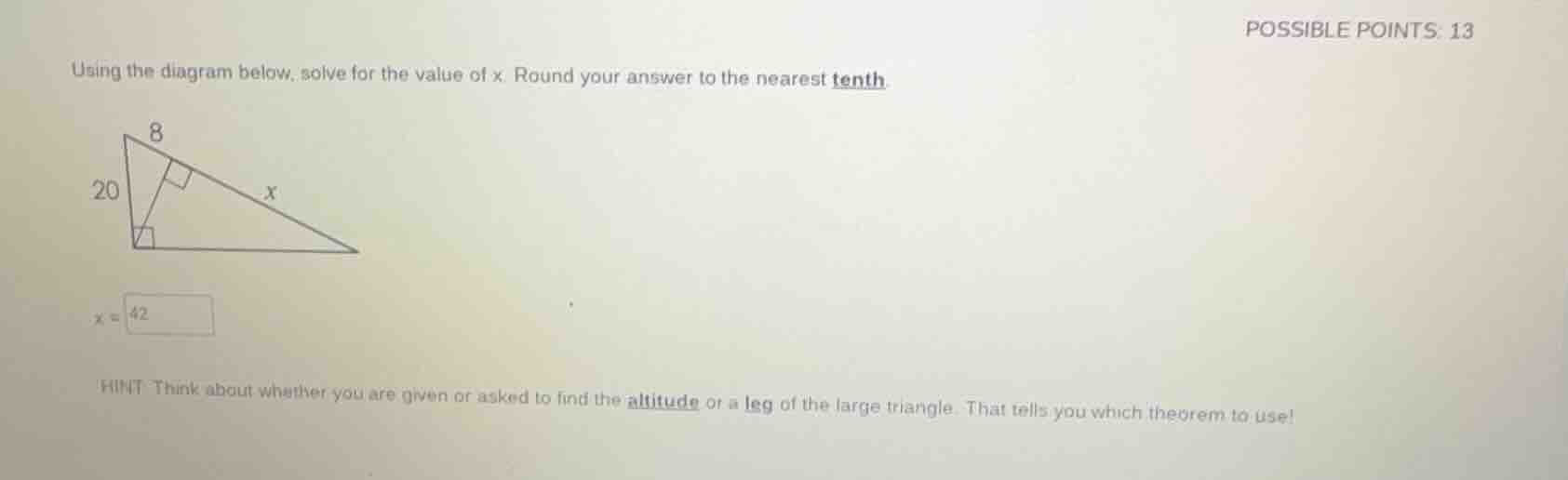
using the diagram below, solve for the value of x. round your answer to the nearest tenth.
hint: think about whether you are given or asked to find the altitude or a leg of the large triangle. that tells you which theorem to use!
possible points: 13
Step1: Identify the geometric theorem
This is a right triangle with an altitude to the hypotenuse, so we use the geometric mean (leg) theorem, which states that in a right triangle, the length of a leg is the geometric mean of the length of the hypotenuse and the length of the adjacent segment of the hypotenuse. Let the hypotenuse of the large triangle be \( c = 8 + x \), one leg is \( 20 \), and the adjacent segment to this leg on the hypotenuse is \( x \)? Wait, no, actually, looking at the diagram, the two segments of the hypotenuse are \( 8 \) and \( x \), and the leg adjacent to the segment \( x \) is \( 20 \). Wait, correct theorem: In a right triangle, if an altitude is drawn to the hypotenuse, then each leg is the geometric mean of the hypotenuse and the segment of the hypotenuse adjacent to that leg. So the leg (length 20) is the geometric mean of the hypotenuse (length \( 8 + x \)) and the segment adjacent to it (length \( x \))? Wait, no, maybe I mixed up. Wait, the two smaller triangles are similar to the large triangle and to each other. So the triangle with leg 20 and hypotenuse (the segment \( x \) plus 8? No, wait the hypotenuse of the large triangle is \( 8 + x \)? Wait no, looking at the diagram: the large triangle is a right triangle, with one leg 20, and the hypotenuse is split into two segments: 8 and \( x \), and there's an altitude to the hypotenuse, forming two smaller right triangles. So by the geometric mean theorem (leg), the length of a leg (20) is the geometric mean of the hypotenuse (let's call the hypotenuse \( H = 8 + x \)) and the segment of the hypotenuse adjacent to that leg (which is \( x \))? Wait, no, actually, the leg (20) is adjacent to the segment \( x \), and the other segment is 8. So the formula is: \( \text{leg}^2 = \text{hypotenuse segment} \times \text{hypotenuse} \). Wait, no, the correct formula is: if the hypotenuse is \( H = a + b \), where \( a = 8 \) and \( b = x \), and the leg is \( l = 20 \), then \( l^2 = b \times H \), so \( 20^2 = x \times (8 + x) \)? Wait, that can't be, because then it's a quadratic. Wait, maybe I got the segments wrong. Wait, maybe the altitude is drawn to the hypotenuse, so the two segments of the hypotenuse are 8 and \( x \), and the leg is 20, which is adjacent to the segment \( x \). Wait, no, let's re-express. Let’s denote:
- Let the large right triangle have legs: one leg is 20, the other leg is the altitude? No, the altitude is inside the triangle. Wait, the diagram: right triangle, right angle at the bottom left, then an altitude from the right angle to the hypotenuse, creating two smaller right triangles. So the hypotenuse of the large triangle is split into two parts: one part is 8 (adjacent to the top leg of length 8), and the other part is \( x \) (adjacent to the bottom leg of length 20). Wait, no, the top leg of the large triangle is 8? No, the left leg is 20, the top segment is 8, and the hypotenuse is split into 8 and \( x \), with the altitude in between. So by the geometric mean theorem (leg), the length of the leg (20) is the geometric mean of the hypotenuse (8 + x) and the segment adjacent to it (x). Wait, no, the leg (20) is opposite to the segment 8? No, maybe the leg (20) is adjacent to the segment \( x \), and the other leg (let's say \( y \)) is adjacent to the segment 8. Then by the geometric mean theorem, \( 20^2 = x \times (8 + x) \) and \( y^2 = 8 \times (8 + x) \), and also \( y \times 20 = 8 \times x \) (area). Wait, but the problem is to find \( x \). Wait, maybe I made a mistake. Wait, the correct formula for the leg: i…

Snap & solve any problem in the app
Get step-by-step solutions on Sovi AI
Photo-based solutions with guided steps
Explore more problems and detailed explanations
\( \boxed{50} \)