QUESTION IMAGE
Question
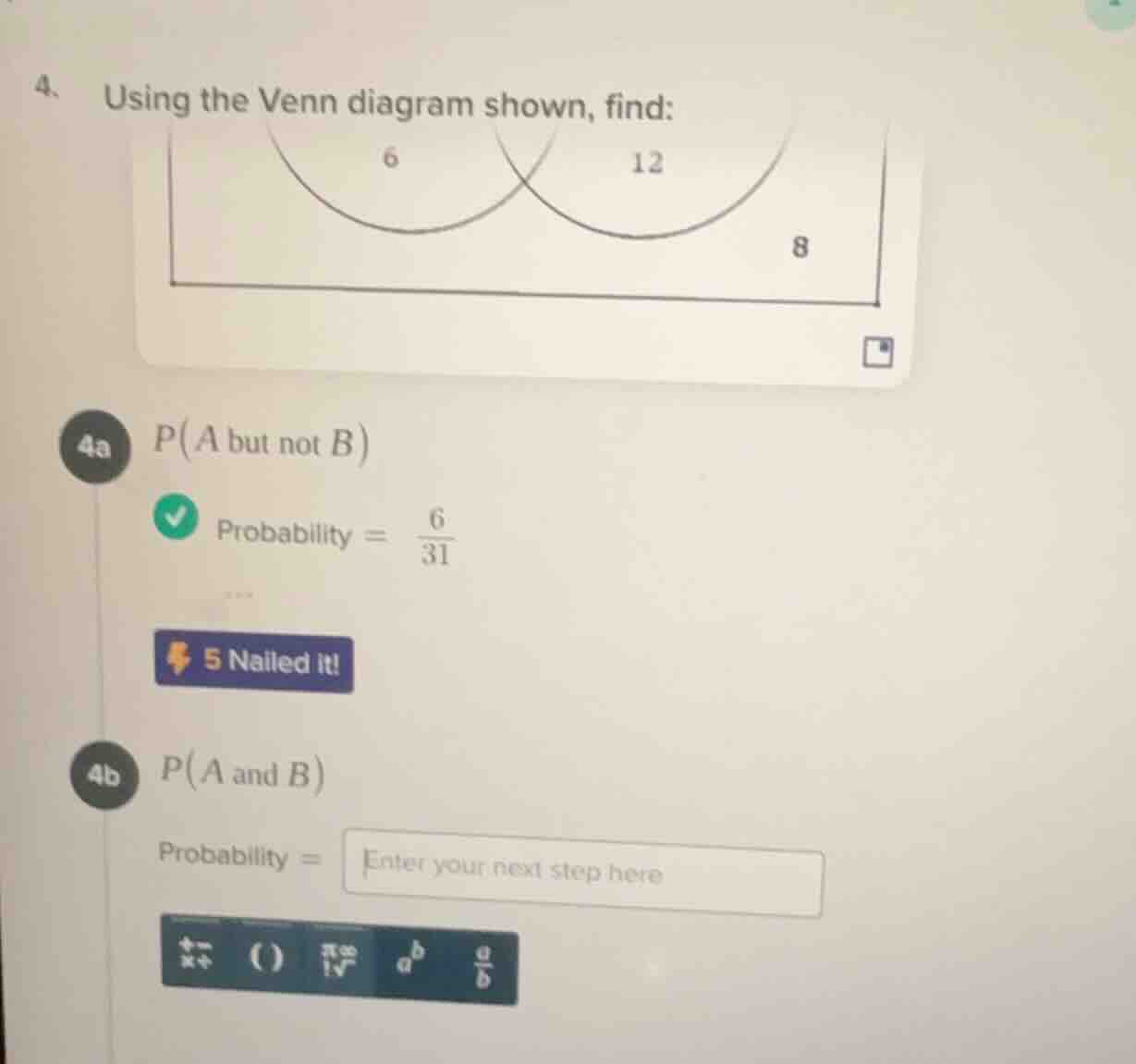
- using the venn diagram shown, find:
4a ( p(a \text{ but not } b) )
probability ( = \frac{6}{31} )
4b ( p(a \text{ and } b) )
probability = enter your next step here
Step1: Find total number of elements
First, we need to find the total number of elements in the universal set. From the Venn diagram, the regions are 6 (only A), 12 (only B), and 8 (neither A nor B), but wait, actually, we missed the intersection? Wait, no, maybe the Venn diagram has two circles: let's re-examine. Wait, the first circle (A) has 6 (only A) and the intersection? Wait, no, maybe the given numbers: 6 (only A), 12 (only B), and 8 (outside both), but we need to find the intersection? Wait, no, for part 4a, we had \( P(A \text{ but not } B) = \frac{6}{31} \), so total elements \( N = 6 + 12 + 8 + x \)? Wait, no, wait 4a's answer is \( \frac{6}{31} \), so total is 31. So total elements \( N = 6 + 12 + 8 + x \)? Wait, no, 6 (only A), let's say the intersection is \( x \), 12 (only B), 8 (outside). Then total is \( 6 + x + 12 + 8 = 26 + x \). But 4a is \( P(A \text{ but not } B) = \frac{6}{31} \), so total is 31. Therefore, \( 6 + x + 12 + 8 = 31 \), so \( x = 31 - 6 - 12 - 8 = 5 \). Wait, but maybe the Venn diagram's circles: the first circle (A) has 6 (only A) and the intersection, the second circle (B) has 12 (only B) and the intersection, and outside is 8. Wait, maybe I misread. Wait, 4a: \( P(A \text{ but not } B) \) is the probability of only A, so number of only A is 6, total is 6 + (intersection) + 12 + 8 = 31 (from 4a's denominator). So total is 31. Therefore, intersection (A and B) is \( 31 - 6 - 12 - 8 = 5 \). Wait, but let's check: 6 (only A) + 5 (A and B) + 12 (only B) + 8 (neither) = 6+5+12+8=31. Yes, that works. So the intersection (A and B) is 5? Wait, no, wait 4b is \( P(A \text{ and } B) \), which is the intersection. Wait, but let's think again. Wait, in 4a, \( P(A \text{ but not } B) = \frac{\text{only } A}{\text{total}} = \frac{6}{31} \), so total is 31. Therefore, the number of elements in \( A \cap B \) is \( 31 - 6 - 12 - 8 = 5 \)? Wait, no, 6 (only A) + (A and B) + 12 (only B) + 8 (neither) = 31. So (A and B) = 31 - 6 - 12 - 8 = 5. Wait, but maybe the Venn diagram's labels: maybe the first circle (A) has 6 (only A) and the intersection, the second circle (B) has 12 (only B) and the intersection, and outside is 8. But 4a's only A is 6, so \( P(A \text{ but not } B) = \frac{6}{31} \), so total is 31. Therefore, the number of elements in \( A \cap B \) is \( 31 - 6 - 12 - 8 = 5 \). Wait, but let's confirm.
Step2: Calculate \( P(A \text{ and } B) \)
The number of elements in \( A \cap B \) is 5 (from total 31 - 6 - 12 - 8 = 5). Therefore, \( P(A \text{ and } B) = \frac{\text{number of elements in } A \cap B}{\text{total number of elements}} = \frac{5}{31} \)? Wait, no, wait maybe I made a mistake. Wait, maybe the Venn diagram is: circle A has 6 (only A) and the intersection, circle B has 12 (only B) and the intersection, and outside is 8. But 4a's \( P(A \text{ but not } B) = \frac{6}{31} \), so total is 31. So 6 (only A) + (intersection) + 12 (only B) + 8 (outside) = 31. So intersection = 31 - 6 - 12 - 8 = 5. Therefore, \( P(A \text{ and } B) = \frac{5}{31} \)? Wait, but maybe the labels are different. Wait, maybe the first circle (A) has 6 (only A) and the intersection is, say, let's see, maybe the Venn diagram is drawn with two circles: one with 6 (only A) and the other with 12 (only B), and outside 8, but the intersection is missing? No, that can't be. Wait, no, in a Venn diagram with two sets, the regions are: only A, only B, both A and B, and neither. So let's denote:
- Only A: \( n(A \setminus B) = 6 \)
- Only B: \( n(B \setminus A) = 12 \)
- Neither: \( n(\overline{A \cup B}) = 8 \)
- Both…

Snap & solve any problem in the app
Get step-by-step solutions on Sovi AI
Photo-based solutions with guided steps
Explore more problems and detailed explanations
\(\boxed{\dfrac{5}{31}}\)