QUESTION IMAGE
Question
va 25 - 26: algebra ii q3
graphing radical functions
describe how the graph of the parent function $y = \sqrt{x}$ is transformed when graphing $y = -3\sqrt{x - 6}$.
the graph is translated 6 units right
the graph is reflected over the x - axis.
the graph has a vertical stretch by a factor of 3.
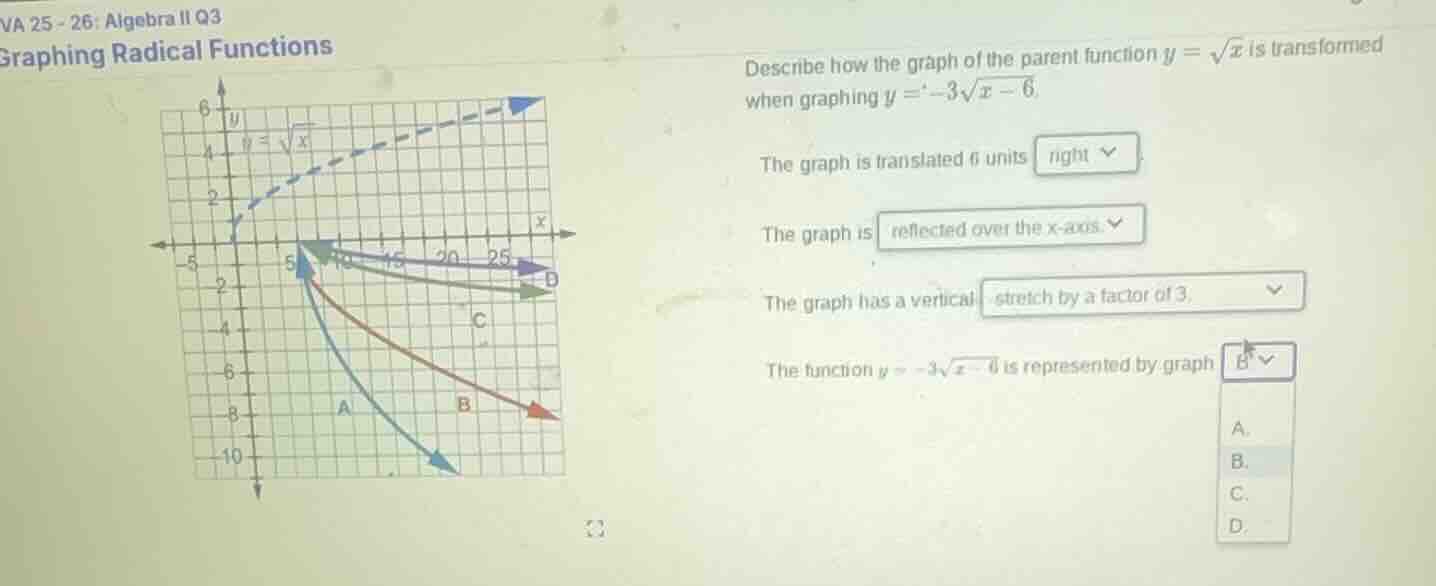
the function $y = -3\sqrt{x - 6}$ is represented by graph b
a.
b.
c.
d.
To analyze the transformation of the parent function \( y = \sqrt{x} \) to \( y = -3\sqrt{x - 6} \), we follow these steps:
Step 1: Horizontal Translation
The general form for horizontal translation is \( y = \sqrt{x - h} \), where \( h \) is the number of units shifted horizontally. For \( y = \sqrt{x - 6} \), \( h = 6 \). Since \( h > 0 \), the graph is translated 6 units to the right.
Step 2: Reflection
The negative sign in front of the radical (\( -3\sqrt{x - 6} \)) indicates a reflection. In the form \( y = a\sqrt{x - h} \), a negative \( a \) reflects the graph over the \( x \)-axis. Here, \( a = -3 \), so the graph is reflected over the \( x \)-axis.
Step 3: Vertical Stretch
The coefficient \( |a| \) determines the vertical stretch or compression. For \( y = -3\sqrt{x - 6} \), \( |a| = 3 \). Since \( |a| > 1 \), the graph is vertically stretched by a factor of 3.
Step 4: Identifying the Graph
- The parent function \( y = \sqrt{x} \) has a domain \( x \geq 0 \) and starts at \( (0, 0) \).
- After translation, the vertex moves to \( (6, 0) \).
- Reflection over the \( x \)-axis flips the graph upside - down.
- Vertical stretch by a factor of 3 makes the graph steeper.
- Among the given graphs (A, B, C, D), graph B matches these transformations: it is shifted right, reflected over the \( x \)-axis, stretched vertically, and has its vertex at \( (6, 0) \) with the correct shape.
Final Answer
- The graph is translated 6 units \(\boldsymbol{\text{right}}\).
- The graph is \(\boldsymbol{\text{reflected over the } x\text{-axis}}\).
- The graph has a vertical \(\boldsymbol{\text{stretch by a factor of 3}}\).
- The function \( y=-3\sqrt{x - 6} \) is represented by graph \(\boldsymbol{B}\).

Snap & solve any problem in the app
Get step-by-step solutions on Sovi AI
Photo-based solutions with guided steps
Explore more problems and detailed explanations
To analyze the transformation of the parent function \( y = \sqrt{x} \) to \( y = -3\sqrt{x - 6} \), we follow these steps:
Step 1: Horizontal Translation
The general form for horizontal translation is \( y = \sqrt{x - h} \), where \( h \) is the number of units shifted horizontally. For \( y = \sqrt{x - 6} \), \( h = 6 \). Since \( h > 0 \), the graph is translated 6 units to the right.
Step 2: Reflection
The negative sign in front of the radical (\( -3\sqrt{x - 6} \)) indicates a reflection. In the form \( y = a\sqrt{x - h} \), a negative \( a \) reflects the graph over the \( x \)-axis. Here, \( a = -3 \), so the graph is reflected over the \( x \)-axis.
Step 3: Vertical Stretch
The coefficient \( |a| \) determines the vertical stretch or compression. For \( y = -3\sqrt{x - 6} \), \( |a| = 3 \). Since \( |a| > 1 \), the graph is vertically stretched by a factor of 3.
Step 4: Identifying the Graph
- The parent function \( y = \sqrt{x} \) has a domain \( x \geq 0 \) and starts at \( (0, 0) \).
- After translation, the vertex moves to \( (6, 0) \).
- Reflection over the \( x \)-axis flips the graph upside - down.
- Vertical stretch by a factor of 3 makes the graph steeper.
- Among the given graphs (A, B, C, D), graph B matches these transformations: it is shifted right, reflected over the \( x \)-axis, stretched vertically, and has its vertex at \( (6, 0) \) with the correct shape.
Final Answer
- The graph is translated 6 units \(\boldsymbol{\text{right}}\).
- The graph is \(\boldsymbol{\text{reflected over the } x\text{-axis}}\).
- The graph has a vertical \(\boldsymbol{\text{stretch by a factor of 3}}\).
- The function \( y=-3\sqrt{x - 6} \) is represented by graph \(\boldsymbol{B}\).