QUESTION IMAGE
Question
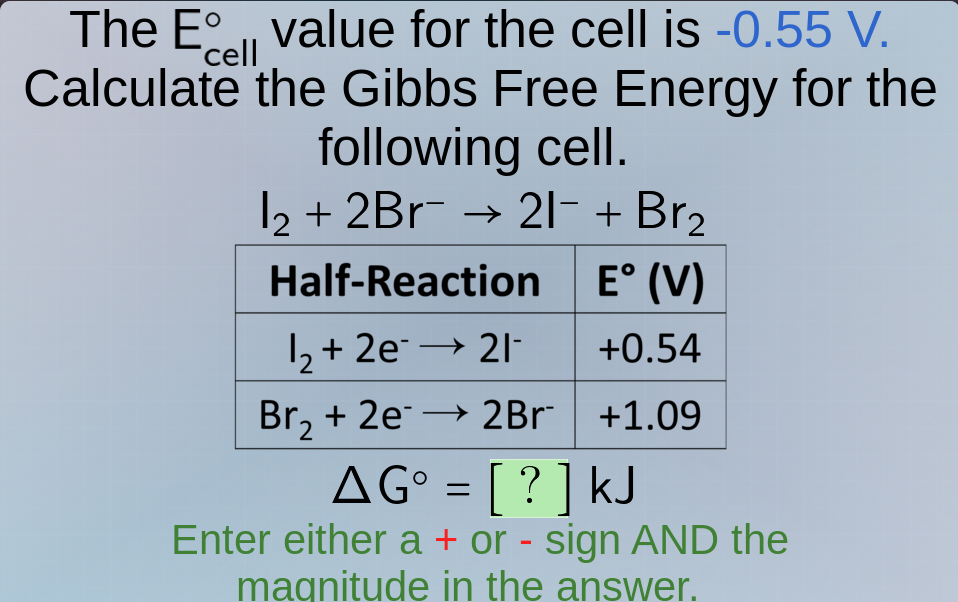
the $e_{\text{cell}}^{\circ}$ value for the cell is -0.55 v. calculate the gibbs free energy for the following cell. $\ce{i_{2} + 2br^{-} -> 2i^{-} + br_{2}}$ \
$\delta g^{\circ} = ?$ kj enter either a + or - sign and the magnitude in the answer.
Step1: Recall the formula for Gibbs free energy
The formula relating standard cell potential ($E^\circ_{cell}$) and standard Gibbs free energy change ($\Delta G^\circ$) is $\Delta G^\circ = -nFE^\circ_{cell}$, where $n$ is the number of moles of electrons transferred, $F$ is Faraday's constant ($F = 96485\ \text{C/mol}$, or $96485\ \text{J/(V·mol)}$), and $E^\circ_{cell}$ is the standard cell potential.
Step2: Determine the number of moles of electrons transferred ($n$)
Looking at the half - reactions:
- Oxidation half - reaction: $2Br^-\to Br_2 + 2e^-$ (reverse of $Br_2+2e^-\to 2Br^-$)
- Reduction half - reaction: $I_2 + 2e^-\to 2I^-$
In both half - reactions, the number of electrons transferred is $n = 2$ moles of electrons.
Step3: Substitute the values into the formula
We know that $E^\circ_{cell}=- 0.55\ \text{V}$, $n = 2\ \text{mol}$, and $F = 96485\ \text{J/(V·mol)}$.
First, calculate $\Delta G^\circ$ in joules:
$\Delta G^\circ=-nFE^\circ_{cell}=-2\ \text{mol}\times96485\ \text{J/(V·mol)}\times(- 0.55\ \text{V})$
$\Delta G^\circ=2\times96485\times0.55\ \text{J}$
$2\times96485\times0.55 = 2\times53066.75=106133.5\ \text{J}$
Then, convert joules to kilojoules. Since $1\ \text{kJ} = 1000\ \text{J}$, divide by 1000:
$\Delta G^\circ=\frac{106133.5\ \text{J}}{1000}=106.1335\ \text{kJ}\approx106\ \text{kJ}$ (or more precisely, we can keep more decimal places during calculation)
Wait, let's do the calculation more accurately:
$\Delta G^\circ=-nFE^\circ_{cell}=-2\times96485\times(- 0.55)$
$=2\times96485\times0.55$
$96485\times0.55 = 96485\times\frac{55}{100}=96485\times0.5 + 96485\times0.05=48242.5+4824.25 = 53066.75$
$2\times53066.75 = 106133.5\ \text{J}=106.1335\ \text{kJ}\approx106\ \text{kJ}$ (or if we use $F = 96500\ \text{C/mol}$ for approximation)
$\Delta G^\circ=-2\times96500\times(- 0.55)=2\times96500\times0.55$
$96500\times0.55 = 53075$
$2\times53075 = 106150\ \text{J}=106.15\ \text{kJ}\approx106\ \text{kJ}$ (or we can also note that the sign: since $E^\circ_{cell}$ is negative, and $\Delta G^\circ=-nFE^\circ_{cell}$, a negative times a negative gives a positive value for $\Delta G^\circ$ when $n$ and $F$ are positive. So $\Delta G^\circ$ is positive.

Snap & solve any problem in the app
Get step-by-step solutions on Sovi AI
Photo-based solutions with guided steps
Explore more problems and detailed explanations
+106 (or more precisely +106.13 or +106.15, but typically rounded to a reasonable number of significant figures. The given $E^\circ_{cell}$ has two significant figures? Wait, $E^\circ_{cell}=- 0.55\ \text{V}$ (two significant figures), $n = 2$ (exact), $F$ is a constant. So the answer can be +106 kJ (or +106 when rounded to a reasonable value). If we calculate with $F = 96485$:
$\Delta G^\circ=-2\times96485\times(-0.55)=2\times96485\times0.55 = 106133.5\ \text{J}=106.1335\ \text{kJ}\approx+106\ \text{kJ}$
So the final answer is $\boxed{+106}$ (or more accurately, if we use more precise calculation, it can be +106 kJ. The slight difference in the last decimal is due to the approximation of $F$ and rounding during steps)