QUESTION IMAGE
Question
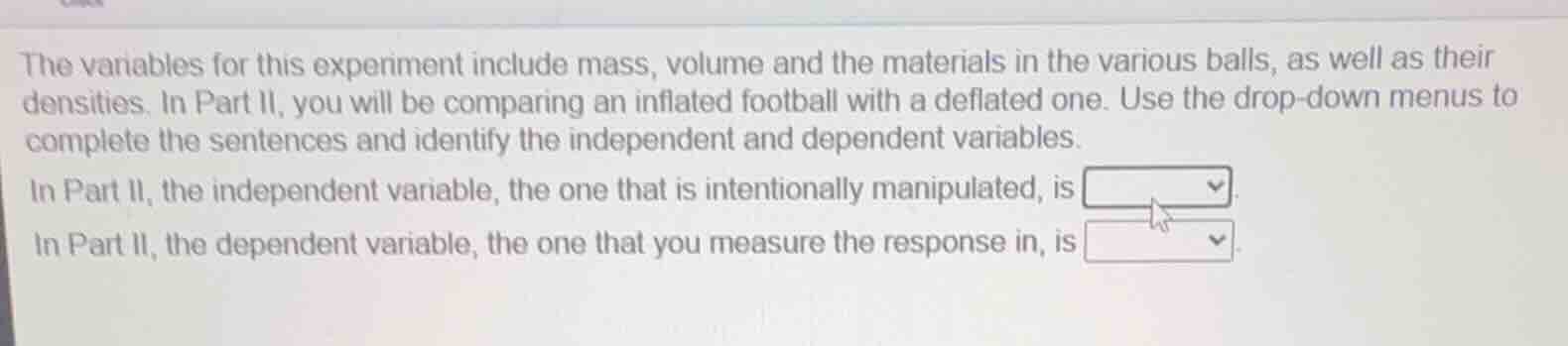
the variables for this experiment include mass, volume and the materials in the various balls, as well as their densities. in part ii, you will be comparing an inflated football with a deflated one. use the drop - down menus to complete the sentences and identify the independent and dependent variables. in part ii, the independent variable, the one that is intentionally manipulated, is
in part ii, the dependent variable, the one that you measure the response in, is
To determine the independent and dependent variables in the experiment comparing an inflated and deflated football:
- The independent variable is what we intentionally change. Here, we manipulate whether the football is inflated or deflated, which affects the volume (or the "inflated state" which relates to volume/mass). But more precisely, the independent variable is the "inflated state" (or the act of inflating/deflating, which changes the volume). However, among the variables given (mass, volume, materials, densities), the independent variable we manipulate is the volume (since inflating/deflating changes the volume). Wait, actually, when comparing inflated and deflated, the independent variable is the "inflation status" (but in terms of measurable variables, the independent variable is the one we control: we control whether it's inflated (so we manipulate the volume by inflating/deflating). The dependent variable is what changes in response, so mass or density? Wait, no: when you inflate a football, you add air, so the mass increases, and volume increases. So the independent variable is the volume (or the "inflated state" which we manipulate, and volume is the variable we change intentionally). The dependent variable would be the mass (since mass changes in response to the volume change, or the density (mass/volume) would change too, but more likely, in this case, when comparing inflated (more volume, more mass) and deflated (less volume, less mass), the independent variable is the volume (or the "inflated state" which we manipulate, so the independent variable is the "volume" (we control it by inflating/deflating), and the dependent variable is the "mass" (since mass depends on the volume (how much air is in it)). Wait, maybe I got it wrong. Let's re-express:
Independent variable: the variable we manipulate. In this experiment, we manipulate the volume (by inflating or deflating the football). So we intentionally change the volume.
Dependent variable: the variable that changes in response, so the mass (because when volume increases (inflated), mass increases (due to added air), and when volume decreases (deflated), mass decreases). Alternatively, density (mass/volume) could be a dependent variable, but more likely, in a basic experiment, mass is the dependent variable here.
Wait, but the problem says "the variables for this experiment include mass, volume and the materials in the various balls, as well as their densities". So in Part II, comparing inflated and deflated (so same ball, materials are same), so materials are constant. So independent variable: we manipulate the volume (by inflating/deflating), so independent variable is volume. Dependent variable: mass (since mass depends on volume (how much air is in it)).
Alternatively, maybe the independent variable is the "inflated state" (but as a variable, volume is the one we change, so independent variable is volume, dependent variable is mass.
But let's check standard definitions: Independent variable (IV) is the cause, dependent variable (DV) is the effect. So we change IV, DV changes.
In this case, when we inflate the football (change volume), the mass changes. So IV: volume (we manipulate it by inflating/deflating), DV: mass (it depends on the volume).
So:
In Part II, the independent variable (intentionally manipulated) is volume (or "the inflated state" which we control, and volume is the measurable variable we change).
In Part II, the dependent variable (measured response) is mass (since mass changes in response to vo…

Snap & solve any problem in the app
Get step-by-step solutions on Sovi AI
Photo-based solutions with guided steps
Explore more problems and detailed explanations
In Part II, the independent variable, the one that is intentionally manipulated, is \boxed{volume}.
In Part II, the dependent variable, the one that you measure the response in, is \boxed{mass}.
(Note: Depending on the experiment's focus, density could also be a dependent variable, but mass is more likely here as inflating adds mass. If the drop-down options include "inflated state" or similar, but based on the given variables, volume (IV) and mass (DV) are the most logical.)