QUESTION IMAGE
Question
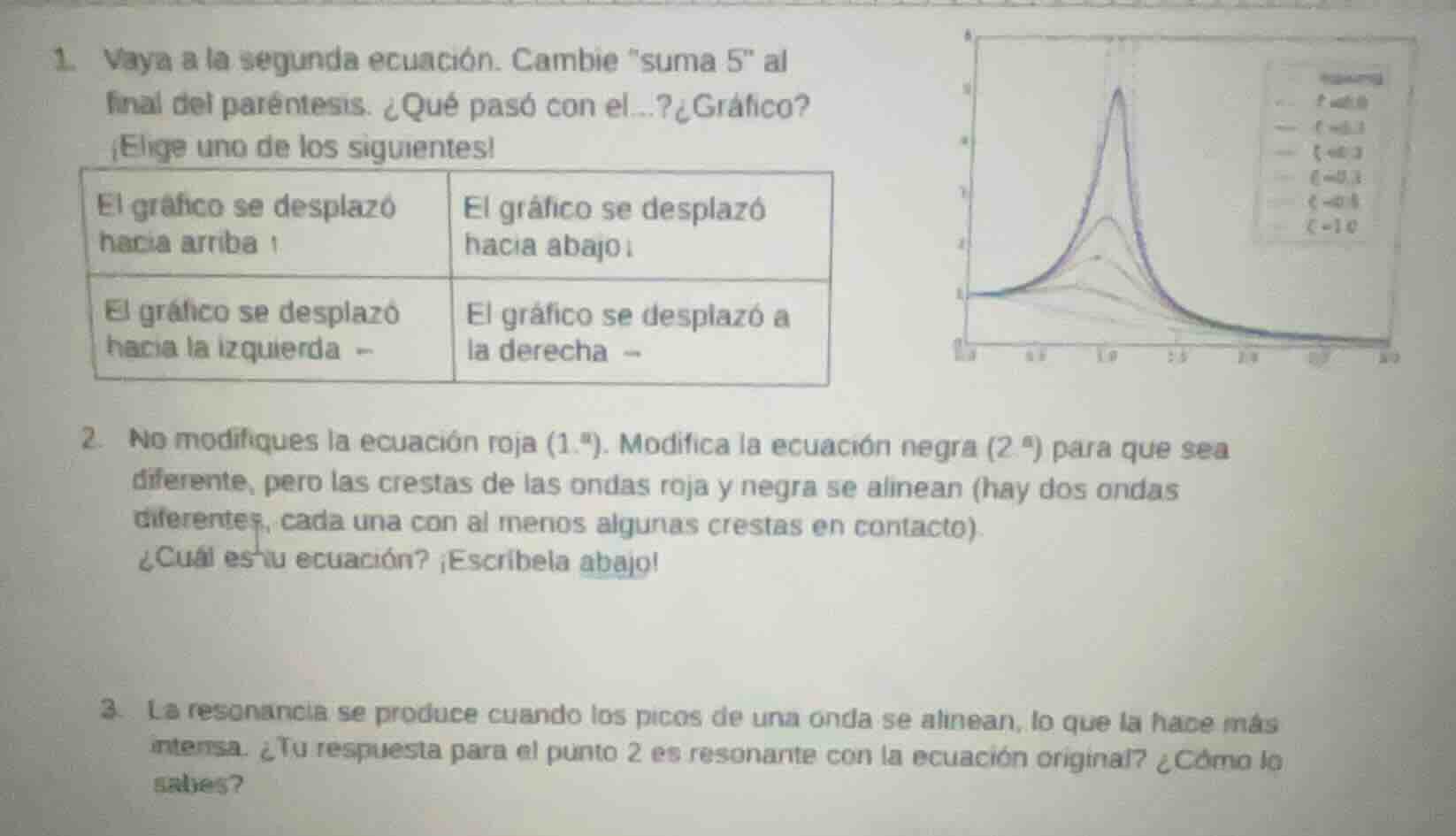
- vaya a la segunda ecuación. cambie \suma 5\ al final del paréntesis. ¿qué pasó con el...?¿gráfico? ¡elige uno de los siguientes!
el gráfico se desplazó hacia arriba ↑ \tel gráfico se desplazó hacia abajo ↓
el gráfico se desplazó hacia la izquierda ← \tel gráfico se desplazó a la derecha →
- no modifiques la ecuación roja (1.ª). modifica la ecuación negra (2.ª) para que sea diferente, pero las crestas de las ondas roja y negra se alinean (hay dos ondas diferentes, cada una con al menos algunas crestas en contacto). ¿cuál es tu ecuación? ¡escríbela abajo!
- la resonancia se produce cuando los picos de una onda se alinean, lo que la hace más intensa. ¿tu respuesta para el punto 2 es resonante con la ecuación original? ¿cómo lo sabes?
Question 1
When a constant is added outside the parenthesis of a function (like \( f(x)+5 \)), it represents a vertical shift. Adding a positive constant shifts the graph upward. Horizontal shifts are due to changes inside the parenthesis (e.g., \( f(x - h) \) for horizontal shift). So moving "suma 5" (add 5) to the end of the parenthesis (vertical shift) moves the graph up.
To align the crests (peaks) of the black wave with the red wave, we can adjust the vertical shift or stretch, but since they need to be different, a vertical shift while keeping the horizontal position of peaks similar works. For example, if the red equation is \( y = f(x) \), the black could be \( y = f(x)+k \) (k ≠ 0) or a scaled version with same peak x - position. A simple example: if red is \( y = e^{-x^2} \), black could be \( y = 2e^{-x^2}+1 \) (adjusting amplitude and vertical shift to align peaks). But generally, an equation like \( y = A\cdot f(x)+B \) where A and B are chosen so peaks align. Let's assume the original red is a Gaussian, so black can be \( y = 3e^{-x^2}+2 \) (example, depends on original, but key is same x - position for peaks).
Resonance occurs when peaks (picos) align. To check, we see if the peaks of the black wave (from question 2) and the red wave (original) have the same x - coordinate (horizontal alignment of peaks). If the equation from question 2 has the same \( x \) - value for its peak as the original red equation, then their peaks align, so it's resonant. For example, if red is \( y = e^{-(x - a)^2} \) (peak at \( x = a \)) and black is \( y = 2e^{-(x - a)^2}+b \), the peak is also at \( x = a \), so peaks align, meaning resonance.

Snap & solve any problem in the app
Get step-by-step solutions on Sovi AI
Photo-based solutions with guided steps
Explore more problems and detailed explanations
El gráfico se desplazó hacia arriba