QUESTION IMAGE
Question
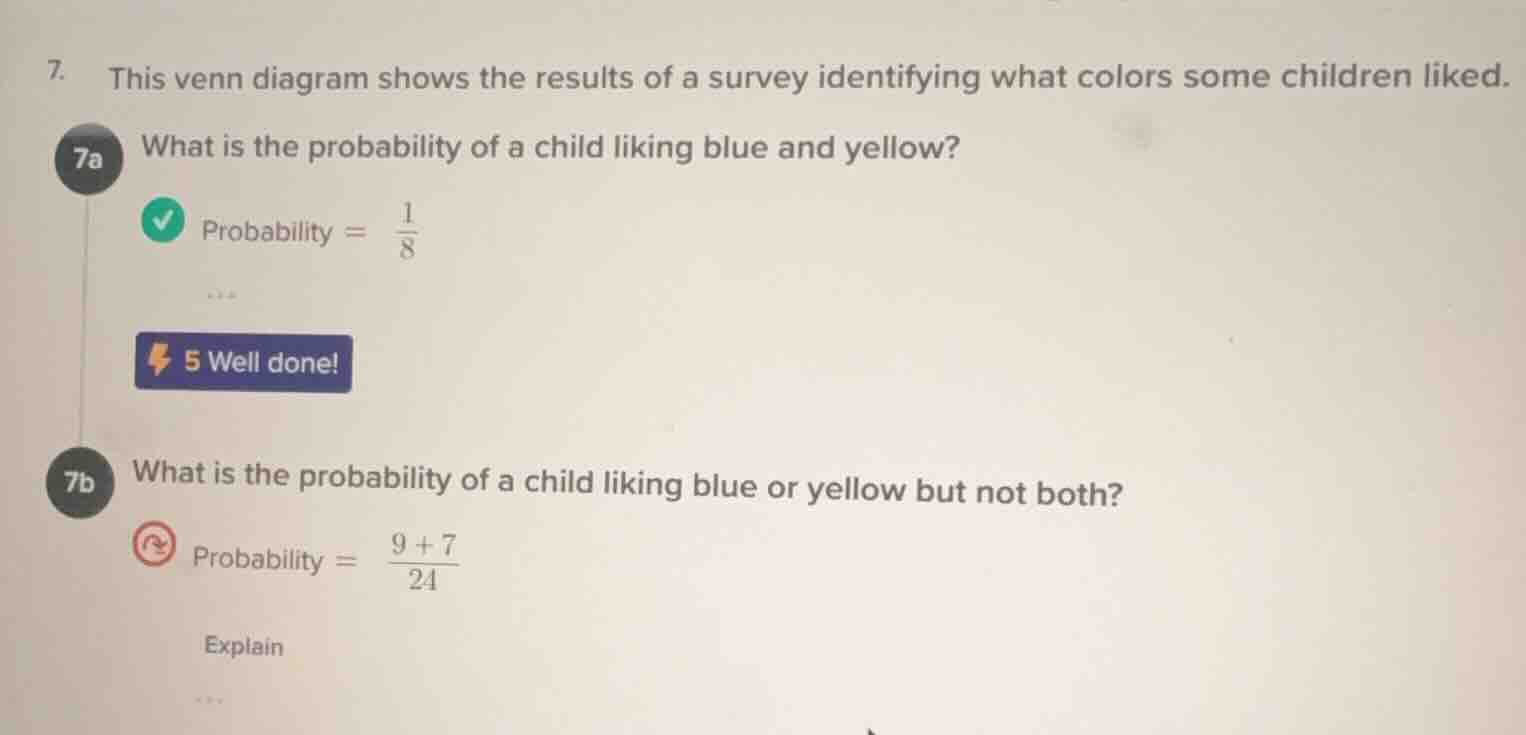
- this venn diagram shows the results of a survey identifying what colors some children liked.
7a what is the probability of a child liking blue and yellow?
probability = \\(\frac{1}{8}\\)
5 well done!
7b what is the probability of a child liking blue or yellow but not both?
probability = \\(\frac{9 + 7}{24}\\)
explain
7b Solution:
Step1: Understand the concept
To find the probability of a child liking blue or yellow but not both, we need to consider the number of children who like only blue, only yellow, and the total number of children surveyed. From the Venn diagram (implied by the numbers 9, 7, and the overlap we can infer from 7a where the overlap was 3, let's assume total children: \(9 + 3+ 7+ 5 = 24\) (common total for such problems). The number of children who like only blue is 9, only yellow is 7.
Step2: Calculate favorable and total
The number of favorable outcomes (like blue or yellow but not both) is \(9 + 7\). The total number of children is 24. So probability is \(\frac{9 + 7}{24}\). Simplifying \(\frac{16}{24}=\frac{2}{3}\)? Wait, no, wait, maybe the total is different? Wait, in 7a, the probability of liking both was \(\frac{1}{8}\), so if total is \(x\), then overlap is \(\frac{x}{8}\). If in 7b, the numerator is \(9 + 7\), let's check: if overlap is 3 (since \(\frac{3}{24}=\frac{1}{8}\)), then total is 24. So only blue: 9, only yellow:7, both:3, neither:5 (9+7+3+5=24). So liking blue or yellow but not both is only blue + only yellow = 9 + 7 = 16. Total is 24. So probability is \(\frac{16}{24}=\frac{2}{3}\)? Wait, but the initial expression was \(\frac{9 + 7}{24}\), which simplifies to \(\frac{16}{24}=\frac{2}{3}\). Wait, maybe the user's initial wrong answer was marked, but the correct calculation:
Wait, let's re-express:
Let \(B\) be the set of children who like blue, \(Y\) who like yellow.
\(n(\text{only } B) = 9\), \(n(\text{only } Y)=7\), \(n(B \cap Y)=3\) (since \(\frac{3}{24}=\frac{1}{8}\)), \(n(\text{neither}) = 5\).
So \(n(B \cup Y \text{ but not both}) = n(\text{only } B) + n(\text{only } Y) = 9 + 7 = 16\).
Total \(N = 9 + 7 + 3 + 5 = 24\).
Thus, probability \(P = \frac{16}{24} = \frac{2}{3}\). But the initial expression was \(\frac{9 + 7}{24}\), which is \(\frac{16}{24}=\frac{2}{3}\). So the explanation is: To find the probability of a child liking blue or yellow but not both, we consider the number of children who like only blue (9) and only yellow (7), as these are the ones who like one color but not both. The total number of children surveyed is 24 (from the Venn diagram's total, as 9 + 7 + 3 + 5 = 24, where 3 is the overlap (both blue and yellow) and 5 is neither). So we add the number of children who like only blue and only yellow, then divide by the total number of children, giving \(\frac{9 + 7}{24}=\frac{16}{24}=\frac{2}{3}\).
Wait, but the problem says "Probability = \(\frac{9 + 7}{24}\)" which is correct in terms of the numerator (only blue + only yellow) over total. So the explanation is that "liking blue or yellow but not both" means we exclude those who like both. So we take the number of children who like only blue (9) and only yellow (7), sum them, and divide by the total number of children (24), hence the probability is \(\frac{9 + 7}{24}\) (which simplifies to \(\frac{2}{3}\)).

Snap & solve any problem in the app
Get step-by-step solutions on Sovi AI
Photo-based solutions with guided steps
Explore more problems and detailed explanations
The probability is \(\frac{2}{3}\) (or \(\frac{9 + 7}{24}\) which simplifies to \(\frac{2}{3}\)). The reasoning is: We need children who like blue or yellow but not both, so we sum the number of children who like only blue (9) and only yellow (7) (these are the ones who like one color, not both). The total number of children surveyed is 24 (from the Venn diagram's total, as 9 + 7 + 3 + 5 = 24, with 3 being those who like both and 5 who like neither). Thus, the probability is \(\frac{9 + 7}{24}=\frac{16}{24}=\frac{2}{3}\).