QUESTION IMAGE
Question
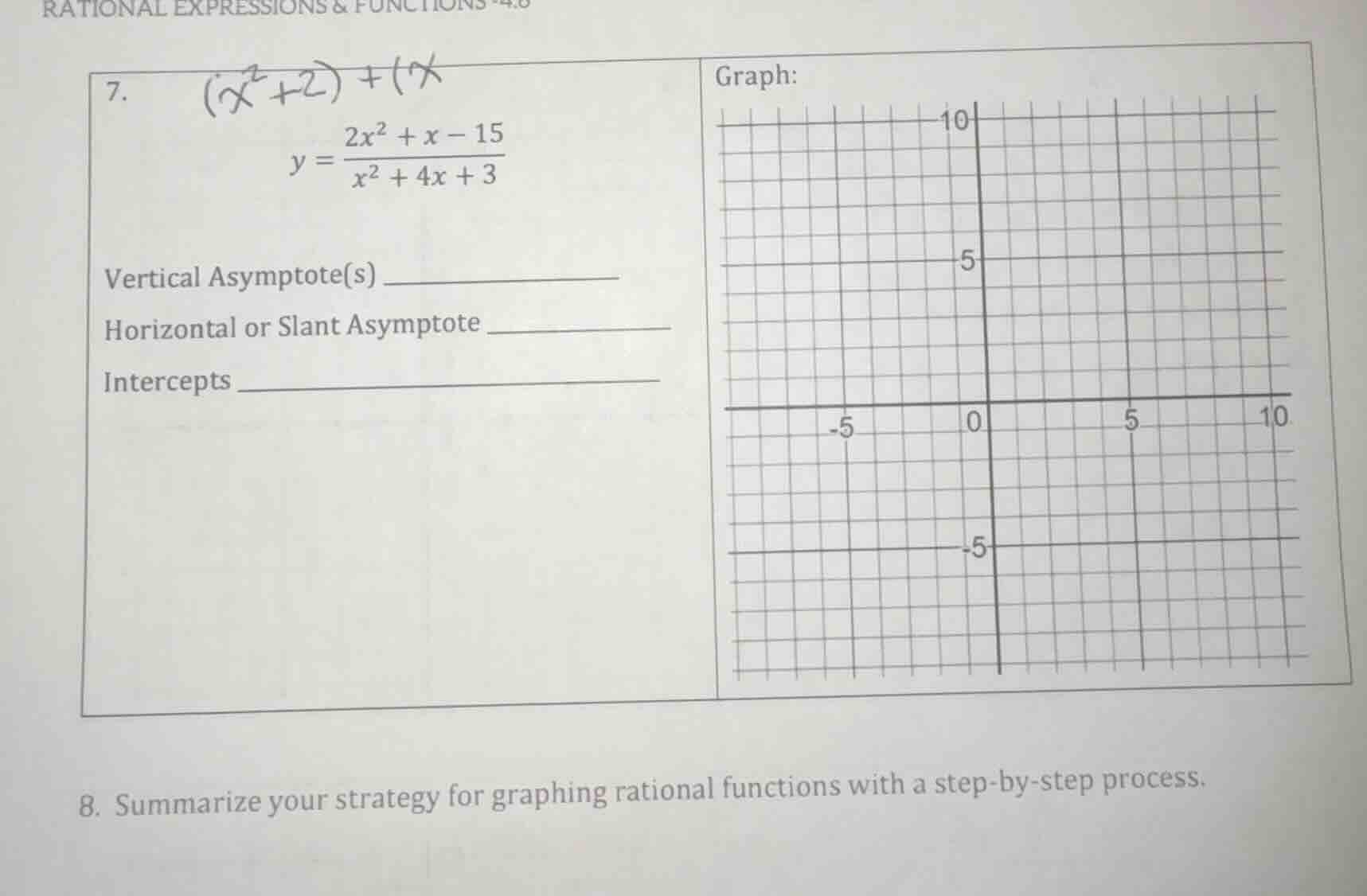
7.
$y = \frac{2x^2 + x - 15}{x^2 + 4x + 3}$
vertical asymptote(s) _______________
horizontal or slant asymptote ____________
intercepts _________________________
graph:
coordinate grid with x from -5 to 10 and y from -5 to 10
- summarize your strategy for graphing rational functions with a step - by - step process.
For Question 7:
Vertical Asymptote(s)
Step1: Factor numerator and denominator
Factor \(2x^2 + x - 15\): We need two numbers that multiply to \(2\times(-15)=-30\) and add to \(1\). Those numbers are \(6\) and \(-5\). So, \(2x^2 + x - 15 = 2x^2 + 6x - 5x - 15 = 2x(x + 3) - 5(x + 3) = (2x - 5)(x + 3)\).
Factor \(x^2 + 4x + 3\): We need two numbers that multiply to \(3\) and add to \(4\). Those numbers are \(1\) and \(3\). So, \(x^2 + 4x + 3 = (x + 1)(x + 3)\).
The function becomes \(y=\frac{(2x - 5)(x + 3)}{(x + 1)(x + 3)}\). Cancel the common factor \((x + 3)\) (note \(x
eq - 3\) to avoid division by zero). So the simplified function is \(y=\frac{2x - 5}{x + 1}\), with a hole at \(x=-3\).
Step2: Find vertical asymptotes
Vertical asymptotes occur where the denominator of the simplified function is zero (and the numerator is not zero there). Set \(x + 1 = 0\), so \(x=-1\).
Step1: Compare degrees of numerator and denominator
The degree of the numerator (after canceling common factors) is \(1\) (from \(2x - 5\)) and the degree of the denominator (from \(x + 1\)) is also \(1\). When the degrees are equal, the horizontal asymptote is the ratio of the leading coefficients.
Step2: Calculate the ratio of leading coefficients
The leading coefficient of the numerator is \(2\) (from \(2x\)) and the leading coefficient of the denominator is \(1\) (from \(x\)). So the horizontal asymptote is \(y=\frac{2}{1}=2\).
Step1: Set \(y = 0\) and solve for \(x\)
Set \(\frac{2x - 5}{x + 1}=0\). A fraction is zero when the numerator is zero (and the denominator is not zero). So set \(2x - 5 = 0\).
Step2: Solve for \(x\)
\(2x - 5 = 0\Rightarrow 2x=5\Rightarrow x=\frac{5}{2}=2.5\). Check the denominator at \(x = \frac{5}{2}\): \(\frac{5}{2}+1=\frac{7}{2}
eq0\), so it's valid.

Snap & solve any problem in the app
Get step-by-step solutions on Sovi AI
Photo-based solutions with guided steps
Explore more problems and detailed explanations
\(x = - 1\)