QUESTION IMAGE
Question
a very useful inquiry into the horrible sickness
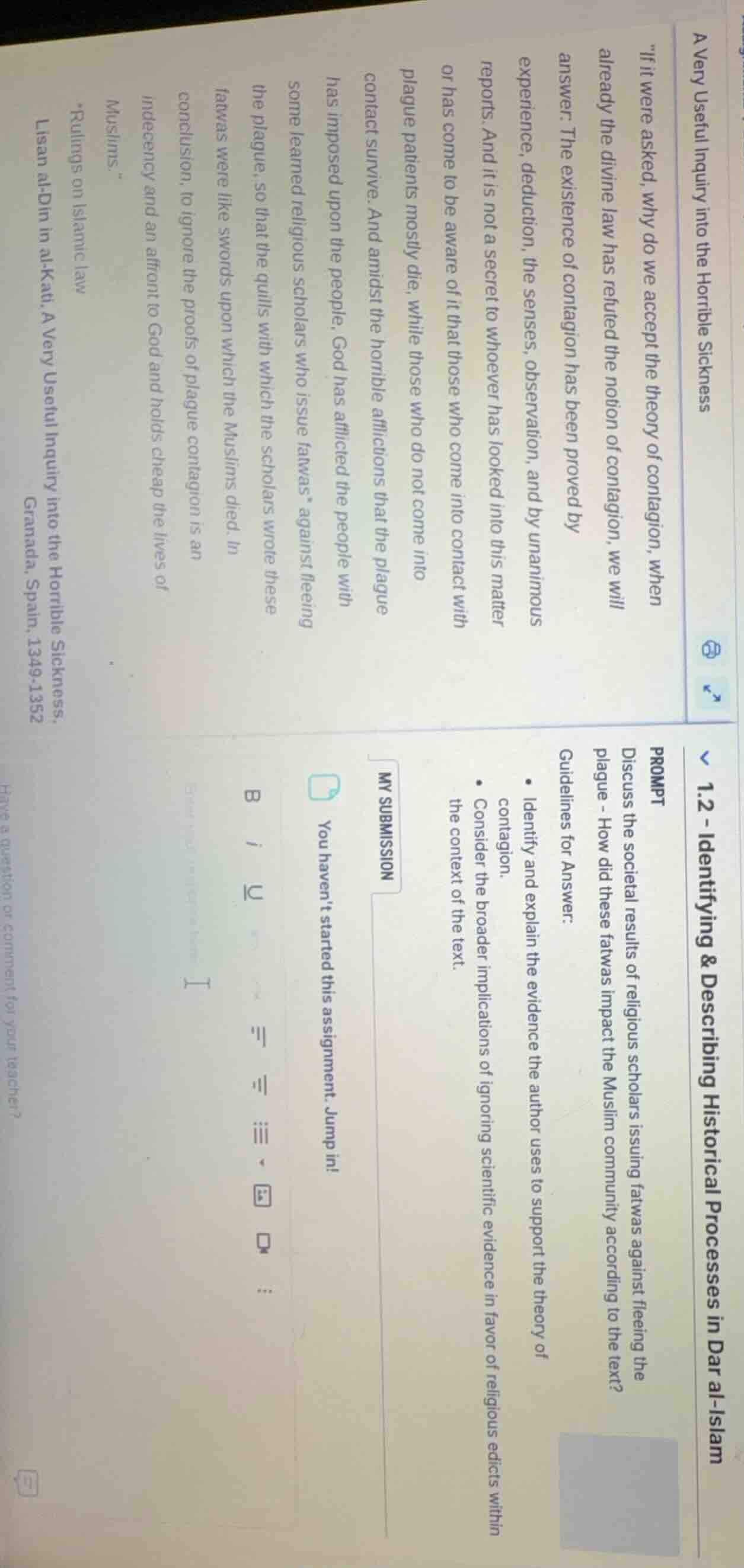
\if it were asked, why do we accept the theory of contagion, when already the divine law has refuted the notion of contagion, we will answer: the existence of contagion has been proved by experience, deduction, the senses, observation, and by unanimous reports. and it is not a secret to whoever has looked into this matter or has come to be aware of it that those who come into contact with plague patients mostly die, while those who do not come into contact survive. and amidst the horrible afflictions that the plague has imposed upon the people, god has afflicted the people with some learned religious scholars who issue fatwas* against fleeing the plague, so that the quills with which the scholars wrote these fatwas were like swords upon which the muslims died. in conclusion, to ignore the proofs of plague contagion is an indecency and an affront to god and holds cheap the lives of muslims.\
*rulings on islamic law
lisan al-din in al-kati, a very useful inquiry into the horrible sickness, granada, spain, 1349-1352
1.2 - identifying & describing historical processes in dar al-islam
prompt
discuss the societal results of religious scholars issuing fatwas against fleeing the plague - how did these fatwas impact the muslim community according to the text?
guidelines for answer:
- identify and explain the evidence the author uses to support the theory of contagion.
- consider the broader implications of ignoring scientific evidence in favor of religious edicts within the context of the text.
my submission
you havent started this assignment. jump in!
For the first prompt part:
- Evidence for contagion: The author uses direct sensory observation and unanimous reports: people who have contact with plague patients mostly die, while those who avoid contact survive. This observable pattern is cited as proof of contagion.
- Implications of ignoring scientific evidence: In the context of the 14th-century plague in Islamic Spain, religious scholars issued fatwas forbidding fleeing plague areas, framing acceptance of contagion as offensive to God. Ignoring the observable evidence of contagion likely led to higher Muslim mortality rates, as people were barred from taking a precaution that could have reduced their risk of contracting the deadly disease.
For the second prompt part:
These fatwas restricted Muslims from fleeing plague zones, forcing them to remain in areas with active, deadly outbreaks. As a result, the Muslim community likely suffered higher infection and death rates during the plague, as they could not take the precaution of escaping contagion that non-compliant people or others outside the fatwa's reach might have used.

Snap & solve any problem in the app
Get step-by-step solutions on Sovi AI
Photo-based solutions with guided steps
Explore more problems and detailed explanations
- - Evidence for contagion: The author uses empirical evidence: direct observation and unanimous reports showing that people who interact with plague patients mostly die, while those who avoid contact survive.
- Implications of ignoring evidence: Within the text's 14th-century Granada context, the fatwas forced Muslims to stay in plague-stricken areas. This led to unnecessary, high mortality rates in the Muslim community, as they were prohibited from taking a proven precaution against the deadly disease, with the fatwas framing acceptance of contagion as a religious offense.
- The fatwas barred Muslims from fleeing plague-affected areas, so the Muslim community faced significantly higher exposure to the disease, resulting in elevated infection and death rates during the outbreak.