QUESTION IMAGE
Question
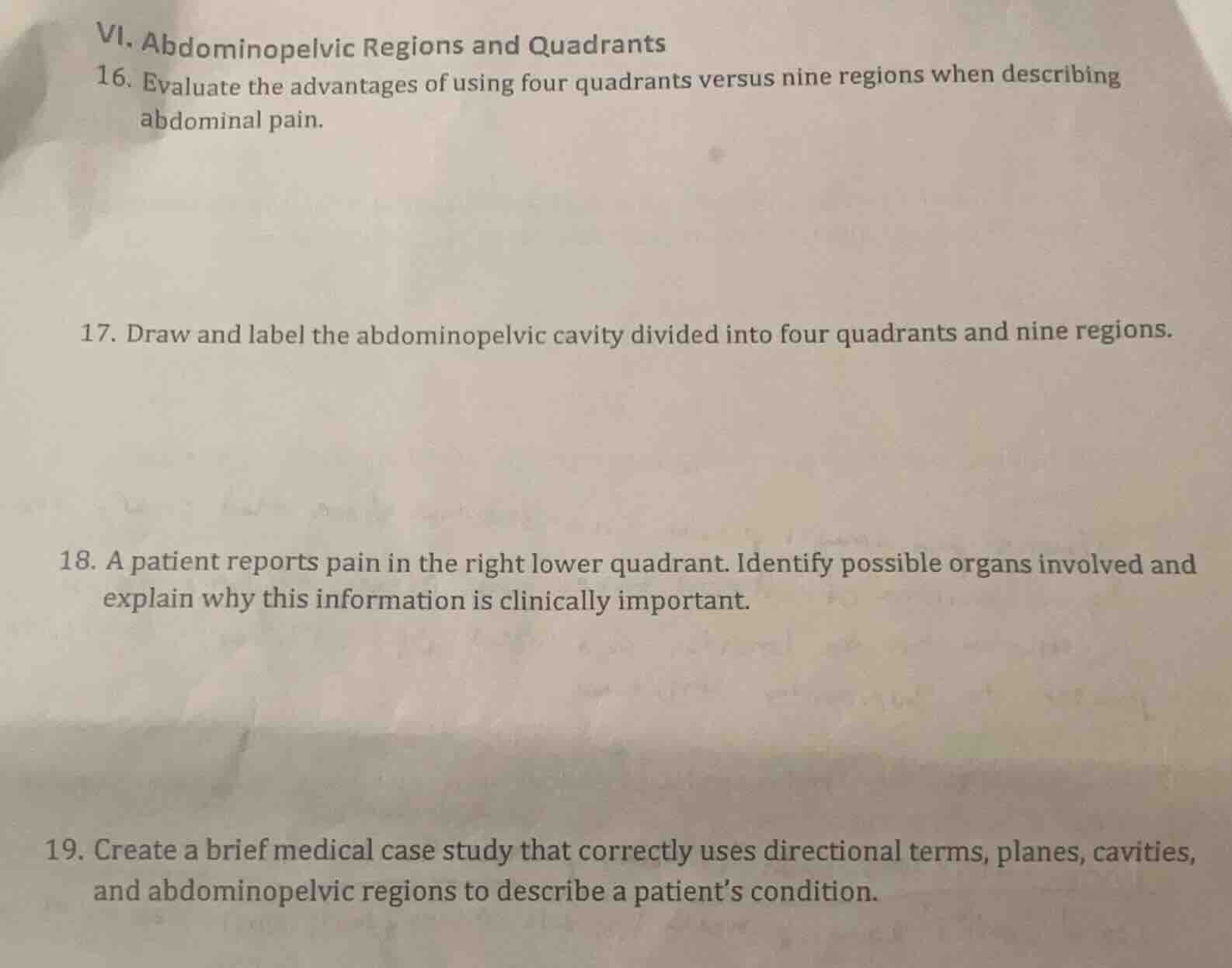
vi. abdominopelvic regions and quadrants
- evaluate the advantages of using four quadrants versus nine regions when describing abdominal pain.
- draw and label the abdominopelvic cavity divided into four quadrants and nine regions.
- a patient reports pain in the right lower quadrant. identify possible organs involved and explain why this information is clinically important.
- create a brief medical case study that correctly uses directional terms, planes, cavities, and abdominopelvic regions to describe a patient’s condition.
Brief Explanations
For Question 16:
- Four quadrants: Simple, quick to use in initial triage or basic patient interviews, requires minimal anatomical expertise to communicate pain location.
- Nine regions: Provides precise anatomical localization, helps narrow down potential organ involvement more specifically, critical for targeted diagnostic testing and specialist referrals.
For Question 17:
- Four Quadrants:
- Draw a vertical line through the midline (median plane) and a horizontal line through the umbilicus (navel) to divide the cavity.
- Label the top-right as Right Upper Quadrant (RUQ), top-left as Left Upper Quadrant (LUQ), bottom-right as Right Lower Quadrant (RLQ), bottom-left as Left Lower Quadrant (LLQ).
- Nine Regions:
- Draw two vertical lines just medial to the midclavicular lines, and two horizontal lines: one subcostal (inferior to the ribcage, at the level of the 10th rib) and one intertubercular (connecting the iliac crests).
- Label the top row (superior to subcostal line): Right Hypochondriac, Epigastric, Left Hypochondriac.
- Label the middle row (between subcostal and intertubercular lines): Right Lumbar, Umbilical, Left Lumbar.
- Label the bottom row (inferior to intertubercular line): Right Iliac (Inguinal), Hypogastric (Pubic), Left Iliac (Inguinal).
For Question 18:
- Possible organs in the right lower quadrant include the appendix, cecum, ascending colon (distal portion), right ovary and fallopian tube (in females), right ureter, and right spermatic cord (in males).
- Clinical importance: This localization narrows differential diagnoses (e.g., RLQ pain is a key sign of appendicitis, a surgical emergency). It guides immediate next steps, such as ordering targeted imaging (like a CT scan of the abdomen/pelvis) or lab work, and helps determine if urgent surgical consultation is needed.
For Question 19:
- A 32-year-old female presents to the emergency department with sharp, worsening pain localized to her right lower quadrant (RLQ) for 8 hours. She reports nausea and one episode of vomiting. On physical exam, tenderness is elicited with deep palpation of the RLQ, and rebound tenderness is present (pain when pressure is released, indicating irritation of the peritoneal cavity). A sagittal plane ultrasound shows an inflamed, enlarged appendix located inferior to the cecum, in the right iliac region of the abdominopelvic cavity. The patient is taken to the operating room for a laparoscopic appendectomy, with incisions made in the umbilical region and right lower quadrant. Post-operatively, she is instructed to avoid heavy lifting to prevent strain on the anterior abdominal wall.

Snap & solve any problem in the app
Get step-by-step solutions on Sovi AI
Photo-based solutions with guided steps
Explore more problems and detailed explanations
- Question 16:
- Advantages of four quadrants: Quick, simple, low anatomical expertise needed.
- Advantages of nine regions: Precise localization, targeted diagnosis/referral.
- Question 17:
- Four quadrants: Divided by midline and umbilical horizontal line; labeled RUQ, LUQ, RLQ, LLQ.
- Nine regions: Divided by 2 vertical midclavicular lines, subcostal and intertubercular horizontal lines; labeled Right Hypochondriac, Epigastric, Left Hypochondriac, Right Lumbar, Umbilical, Left Lumbar, Right Iliac, Hypogastric, Left Iliac.
- Question 18:
- Possible organs: Appendix, cecum, distal ascending colon, right ovary/fallopian tube (female), right ureter, right spermatic cord (male).
- Clinical importance: Narrows differential diagnoses (e.g., appendicitis), guides targeted testing and urgent care decisions.
- Question 19:
- Case study: 32F with 8-hour worsening RLQ pain, nausea/vomiting. RLQ tenderness/rebound tenderness on exam. Sagittal ultrasound shows inflamed appendix in right iliac region. Laparoscopic appendectomy with umbilical/RLQ incisions; post-op lifting restrictions.