QUESTION IMAGE
Question
view passage 1
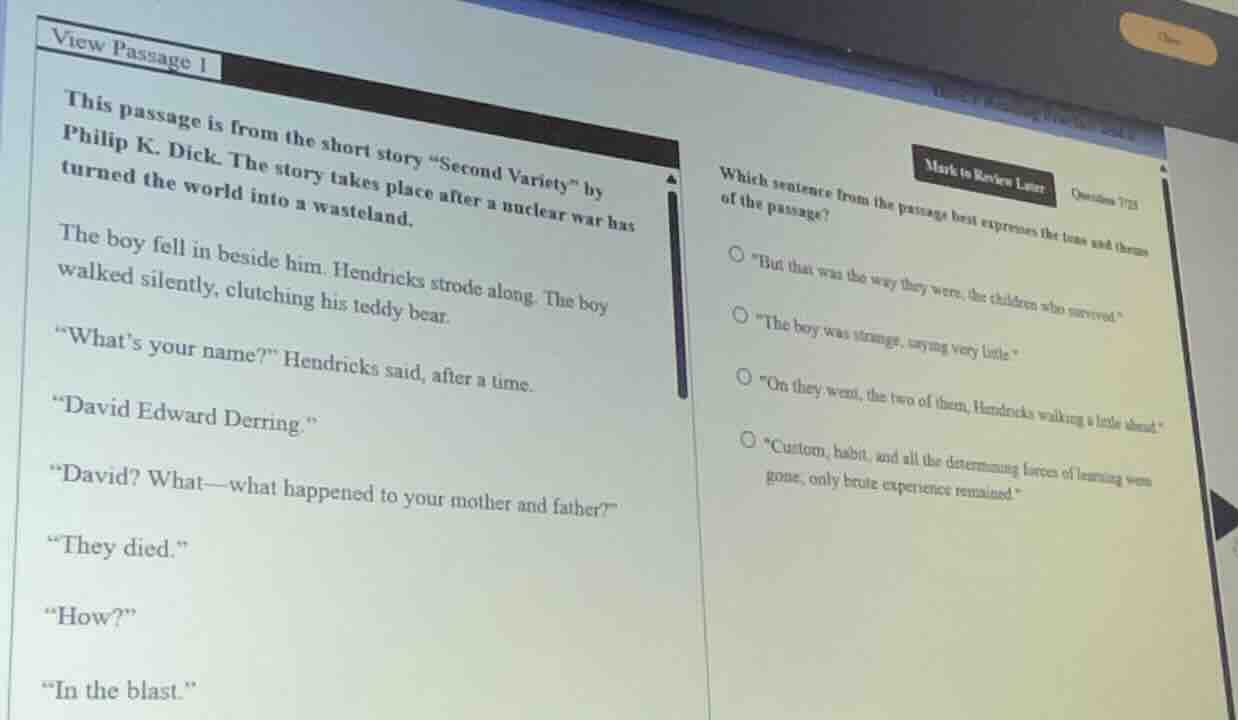
this passage is from the short story “second variety” by philip k. dick. the story takes place after a nuclear war has turned the world into a wasteland.
the boy fell in beside him. hendricks strode along. the boy walked silently, clutching his teddy bear.
“what’s your name?” hendricks said, after a time.
“david edward derring.”
“david? what—what happened to your mother and father?”
“they died.”
“how?”
“in the blast.”
which sentence from the passage best expresses the tone and theme of the passage?
○ “but that was the way they were, the children who survived.”
○ “the boy was strange, saying very little.”
○ “on they went, the two of them, hendricks walking a little ahead.”
○ “custom, habit, and all the determining forces of learning were gone, only brute experience remained.”
To determine the sentence that best expresses the tone and theme of the passage (set in a post - nuclear war wasteland), we analyze each option:
- Option 1: “But that was the way they were, the children who survived” mainly describes the nature of surviving children, not the overall tone/theme of the wasteland and loss.
- Option 2: “The boy was strange, saying very little” focuses on the boy's demeanor, not the broader theme.
- Option 3: “On they went, the two of them, Hendricks walking a little ahead” is about their movement, not the theme.
- Option 4: “Custom, habit, and all the determining forces of learning were gone, only brute experience remained” reflects the loss of normalcy (customs, learning forces) and the harsh, brute reality of the post - nuclear war world, which aligns with the tone and theme of a wasteland after a nuclear war.

Snap & solve any problem in the app
Get step-by-step solutions on Sovi AI
Photo-based solutions with guided steps
Explore more problems and detailed explanations
D. “Custom, habit, and all the determining forces of learning were gone, only brute experience remained.”