QUESTION IMAGE
Question
révision éclair
pour décrire la position d’une figure
dans un plan cartésien, tu peux
utiliser des paires ordonnées.
les nombres dans une paire
ordonnée sont appelés coordonnées.
la première coordonnée indique la
distance à parcourir vers la droite.
la deuxième coordonnée indique
la distance à parcourir vers le haut.
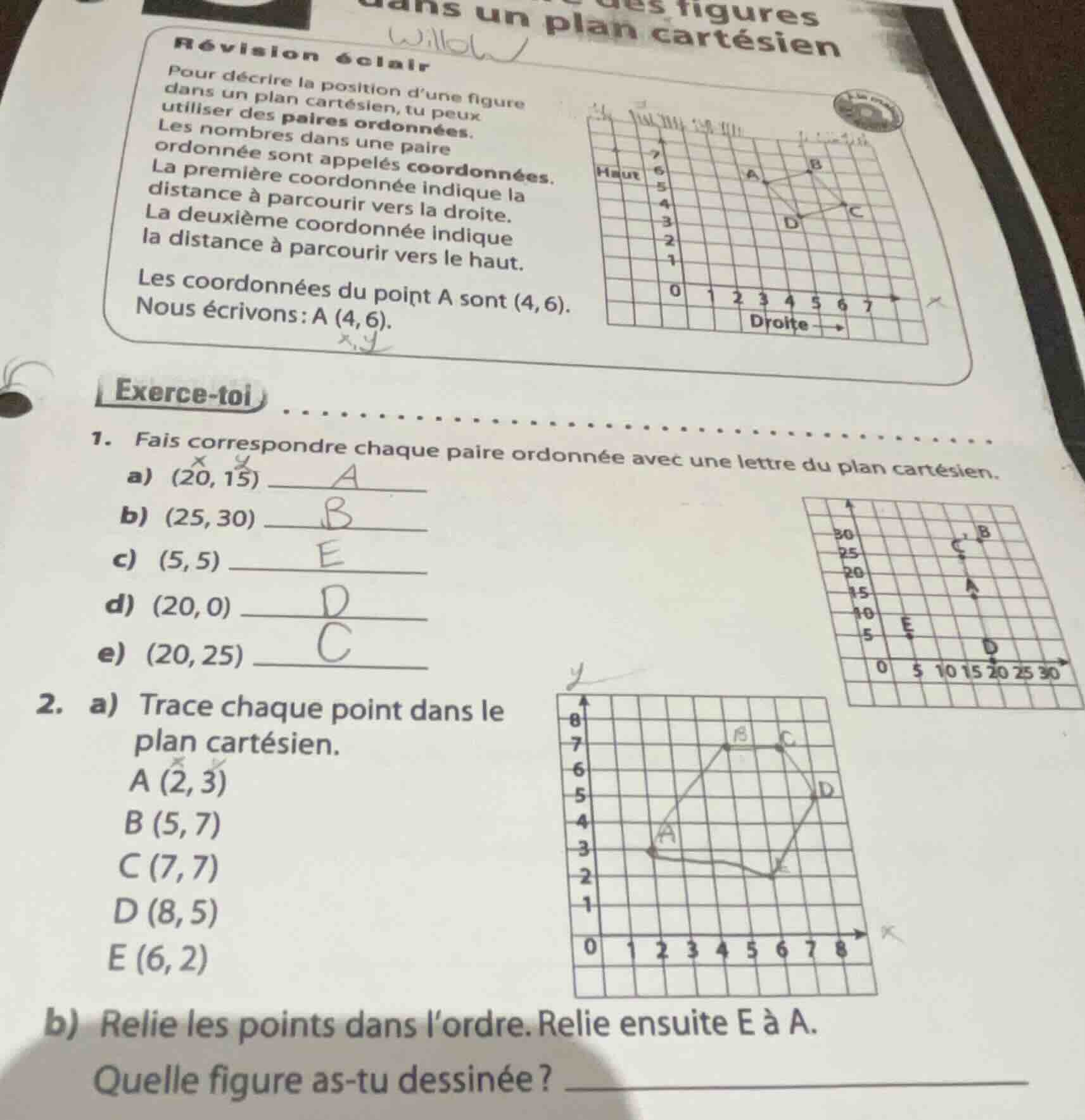
les coordonnées du point a sont (4,6).
nous écrivons: a (4,6).
exerce - toi
- fais correspondre chaque paire ordonnée avec une lettre du plan cartésien.
a) (20, 15)
b) (25, 30)
c) (5, 5)
d) (20, 0)
e) (20, 25)
- a) trace chaque point dans le
plan cartésien.
a (2, 3)
b (5, 7)
c (7, 7)
d (8, 5)
e (6, 2)
b) relie les points dans l’ordre. relie ensuite e à a.
quelle figure as - tu dessinée?
Part 1: Matching Coordinates to Points (Sub - question 1)
a) For \((20,15)\)
- Looking at the second grid (with the \(x\) - axis from \(0\) to \(30\) and \(y\) - axis from \(0\) to \(30\)), we check the position of each point. Point \(A\) in this grid has a \(x\) - coordinate of \(20\) and a \(y\) - coordinate of \(15\) (since it is at the intersection where moving \(20\) units to the right and \(15\) units up from the origin \((0,0)\)). So \((20,15)\) corresponds to \(A\).
b) For \((25,30)\)
- In the second grid, point \(B\) is at a position where \(x = 25\) (25 units to the right) and \(y=30\) (30 units up). So \((25,30)\) corresponds to \(B\).
c) For \((5,5)\)
- In the second grid, point \(E\) is at \(x = 5\) (5 units to the right) and \(y = 5\) (5 units up). So \((5,5)\) corresponds to \(E\).
d) For \((20,0)\)
- In the second grid, point \(D\) is at \(x=20\) (20 units to the right) and \(y = 0\) (0 units up, i.e., on the \(x\) - axis). So \((20,0)\) corresponds to \(D\).
e) For \((20,25)\)
- In the second grid, point \(C\) is at \(x = 20\) (20 units to the right) and \(y=25\) (25 units up). So \((20,25)\) corresponds to \(C\).
Part 2: Plotting Points and Identifying the Figure (Sub - question 2)
a) Plotting Points
- For point \(A(2,3)\): We move \(2\) units to the right along the \(x\) - axis and \(3\) units up along the \(y\) - axis from the origin \((0,0)\) in the third grid (with \(x\) from \(0\) to \(8\) and \(y\) from \(0\) to \(8\)) and mark the point.
- For point \(B(5,7)\): We move \(5\) units to the right along the \(x\) - axis and \(7\) units up along the \(y\) - axis and mark the point.
- For point \(C(7,7)\): We move \(7\) units to the right along the \(x\) - axis and \(7\) units up along the \(y\) - axis and mark the point.
- For point \(D(8,5)\): We move \(8\) units to the right along the \(x\) - axis and \(5\) units up along the \(y\) - axis and mark the point.
- For point \(E(6,2)\): We move \(6\) units to the right along the \(x\) - axis and \(2\) units up along the \(y\) - axis and mark the point.
b) Connecting Points
- When we connect the points \(A(2,3)\), \(B(5,7)\), \(C(7,7)\), \(D(8,5)\), \(E(6,2)\) and then \(E\) back to \(A\):
- The side \(BC\) is horizontal (since \(B(5,7)\) and \(C(7,7)\) have the same \(y\) - coordinate, so the length of \(BC\) is \(|7 - 5|=2\) units).
- The side \(AB\): The distance between \(A(2,3)\) and \(B(5,7)\) is \(\sqrt{(5 - 2)^2+(7 - 3)^2}=\sqrt{9 + 16}=\sqrt{25} = 5\) units. The distance between \(E(6,2)\) and \(A(2,3)\) is \(\sqrt{(2 - 6)^2+(3 - 2)^2}=\sqrt{16 + 1}= \sqrt{17}\) units. The distance between \(D(8,5)\) and \(C(7,7)\) is \(\sqrt{(7 - 8)^2+(7 - 5)^2}=\sqrt{1 + 4}=\sqrt{5}\) units. The distance between \(D(8,5)\) and \(E(6,2)\) is \(\sqrt{(6 - 8)^2+(2 - 5)^2}=\sqrt{4 + 9}=\sqrt{13}\) units.
- By looking at the shape, we can see that it is a pentagon (a five - sided figure). But more specifically, when we analyze the angles and sides, we can also note that it has a somewhat irregular shape, but the key is that it is a pentagon. However, if we look at the symmetry and the way the points are connected, it can also be identified as a pentagon (or more precisely, an irregular pentagon). But if we consider the given diagram (the third grid), when we connect the points in order \(A - B - C - D - E - A\), the figure formed is a pentagon. But from the visual of the pre - drawn figure in the third grid (the one with \(x\) from \(0\) to \(8\) and \(y\) from \(0\) to \(8\)), the figure formed is a pentagon (or a "pentago…

Snap & solve any problem in the app
Get step-by-step solutions on Sovi AI
Photo-based solutions with guided steps
Explore more problems and detailed explanations
Part 1: Matching Coordinates to Points (Sub - question 1)
a) For \((20,15)\)
- Looking at the second grid (with the \(x\) - axis from \(0\) to \(30\) and \(y\) - axis from \(0\) to \(30\)), we check the position of each point. Point \(A\) in this grid has a \(x\) - coordinate of \(20\) and a \(y\) - coordinate of \(15\) (since it is at the intersection where moving \(20\) units to the right and \(15\) units up from the origin \((0,0)\)). So \((20,15)\) corresponds to \(A\).
b) For \((25,30)\)
- In the second grid, point \(B\) is at a position where \(x = 25\) (25 units to the right) and \(y=30\) (30 units up). So \((25,30)\) corresponds to \(B\).
c) For \((5,5)\)
- In the second grid, point \(E\) is at \(x = 5\) (5 units to the right) and \(y = 5\) (5 units up). So \((5,5)\) corresponds to \(E\).
d) For \((20,0)\)
- In the second grid, point \(D\) is at \(x=20\) (20 units to the right) and \(y = 0\) (0 units up, i.e., on the \(x\) - axis). So \((20,0)\) corresponds to \(D\).
e) For \((20,25)\)
- In the second grid, point \(C\) is at \(x = 20\) (20 units to the right) and \(y=25\) (25 units up). So \((20,25)\) corresponds to \(C\).
Part 2: Plotting Points and Identifying the Figure (Sub - question 2)
a) Plotting Points
- For point \(A(2,3)\): We move \(2\) units to the right along the \(x\) - axis and \(3\) units up along the \(y\) - axis from the origin \((0,0)\) in the third grid (with \(x\) from \(0\) to \(8\) and \(y\) from \(0\) to \(8\)) and mark the point.
- For point \(B(5,7)\): We move \(5\) units to the right along the \(x\) - axis and \(7\) units up along the \(y\) - axis and mark the point.
- For point \(C(7,7)\): We move \(7\) units to the right along the \(x\) - axis and \(7\) units up along the \(y\) - axis and mark the point.
- For point \(D(8,5)\): We move \(8\) units to the right along the \(x\) - axis and \(5\) units up along the \(y\) - axis and mark the point.
- For point \(E(6,2)\): We move \(6\) units to the right along the \(x\) - axis and \(2\) units up along the \(y\) - axis and mark the point.
b) Connecting Points
- When we connect the points \(A(2,3)\), \(B(5,7)\), \(C(7,7)\), \(D(8,5)\), \(E(6,2)\) and then \(E\) back to \(A\):
- The side \(BC\) is horizontal (since \(B(5,7)\) and \(C(7,7)\) have the same \(y\) - coordinate, so the length of \(BC\) is \(|7 - 5|=2\) units).
- The side \(AB\): The distance between \(A(2,3)\) and \(B(5,7)\) is \(\sqrt{(5 - 2)^2+(7 - 3)^2}=\sqrt{9 + 16}=\sqrt{25} = 5\) units. The distance between \(E(6,2)\) and \(A(2,3)\) is \(\sqrt{(2 - 6)^2+(3 - 2)^2}=\sqrt{16 + 1}= \sqrt{17}\) units. The distance between \(D(8,5)\) and \(C(7,7)\) is \(\sqrt{(7 - 8)^2+(7 - 5)^2}=\sqrt{1 + 4}=\sqrt{5}\) units. The distance between \(D(8,5)\) and \(E(6,2)\) is \(\sqrt{(6 - 8)^2+(2 - 5)^2}=\sqrt{4 + 9}=\sqrt{13}\) units.
- By looking at the shape, we can see that it is a pentagon (a five - sided figure). But more specifically, when we analyze the angles and sides, we can also note that it has a somewhat irregular shape, but the key is that it is a pentagon. However, if we look at the symmetry and the way the points are connected, it can also be identified as a pentagon (or more precisely, an irregular pentagon). But if we consider the given diagram (the third grid), when we connect the points in order \(A - B - C - D - E - A\), the figure formed is a pentagon. But from the visual of the pre - drawn figure in the third grid (the one with \(x\) from \(0\) to \(8\) and \(y\) from \(0\) to \(8\)), the figure formed is a pentagon (or a "pentagone" in French, which is a pentagon).
Final Answers
- a) \(A\)
b) \(B\)
c) \(E\)
d) \(D\)
e) \(C\)
- b) The figure drawn is a pentagon (or "pentagone" in French).