QUESTION IMAGE
Question
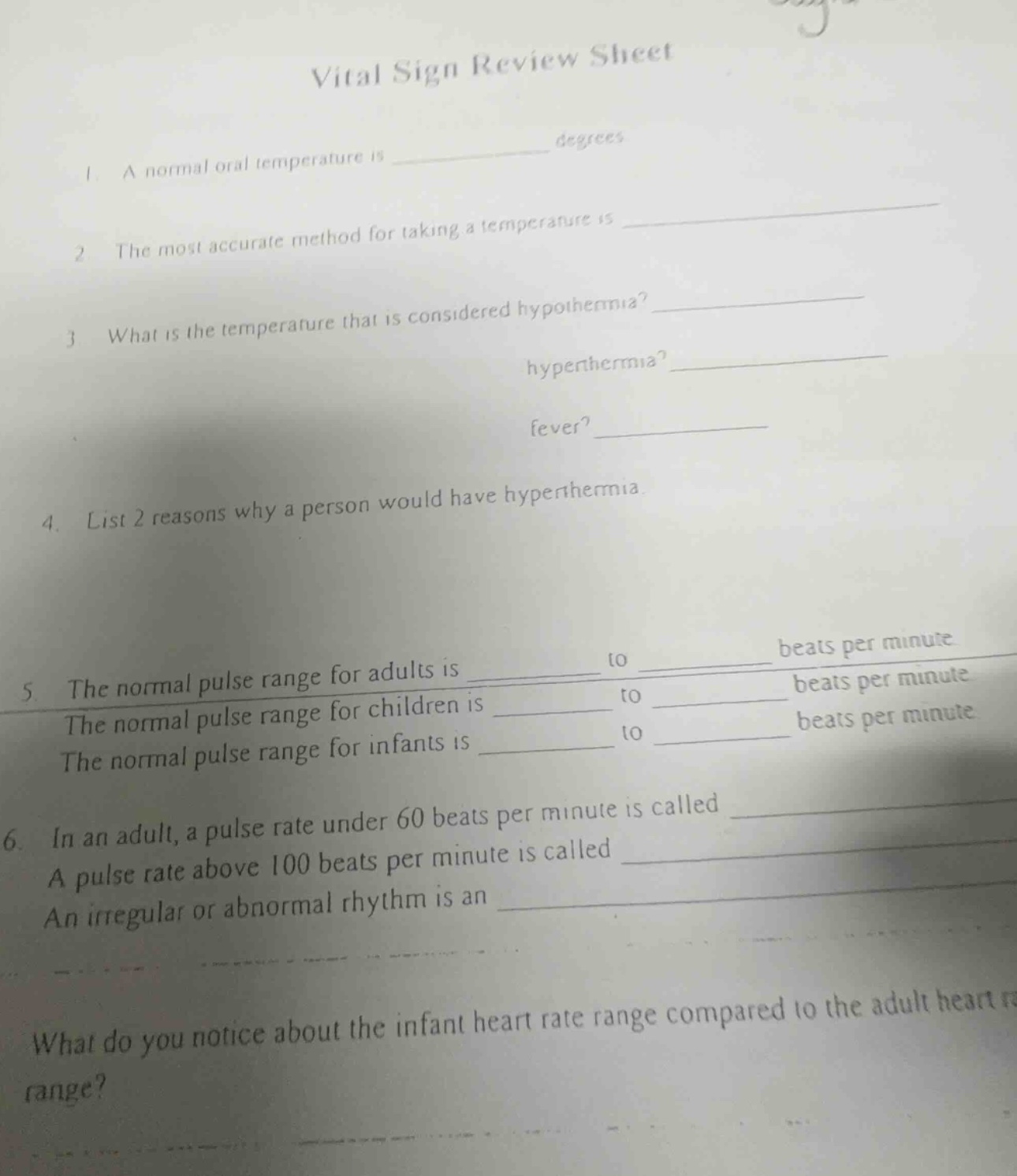
vital sign review sheet
- a normal oral temperature is ______ degrees
- the most accurate method for taking a temperature is ______
- what is the temperature that is considered hypothermia? ______
hyperthermia? ______
fever? ______
- list 2 reasons why a person would have hyperthermia.
- the normal pulse range for adults is ____ to ____ beats per minute.
the normal pulse range for children is ____ to ____ beats per minute.
the normal pulse range for infants is ____ to ____ beats per minute.
- in an adult, a pulse rate under 60 beats per minute is called ______
a pulse rate above 100 beats per minute is called ______
an irregular or abnormal rhythm is an ______
what do you notice about the infant heart rate range compared to the adult heart rate range?
Brief Explanations
- Normal oral temperature is a standard clinical value in Fahrenheit.
- Rectal measurement is the gold standard for temperature accuracy.
- Hypothermia, hyperthermia, and fever have defined clinical temperature thresholds (Fahrenheit).
- Hyperthermia can stem from environmental or internal factors.
- Normal pulse ranges vary by age group, with infants having the highest rates.
- Adult pulse abnormalities have specific clinical terms.
- Infant heart rate is inherently faster than adult due to physiological needs.

Snap & solve any problem in the app
Get step-by-step solutions on Sovi AI
Photo-based solutions with guided steps
Explore more problems and detailed explanations
- 98.6
- Rectal temperature measurement
- Hypothermia: Below 95°F; Hyperthermia: Above 104°F; Fever: Above 100.4°F
- 1. Prolonged exposure to extreme heat; 2. Severe dehydration
- Adults: 60 to 100 beats per minute; Children: 70 to 120 beats per minute; Infants: 100 to 160 beats per minute
- Bradycardia; Tachycardia; Arrhythmia
- The infant heart rate range is significantly higher than the adult heart rate range.