QUESTION IMAGE
Question
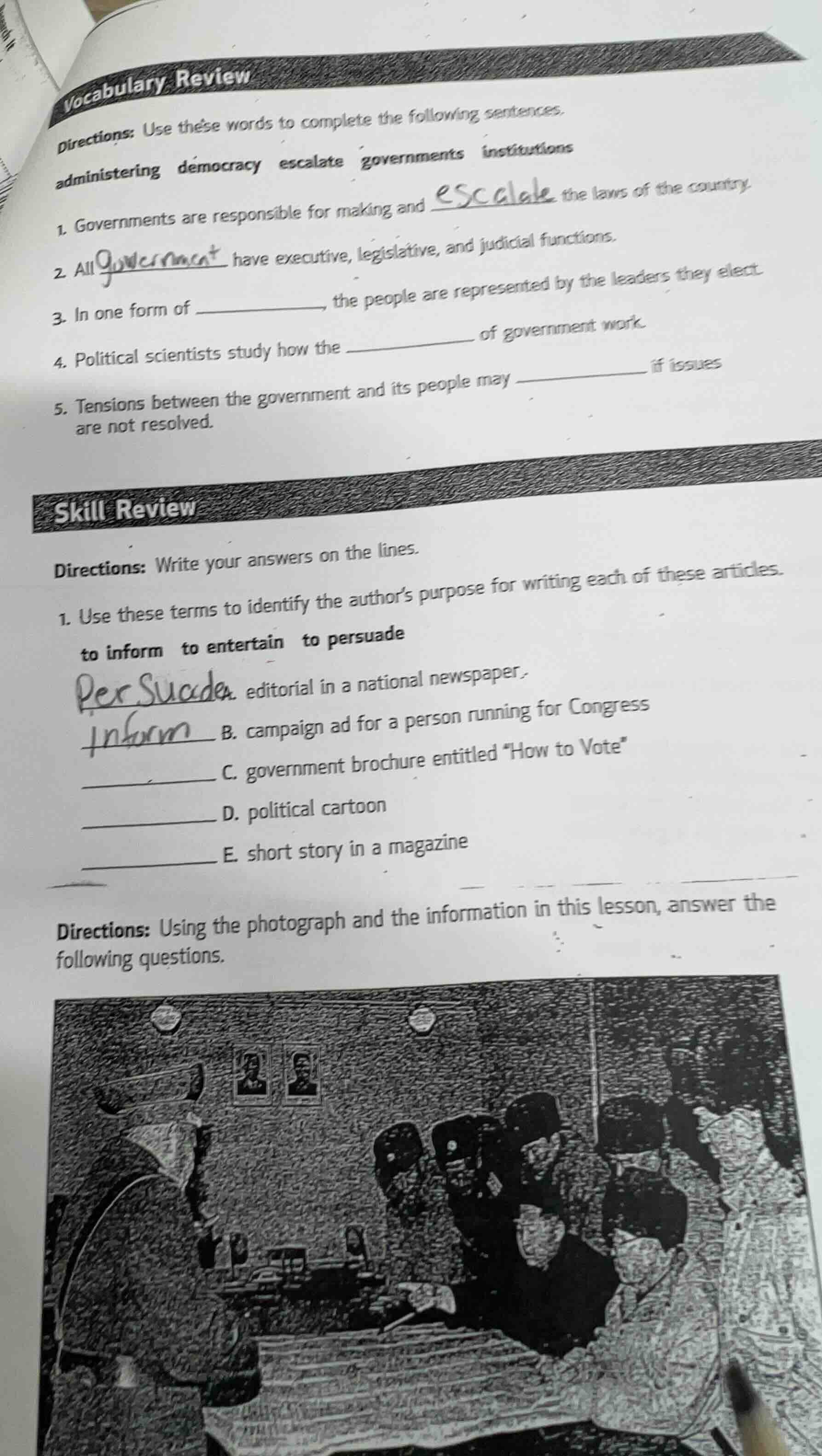
vocabulary review
directions: use these words to complete the following sentences.
administering democracy escalate governments institutions
- governments are responsible for making and ____ the laws of the country.
- all ____ have executive, legislative, and judicial functions.
- in one form of ____, the people are represented by the leaders they elect.
- political scientists study how the ____ of government work.
- tensions between the government and its people may ____ if issues
are not resolved.
skill review
directions: write your answers on the lines.
- use these terms to identify the author’s purpose for writing each of these articles.
to inform to entertain to persuade
____ editorial in a national newspaper.
____ b. campaign ad for a person running for congress
____ c. government brochure entitled “how to vote”
____ d. political cartoon
____ e. short story in a magazine
directions: using the photograph and the information in this lesson, answer the
following questions.
image omitted
Vocabulary Review Answers:
- administering (Governments make and enforce/administer laws, and "administering" fits the structure with "making" as a parallel gerund).
- governments (Governments typically have executive, legislative, and judicial branches/functions).
- democracy (In a democracy, people elect representatives to act on their behalf).
- institutions (Political scientists study how government institutions (like agencies, courts, etc.) operate).
- escalate (Unresolved issues can cause tensions to escalate (increase in intensity)).
Skill Review (Author’s Purpose) Answers:
- A. editorial in a national newspaper: to persuade (Editorials aim to convince readers of a viewpoint).
- B. campaign ad for a person running for Congress: to persuade (Campaign ads seek to persuade voters to support a candidate).
- C. government brochure entitled “How to Vote”: to inform (Brochures like this provide factual information about voting processes).
- D. political cartoon: to persuade (or inform/entertain) (Political cartoons often persuade by critiquing issues, or inform/entertain while making a point).
- E. short story in a magazine: to entertain (Short stories are primarily written to engage/entertain readers).
Note on the Photograph Section:
Since the photograph’s content isn’t fully described, a general approach: Analyze the image (e.g., people, setting, actions) and connect it to lesson concepts (likely government, civic participation, or political systems) to answer related questions (e.g., “What does this image show about [topic]?”). For example, if it shows a voting scene, it might relate to democracy or civic engagement.

Snap & solve any problem in the app
Get step-by-step solutions on Sovi AI
Photo-based solutions with guided steps
Explore more problems and detailed explanations
Vocabulary Review Answers:
- administering (Governments make and enforce/administer laws, and "administering" fits the structure with "making" as a parallel gerund).
- governments (Governments typically have executive, legislative, and judicial branches/functions).
- democracy (In a democracy, people elect representatives to act on their behalf).
- institutions (Political scientists study how government institutions (like agencies, courts, etc.) operate).
- escalate (Unresolved issues can cause tensions to escalate (increase in intensity)).
Skill Review (Author’s Purpose) Answers:
- A. editorial in a national newspaper: to persuade (Editorials aim to convince readers of a viewpoint).
- B. campaign ad for a person running for Congress: to persuade (Campaign ads seek to persuade voters to support a candidate).
- C. government brochure entitled “How to Vote”: to inform (Brochures like this provide factual information about voting processes).
- D. political cartoon: to persuade (or inform/entertain) (Political cartoons often persuade by critiquing issues, or inform/entertain while making a point).
- E. short story in a magazine: to entertain (Short stories are primarily written to engage/entertain readers).
Note on the Photograph Section:
Since the photograph’s content isn’t fully described, a general approach: Analyze the image (e.g., people, setting, actions) and connect it to lesson concepts (likely government, civic participation, or political systems) to answer related questions (e.g., “What does this image show about [topic]?”). For example, if it shows a voting scene, it might relate to democracy or civic engagement.