QUESTION IMAGE
Question
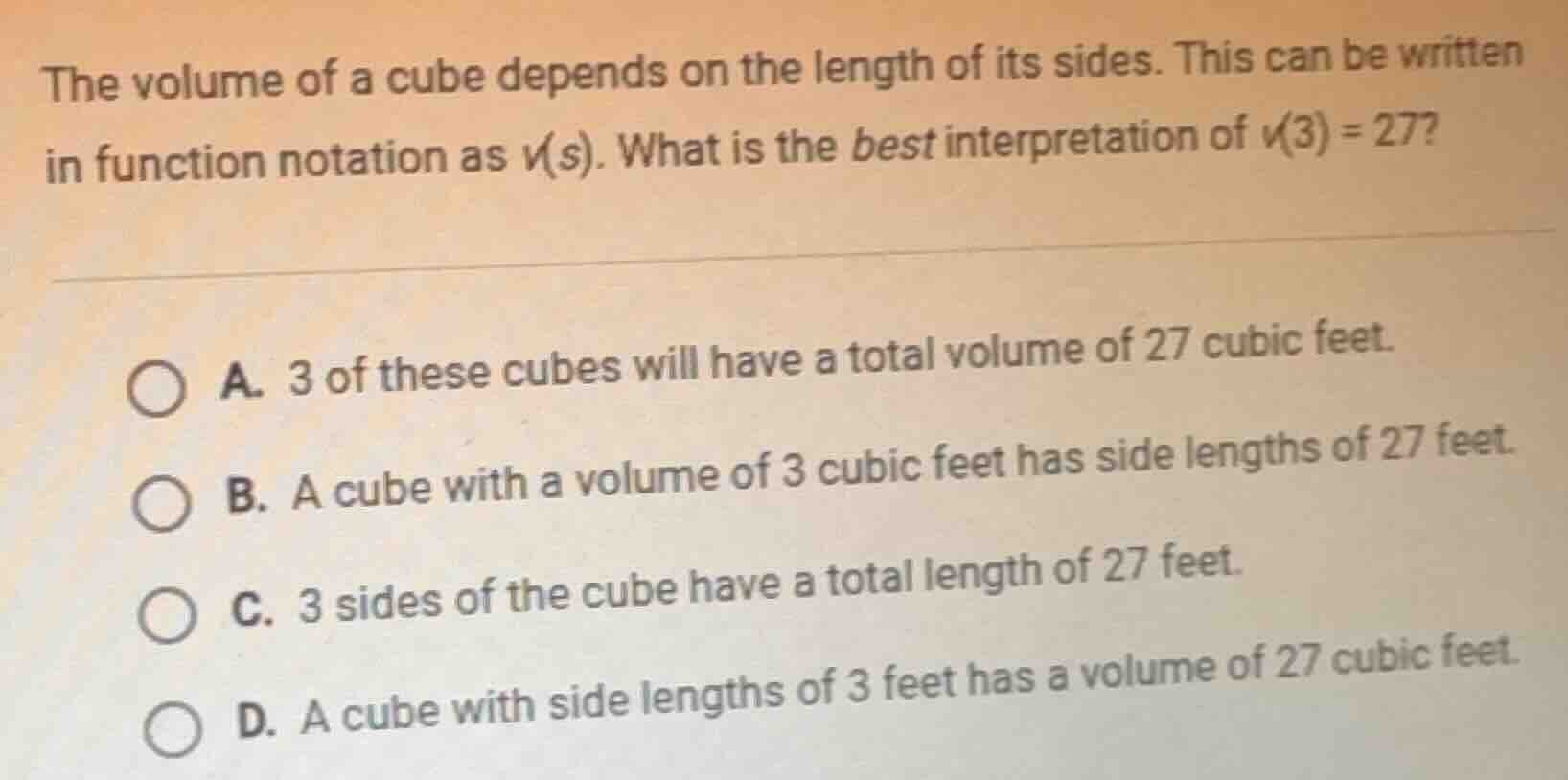
the volume of a cube depends on the length of its sides. this can be written in function notation as ( v(s) ). what is the best interpretation of ( v(3) = 27 )?
a. 3 of these cubes will have a total volume of 27 cubic feet.
b. a cube with a volume of 3 cubic feet has side lengths of 27 feet.
c. 3 sides of the cube have a total length of 27 feet.
d. a cube with side lengths of 3 feet has a volume of 27 cubic feet.
In the function \( v(s) \), \( s \) represents the side length of the cube, and \( v(s) \) represents the volume. So \( v(3) = 27 \) means when the side length \( s = 3 \) (units, say feet), the volume \( v \) is 27 (cubic feet).
- Option A is wrong because it's about 3 cubes, not a cube with side length 3.
- Option B swaps volume and side length.
- Option C is about the total length of 3 sides, not volume.
- Option D correctly interprets that a cube with side length 3 feet has a volume of 27 cubic feet.

Snap & solve any problem in the app
Get step-by-step solutions on Sovi AI
Photo-based solutions with guided steps
Explore more problems and detailed explanations
D. A cube with side lengths of 3 feet has a volume of 27 cubic feet.