QUESTION IMAGE
Question
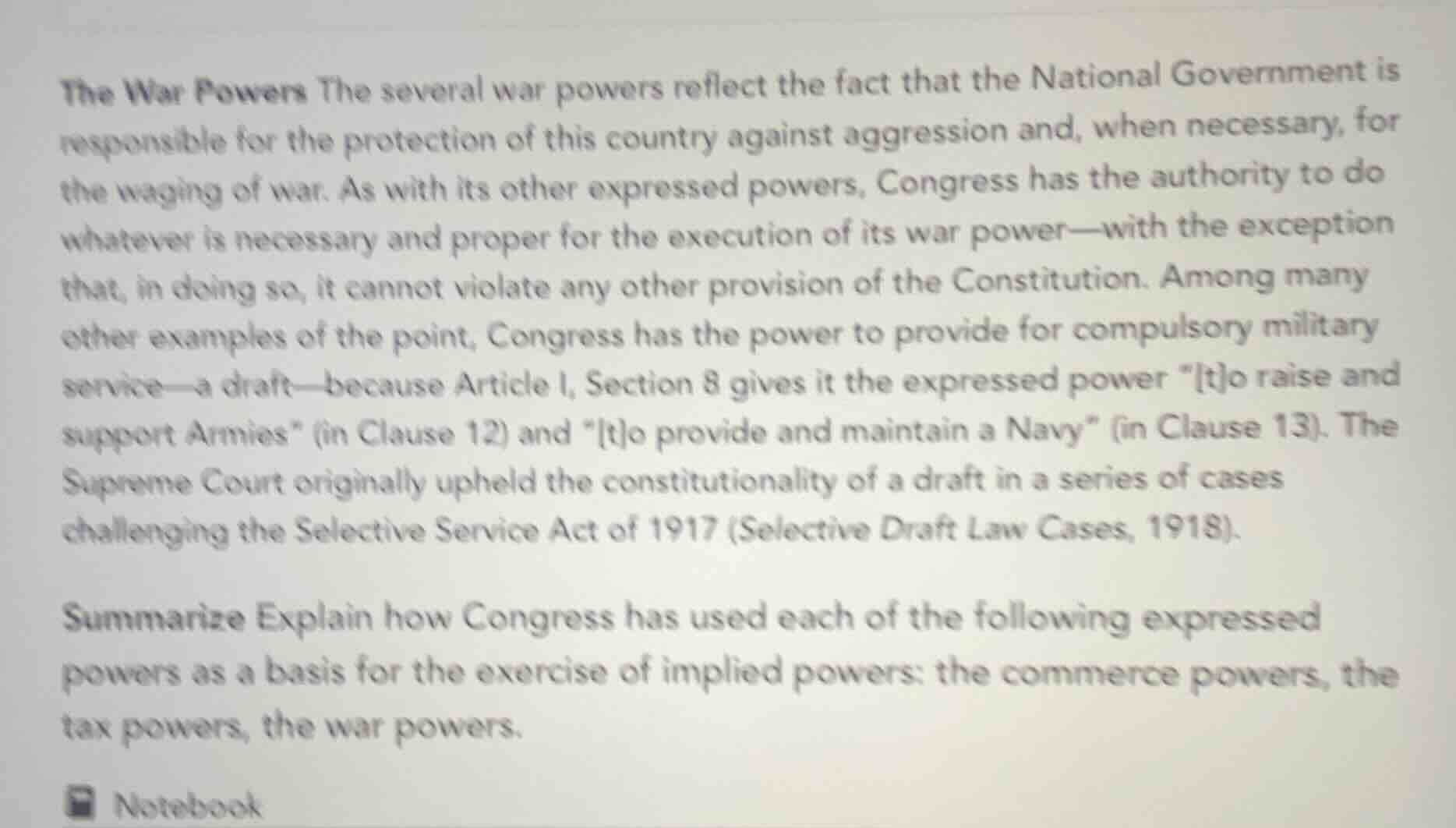
the war powers the several war powers reflect the fact that the national government is responsible for the protection of this country against aggression and, when necessary, for the waging of war. as with its other expressed powers, congress has the authority to do whatever is necessary and proper for the execution of its war power—with the exception that, in doing so, it cannot violate any other provision of the constitution. among many other examples of the point, congress has the power to provide for compulsory military service—a draft—because article i, section 8 gives it the expressed power \to raise and support armies\ (in clause 12) and \to provide and maintain a navy\ (in clause 13). the supreme court originally upheld the constitutionality of a draft in a series of cases challenging the selective service act of 1917 (selective draft law cases, 1918).
summarize explain how congress has used each of the following expressed powers as a basis for the exercise of implied powers: the commerce powers, the tax powers, the war powers.
- Commerce Powers: Congress uses its expressed power to regulate interstate/foreign commerce (Article I, Section 8, Clause 3) as a basis for implied powers. For example, it has regulated activities like local manufacturing or civil rights enforcement, arguing these substantially affect interstate commerce, extending its authority beyond direct commercial transactions.
- Tax Powers: Congress's expressed power to lay and collect taxes (Article I, Section 8, Clause 1) supports implied powers. It has used this to pass laws like the Affordable Care Act's individual mandate (originally upheld as a tax) and to fund broad domestic programs, using tax policy to achieve goals not explicitly stated in the Constitution, as long as it is for the general welfare.
- War Powers: As outlined, Congress's expressed powers to raise/support armies and maintain a navy (Article I, Section 8, Clauses 12-13) allow implied powers. A key example is instituting military conscription (the draft), upheld by the Supreme Court in Selective Draft Law Cases (1918), as this is a necessary and proper means to execute its war-related expressed powers, without violating other constitutional provisions.

Snap & solve any problem in the app
Get step-by-step solutions on Sovi AI
Photo-based solutions with guided steps
Explore more problems and detailed explanations
- Commerce Powers: Congress leverages its expressed authority to regulate interstate/foreign commerce to exercise implied powers, such as regulating local activities that impact interstate commerce or enforcing civil rights under the commerce clause.
- Tax Powers: Congress uses its expressed tax-levying power to implement implied powers, including funding domestic programs or using tax policy (like the ACA's individual mandate, initially upheld as a tax) to pursue general welfare goals not explicitly named in the Constitution.
- War Powers: Congress uses its expressed powers to raise armies and maintain a navy to exercise implied powers, most notably instituting military conscription (the draft), which was upheld as constitutional as a necessary and proper means to execute its war-related duties.