QUESTION IMAGE
Question
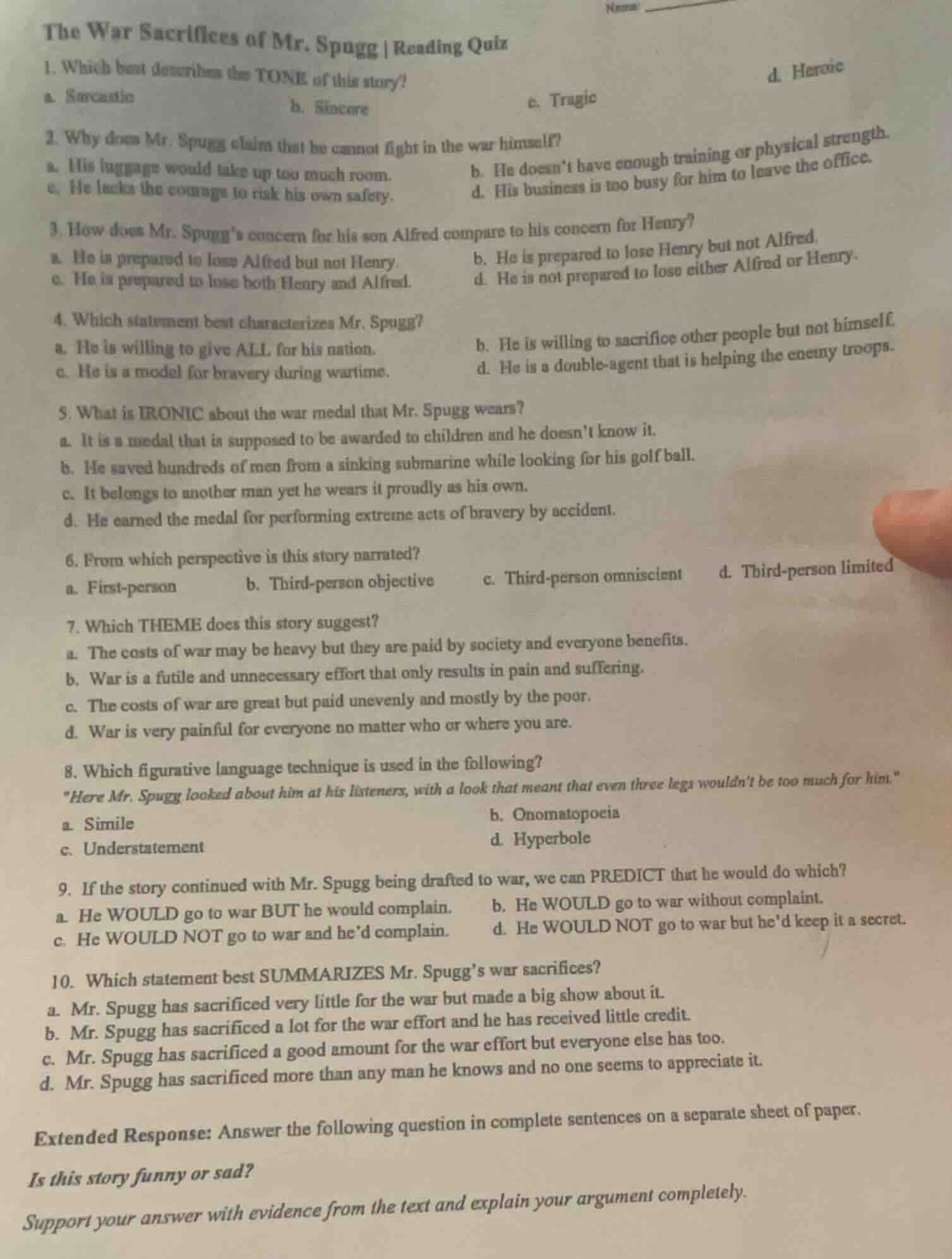
the war sacrifices of mr. spagg | reading quiz
- which best describes the tone of this story?
a. sarcastic b. sincere c. tragic d. heroic
- why does mr. spugg claim that he cannot fight in the war himself?
a. his luggage would take up too much room. b. he doesnt have enough training or physical strength.
c. he lacks the courage to risk his own safety. d. his business is too busy for him to leave the office.
- how does mr. spuggs concern for his son alfred compare to his concern for henry?
a. he is prepared to lose alfred but not henry. b. he is prepared to lose henry but not alfred.
c. he is prepared to lose both henry and alfred. d. he is not prepared to lose either alfred or henry.
- which statement best characterizes mr. spugg?
a. he is willing to give all for his nation. b. he is willing to sacrifice other people but not himself.
c. he is a model for bravery during wartime. d. he is a double - agent that is helping the enemy troops.
- what is ironic about the war medal that mr. spugg wears?
a. it is a medal that is supposed to be awarded to children and he doesnt know it.
b. he saved hundreds of men from a sinking submarine while looking for his golf ball.
c. it belongs to another man yet he wears it proudly as his own.
d. he earned the medal for performing extreme acts of bravery by accident.
- from which perspective is this story narrated?
a. first - person b. third - person objective c. third - person omniscient d. third - person limited
- which theme does this story suggest?
a. the costs of war may be heavy but they are paid by society and everyone benefits.
b. war is a futile and unnecessary effort that only results in pain and suffering.
c. the costs of war are great but paid unevenly and mostly by the poor.
d. war is very painful for everyone no matter who or where you are.
- which figurative language technique is used in the following?
\here mr. spugg looked about him at his listeners, with a look that meant that even three legs wouldnt be too much for him.\
a. simile b. onomatopoeia
c. understatement d. hyperbole
- if the story continued with mr. spugg being drafted to war, we can predict that he would do which?
a. he would go to war but he would complain. b. he would go to war without complaint.
c. he would not go to war and hed complain. d. he would not go to war but hed keep it a secret.
- which statement best summarizes mr. spuggs war sacrifices?
a. mr. spugg has sacrificed very little for the war but made a big show about it.
b. mr. spugg has sacrificed a lot for the war effort and he has received little credit.
c. mr. spugg has sacrificed a good amount for the war effort but everyone else has too.
d. mr. spugg has sacrificed more than any man he knows and no one seems to appreciate it.
extended response: answer the following question in complete sentences on a separate sheet of paper.
is this story funny or sad?
support your answer with evidence from the text and explain your argument completely.
To solve these reading comprehension questions, we analyze each based on the story "The War Sacrifices of Mr. Spagg" (assuming "Spagg" is a typo for "Spugg"):
Question 1: Tone of the Story
The story likely uses sarcasm to critique Mr. Spugg’s shallow “sacrifices.”
- Answer: a. Sarcastic
Question 2: Why Mr. Spugg Can’t Fight
Mr. Spugg’s excuse for not fighting is related to his business (he claims he can’t leave the office).
- Answer: d. His business is too busy for him to leave the office.
Question 3: Concern for Alfred vs. Henry
Mr. Spugg is willing to sacrifice others (like Henry) but not his own son (Alfred).
- Answer: b. He is prepared to lose Henry but not Alfred.
Question 4: Characterizing Mr. Spugg
Mr. Spugg sacrifices others (e.g., sending others to war) but avoids risking himself.
- Answer: b. He is willing to sacrifice other people but not himself.
Question 5: Irony of the War Medal
The medal’s irony is that he earned it accidentally (not through intentional bravery).
- Answer: d. He earned the medal for performing extreme acts of bravery by accident.
Question 6: Narrative Perspective
The story is told from a third - person omniscient view (knows thoughts/feelings of characters).
- Answer: c. Third - person omniscient
Question 7: Theme of the Story
The story suggests war’s costs are unevenly paid, mostly by the poor (Mr. Spugg sacrifices others, not himself).
- Answer: c. The costs of war are great but paid unevenly and mostly by the poor.
Question 8: Figurative Language
The phrase “even three legs wouldn’t be too much for him” exaggerates (hyperbole) his supposed capability.
- Answer: d. Hyperbole
Question 9: Prediction if Drafted
Mr. Spugg would avoid war and complain (consistent with his self - serving nature).
- Answer: c. He WOULD NOT go to war and he’d complain.
Question 10: Summarizing Mr. Spugg’s Sacrifices
Mr. Spugg’s “sacrifices” are minimal but he makes a big show of them (sarcastic tone).
- Answer: a. Mr. Spugg has sacrificed very little for the war but made a big show about it.
Extended Response: Funny or Sad?
The story is funny (sarcastic) because it mocks Mr. Spugg’s hypocrisy. For example, he avoids war himself but sends others, and his “sacrifices” (like wearing a medal earned by accident) are absurd. The irony of his self - serving actions creates humor as a critique of shallow patriotism. Alternatively, it could be sad if viewed as a commentary on how war exploits the vulnerable while the wealthy avoid sacrifice. Evidence like his refusal to fight, willingness to sacrifice others, and empty posturing supports either interpretation (but sarcasm leans toward “funny” as a critique).
(Note: For the extended response, structure your answer with a clear claim, evidence from the text, and explanation.)

Snap & solve any problem in the app
Get step-by-step solutions on Sovi AI
Photo-based solutions with guided steps
Explore more problems and detailed explanations
To solve these reading comprehension questions, we analyze each based on the story "The War Sacrifices of Mr. Spagg" (assuming "Spagg" is a typo for "Spugg"):
Question 1: Tone of the Story
The story likely uses sarcasm to critique Mr. Spugg’s shallow “sacrifices.”
- Answer: a. Sarcastic
Question 2: Why Mr. Spugg Can’t Fight
Mr. Spugg’s excuse for not fighting is related to his business (he claims he can’t leave the office).
- Answer: d. His business is too busy for him to leave the office.
Question 3: Concern for Alfred vs. Henry
Mr. Spugg is willing to sacrifice others (like Henry) but not his own son (Alfred).
- Answer: b. He is prepared to lose Henry but not Alfred.
Question 4: Characterizing Mr. Spugg
Mr. Spugg sacrifices others (e.g., sending others to war) but avoids risking himself.
- Answer: b. He is willing to sacrifice other people but not himself.
Question 5: Irony of the War Medal
The medal’s irony is that he earned it accidentally (not through intentional bravery).
- Answer: d. He earned the medal for performing extreme acts of bravery by accident.
Question 6: Narrative Perspective
The story is told from a third - person omniscient view (knows thoughts/feelings of characters).
- Answer: c. Third - person omniscient
Question 7: Theme of the Story
The story suggests war’s costs are unevenly paid, mostly by the poor (Mr. Spugg sacrifices others, not himself).
- Answer: c. The costs of war are great but paid unevenly and mostly by the poor.
Question 8: Figurative Language
The phrase “even three legs wouldn’t be too much for him” exaggerates (hyperbole) his supposed capability.
- Answer: d. Hyperbole
Question 9: Prediction if Drafted
Mr. Spugg would avoid war and complain (consistent with his self - serving nature).
- Answer: c. He WOULD NOT go to war and he’d complain.
Question 10: Summarizing Mr. Spugg’s Sacrifices
Mr. Spugg’s “sacrifices” are minimal but he makes a big show of them (sarcastic tone).
- Answer: a. Mr. Spugg has sacrificed very little for the war but made a big show about it.
Extended Response: Funny or Sad?
The story is funny (sarcastic) because it mocks Mr. Spugg’s hypocrisy. For example, he avoids war himself but sends others, and his “sacrifices” (like wearing a medal earned by accident) are absurd. The irony of his self - serving actions creates humor as a critique of shallow patriotism. Alternatively, it could be sad if viewed as a commentary on how war exploits the vulnerable while the wealthy avoid sacrifice. Evidence like his refusal to fight, willingness to sacrifice others, and empty posturing supports either interpretation (but sarcasm leans toward “funny” as a critique).
(Note: For the extended response, structure your answer with a clear claim, evidence from the text, and explanation.)