QUESTION IMAGE
Question
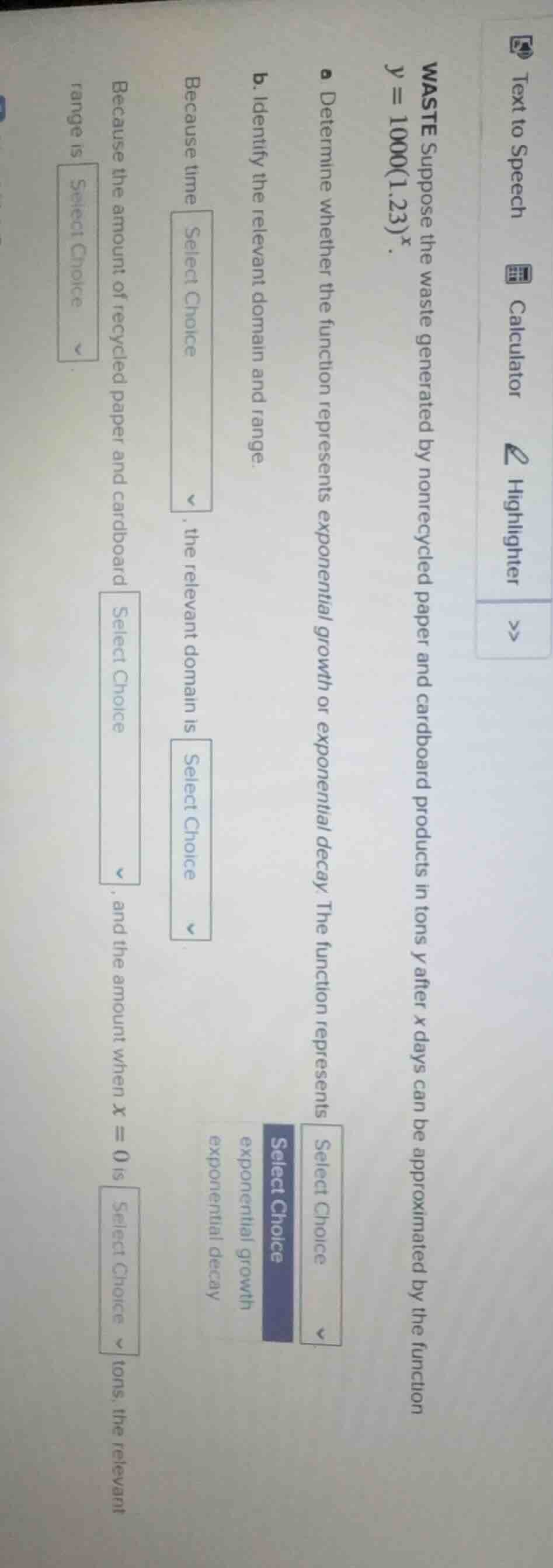
waste suppose the waste generated by nonrecycled paper and cardboard products in tons $y$ after $x$ days can be approximated by the function $y = 1000(1.23)^x$.
a. determine whether the function represents exponential growth or exponential decay. the function represents $\boldsymbol{\text{select choice}}$
options:
exponential growth
exponential decay
b. identify the relevant domain and range.
because time $\boldsymbol{\text{select choice}}$, the relevant domain is $\boldsymbol{\text{select choice}}$
because the amount of recycled paper and cardboard $\boldsymbol{\text{select choice}}$, and the amount when $x = 0$ is $\boldsymbol{\text{select choice}}$ tons, the relevant range is $\boldsymbol{\text{select choice}}$.
Step1: Classify exponential function
An exponential function has the form $y = a(b)^x$. If $b>1$, it is growth; if $0
Step2: Define relevant domain
Time $x$ cannot be negative, so $x$ is non-negative real numbers.
Step3: Define relevant range
At $x=0$, $y=1000(1.23)^0=1000$. As $x$ increases, $y$ increases without bound, so $y\geq1000$.

Snap & solve any problem in the app
Get step-by-step solutions on Sovi AI
Photo-based solutions with guided steps
Explore more problems and detailed explanations
a. exponential growth
b. Relevant domain: All non-negative real numbers ($x\geq0$)
Relevant range: All real numbers greater than or equal to 1000 ($y\geq1000$)
When $x=0$: 1000 tons