QUESTION IMAGE
Question
- water cycle
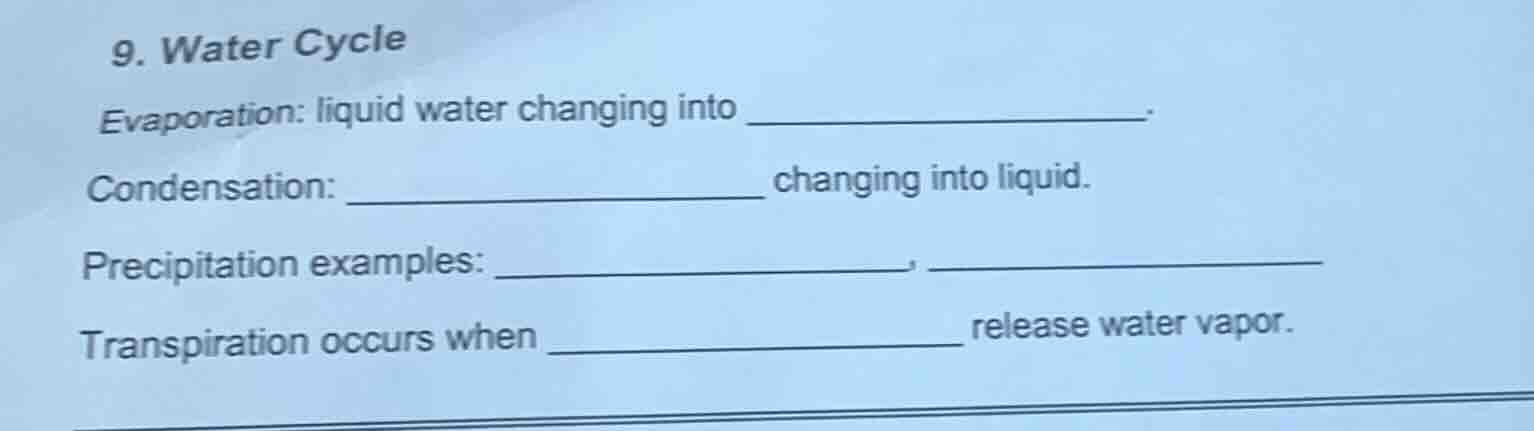
evaporation: liquid water changing into ______________.
condensation: ______________ changing into liquid.
precipitation examples: ____________, ____________
transpiration occurs when ______________ release water vapor.
Brief Explanations
- Evaporation: In the water cycle, evaporation is the process where liquid water gains energy (usually from heat, like solar energy) and changes its state to water vapor (a gas). So the blank here should be filled with "water vapor (or gaseous water)".
- Condensation: Condensation is the opposite of evaporation. It's when water vapor (gas) loses energy and changes back into liquid water. So the blank is "water vapor (or gaseous water)".
- Precipitation examples: Precipitation is any form of water, liquid or solid, that falls from clouds to the Earth's surface. Common examples include rain (liquid water droplets), snow (solid ice crystals), sleet (a mix or transition between rain and snow), and hail (solid ice pellets). So we can fill in two common ones like "rain" and "snow" (other valid ones could be sleet, hail etc.).
- Transpiration: Transpiration is the process by which plants (specifically through their leaves, using structures called stomata) release water vapor into the atmosphere. So the blank is "plants (or plant leaves)".

Snap & solve any problem in the app
Get step-by-step solutions on Sovi AI
Photo-based solutions with guided steps
Explore more problems and detailed explanations
- Evaporation: liquid water changing into $\boldsymbol{\text{water vapor (gaseous water)}}$.
- Condensation: $\boldsymbol{\text{water vapor (gaseous water)}}$ changing into liquid.
- Precipitation examples: $\boldsymbol{\text{rain}}$, $\boldsymbol{\text{snow}}$ (other valid answers: sleet, hail, etc.)
- Transpiration occurs when $\boldsymbol{\text{plants (plant leaves)}}$ release water vapor.