QUESTION IMAGE
Question
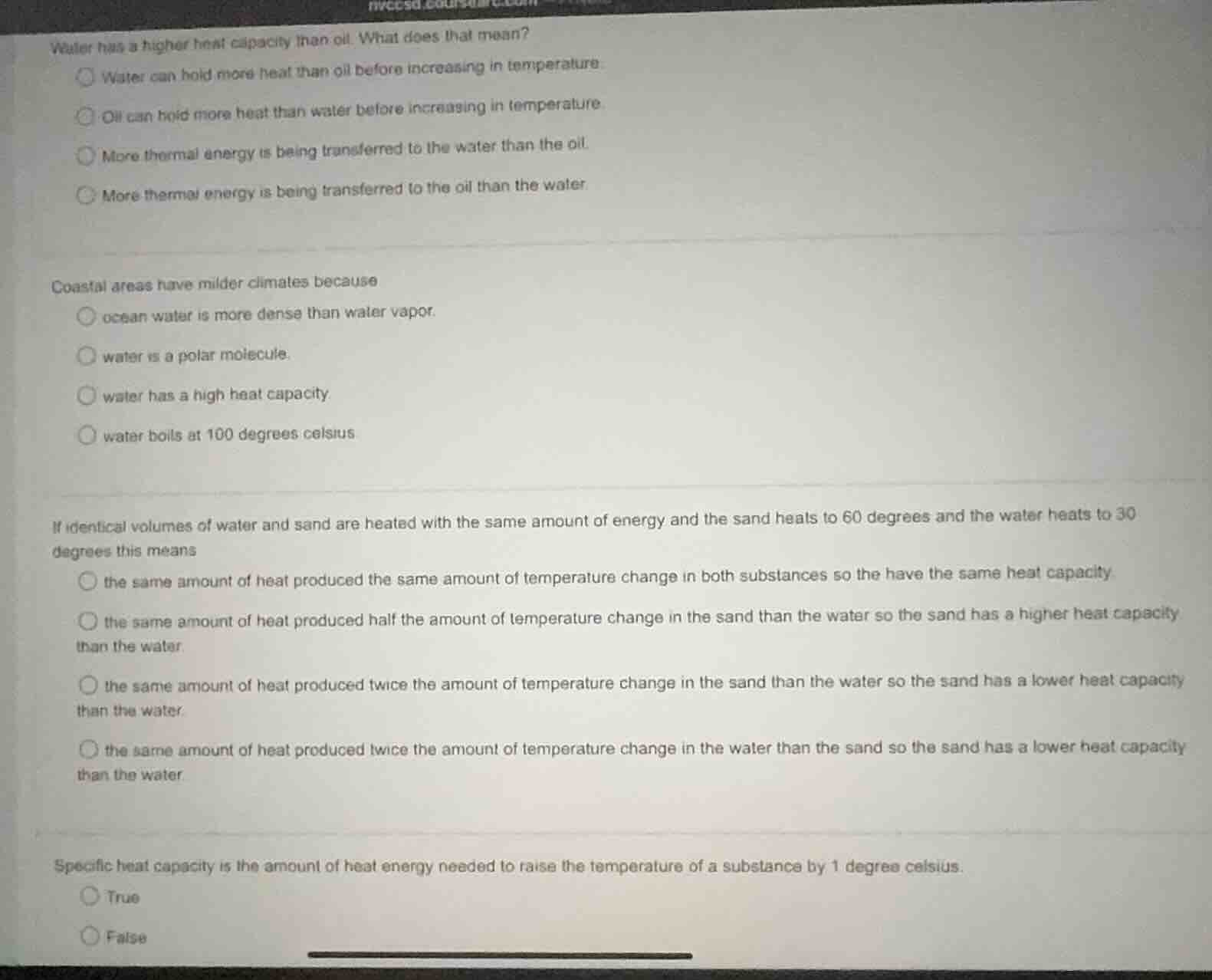
water has a higher heat capacity than oil. what does that mean?
water can hold more heat than oil before increasing in temperature.
oil can hold more heat than water before increasing in temperature.
more thermal energy is being transferred to the water than the oil.
more thermal energy is being transferred to the oil than the water.
coastal areas have milder climates because
ocean water is more dense than water vapor.
water is a polar molecule.
water has a high heat capacity
water boils at 100 degrees celsius
if identical volumes of water and sand are heated with the same amount of energy and the sand heats to 60 degrees and the water heats to 30 degrees this means
the same amount of heat produced the same amount of temperature change in both substances so the have the same heat capacity
the same amount of heat produced half the amount of temperature change in the sand than the water so the sand has a higher heat capacity than the water
the same amount of heat produced twice the amount of temperature change in the sand than the water so the sand has a lower heat capacity than the water.
the same amount of heat produced twice the amount of temperature change in the water than the sand so the sand has a lower heat capacity than the water
specific heat capacity is the amount of heat energy needed to raise the temperature of a substance by 1 degree celsius.
true
false
First Question (Water has a higher heat capacity than oil. What does that mean?)
Heat capacity is the amount of heat required to raise the temperature of a substance. A higher heat capacity means a substance can absorb more heat before its temperature increases. So water, with higher heat capacity than oil, can hold more heat before temperature rise. The other options are incorrect: oil can't hold more heat (opposite of heat capacity definition), and heat transfer amount isn't determined by heat capacity alone (it depends on time, source, etc.).
Coastal areas have milder climates because water has a high heat capacity. It absorbs and releases heat slowly, moderating temperature changes. Ocean water density vs vapor, water being polar, or boiling point don't relate to climate moderation from water's heat - holding ability.
The temperature change of sand (60 - initial, assuming initial same) is twice that of water (30 - initial). Heat capacity is inversely related to temperature change for the same heat input ($Q = mc\Delta T$, same $Q$, $m$ related to volume/density, but here we see $\Delta T_{sand}=2\Delta T_{water}$). So same heat produces twice the temp change in sand, meaning sand has lower heat capacity (since lower $c$ means more $\Delta T$ for same $Q$).

Snap & solve any problem in the app
Get step-by-step solutions on Sovi AI
Photo-based solutions with guided steps
Explore more problems and detailed explanations
A. Water can hold more heat than oil before increasing in temperature