QUESTION IMAGE
Question
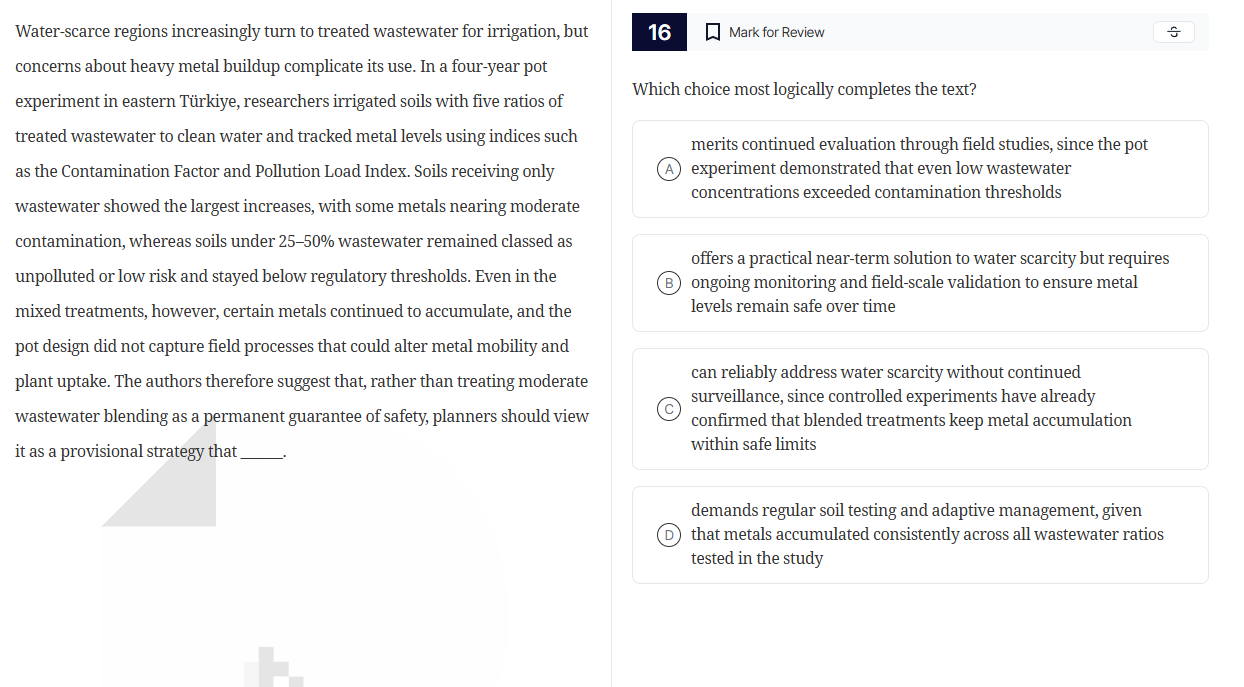
water - scarce regions increasingly turn to treated wastewater for irrigation, but concerns about heavy metal buildup complicate its use. in a four - year pot experiment in eastern türkiye, researchers irrigated soils with five ratios of treated wastewater to clean water and tracked metal levels using indices such as the contamination factor and pollution load index. soils receiving only wastewater showed the largest increases, with some metals nearing moderate contamination, whereas soils under 25 - 50% wastewater remained classed as unpolluted or low risk and stayed below regulatory thresholds. even in the mixed treatments, however, certain metals continued to accumulate, and the pot design did not capture field processes that could alter metal mobility and plant uptake. the authors therefore suggest that, rather than treating moderate wastewater blending as a permanent guarantee of safety, planners should view it as a provisional strategy that ______.
16
mark for review
which choice most logically completes the text?
a merits continued evaluation through field studies, since the pot experiment demonstrated that even low wastewater concentrations exceeded contamination thresholds
b offers a practical near - term solution to water scarcity but requires ongoing monitoring and field - scale validation to ensure metal levels remain safe over time
c can reliably address water scarcity without continued surveillance, since controlled experiments have already confirmed that blended treatments keep metal accumulation within safe limits
d demands regular soil testing and adaptive management, given that metals accumulated consistently across all wastewater ratios tested in the study
To solve this, we analyze each option:
- Option A: The pot experiment showed low wastewater concentrations could exceed thresholds, so continued field studies (evaluation) make sense for a provisional strategy. The text says the pot design didn't capture field processes, so moving to field studies is logical.
- Option B: The text shows even mixed treatments had metal accumulation, and the pot experiment has limitations. Saying it "offers a practical near - term solution" is inconsistent with the need for caution due to metal accumulation and pot experiment limitations.
- Option C: The text states certain metals accumulated even in mixed treatments and the pot design has issues. So claiming it can "reliably address water scarcity without continued surveillance" is wrong.
- Option D: The study showed soils with 25 - 50% wastewater stayed below thresholds, so "metals accumulated consistently across all ratios" is false.

Snap & solve any problem in the app
Get step-by-step solutions on Sovi AI
Photo-based solutions with guided steps
Explore more problems and detailed explanations
A. merits continued evaluation through field studies, since the pot experiment demonstrated that even low wastewater concentrations exceeded contamination thresholds