QUESTION IMAGE
Question
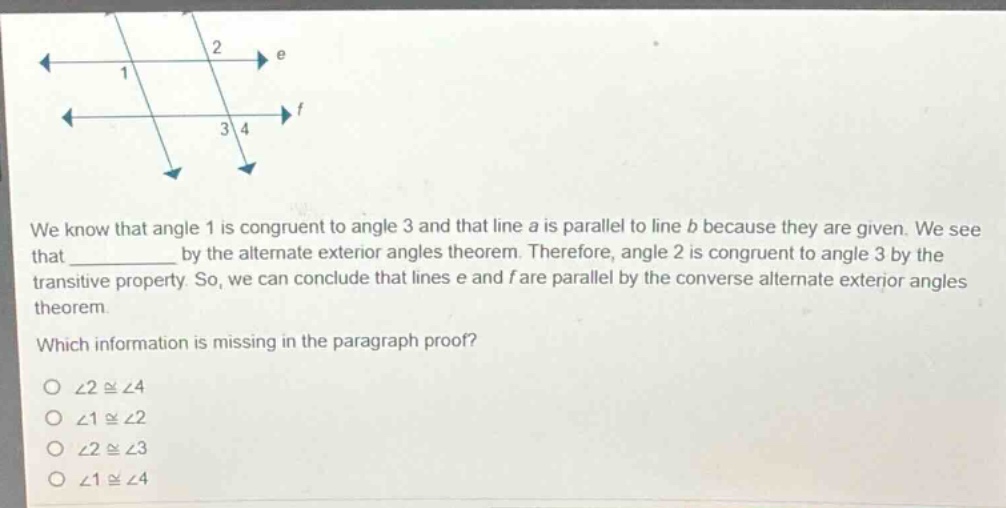
we know that angle 1 is congruent to angle 3 and that line a is parallel to line b because they are given. we see that ______ by the alternate exterior angles theorem. therefore, angle 2 is congruent to angle 3 by the transitive property. so, we can conclude that lines e and f are parallel by the converse alternate exterior angles theorem. which information is missing in the paragraph proof? \\(\bigcirc\\) \\(\angle 2 \cong \angle 4\\) \\(\bigcirc\\) \\(\angle 1 \cong \angle 2\\) \\(\bigcirc\\) \\(\angle 2 \cong \angle 3\\) \\(\bigcirc\\) \\(\angle 1 \cong \angle 4\\)
To determine the missing information, we analyze the proof:
- We know \( \angle 1 \cong \angle 3 \) (given) and need to apply the alternate exterior angles theorem. The alternate exterior angles theorem states that if two parallel lines are cut by a transversal, then alternate exterior angles are congruent. Here, lines \( a \) and \( b \) are parallel (given), so the alternate exterior angles formed by transversal (for \( \angle 1 \) and \( \angle 2 \)) should be congruent. So we need \( \angle 1 \cong \angle 2 \) to use the alternate exterior angles theorem (since \( \angle 1 \) and \( \angle 2 \) would be alternate exterior angles for parallel lines \( a \) and \( b \)). Then, using transitivity (\( \angle 1 \cong \angle 3 \) and \( \angle 1 \cong \angle 2 \)), we get \( \angle 2 \cong \angle 3 \), which leads to \( e \parallel f \).
- Checking other options:
- \( \angle 2 \cong \angle 4 \): Vertical angles, but not needed here.
- \( \angle 2 \cong \angle 3 \): This is the result of transitivity, not the step from the alternate exterior angles theorem.
- \( \angle 1 \cong \angle 4 \): Not related to alternate exterior angles for lines \( a \) and \( b \).
So the missing step is \( \angle 1 \cong \angle 2 \) as it's needed for the alternate exterior angles theorem application.

Snap & solve any problem in the app
Get step-by-step solutions on Sovi AI
Photo-based solutions with guided steps
Explore more problems and detailed explanations
B. \( \angle 1 \cong \angle 2 \)