QUESTION IMAGE
Question
weathering, erosion or deposition?
group cardsort
name: zanna due tues
date: ______ per: 1/13
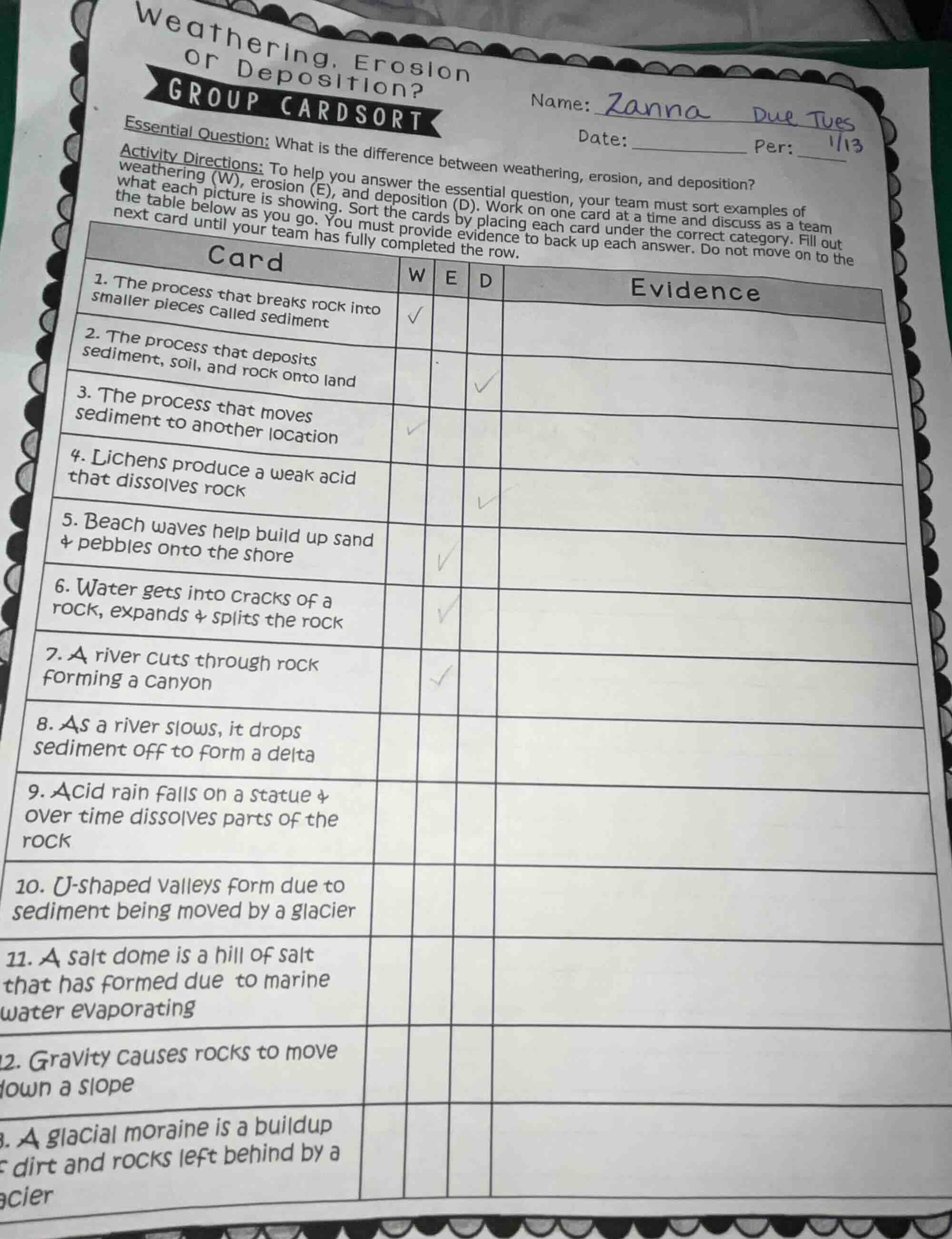
essential question: what is the difference between weathering, erosion, and deposition?
activity directions: to help you answer the essential question, your team must sort examples of weathering (w), erosion (e), and deposition (d). work on one card at a time and discuss as a team what each picture is showing. sort the cards by placing each card under the correct category. fill out the table below as you go. you must provide evidence to back up each answer. do not move on to the next card until your team has fully completed the row.
| card | w | e | d | evidence |
|---|---|---|---|---|
| 2. the process that deposits sediment, soil, and rock onto land | √ | |||
| 3. the process that moves sediment to another location | √ | |||
| 4. lichens produce a weak acid that dissolves rock | √ | |||
| 5. beach waves help build up sand & pebbles onto the shore | √ | |||
| 6. water gets into cracks of a rock, expands & splits the rock | √ | |||
| 7. a river cuts through rock forming a canyon | √ | |||
| 8. as a river slows, it drops sediment off to form a delta | ||||
| 9. acid rain falls on a statue & over time dissolves parts of the rock | ||||
| 10. u - shaped valleys form due to sediment being moved by a glacier | ||||
| 11. a salt dome is a hill of salt that has formed due to marine water evaporating | ||||
| 12. gravity causes rocks to move down a slope | ||||
| 13. a glacial moraine is a buildup of dirt and rocks left behind by a glacier |
First, define each process:
- Weathering (W): Breaks rock into smaller pieces (sediment) in place, no movement of the broken material away.
- Erosion (E): Moves sediment/rock from one location to another.
- Deposition (D): Drops or lays down sediment/rock in a new location.
Then categorize each card and provide evidence based on the definitions:
- Matches the core definition of weathering (breaking rock into sediment).
- Matches the core definition of deposition (depositing sediment/rock on land).
- Matches the core definition of erosion (moving sediment to a new location).
- Lichens dissolve rock in place, breaking it down without moving it.
- Waves build up sand/pebbles by depositing them on the shore.
- Water splits rock in place, breaking it down without moving the pieces.
- A river moves sediment by cutting through rock, transporting it away.
- A river slows and drops sediment to form a delta, laying it down.
- Acid rain dissolves rock in place, breaking it down without movement.
- A glacier moves sediment to carve the valley, transporting material.
- Evaporating marine water leaves salt behind, depositing it into a dome.
- Gravity moves rocks down a slope, transporting them to a new location.
- A glacier leaves dirt/rocks behind, depositing the material.

Snap & solve any problem in the app
Get step-by-step solutions on Sovi AI
Photo-based solutions with guided steps
Explore more problems and detailed explanations
| Card | W | E | D | Evidence |
|---|---|---|---|---|
| 2. The process that deposits sediment, soil, and rock onto land | ✓ | Lays down sediment in a new area | ||
| 3. The process that moves sediment to another location | ✓ | Moves sediment to a new location | ||
| 4. Lichens produce a weak acid that dissolves rock | ✓ | Dissolves rock in place (no movement) | ||
| 5. Beach waves help build up sand & pebbles onto the shore | ✓ | Deposits sand/pebbles on the shore | ||
| 6. Water gets into cracks of a rock, expands & splits the rock | ✓ | Splits rock in place (no movement) | ||
| 7. A river cuts through rock forming a canyon | ✓ | Moves sediment by cutting through rock | ||
| 8. As a river slows, it drops sediment off to form a delta | ✓ | Drops sediment to form a delta | ||
| 9. Acid rain falls on a statue & over time dissolves parts of the rock | ✓ | Dissolves rock in place (no movement) | ||
| 10. U-shaped valleys form due to sediment being moved by a glacier | ✓ | Glacier moves sediment to carve the valley | ||
| 11. A salt dome is a hill of salt that has formed due to marine water evaporating | ✓ | Evaporation leaves salt deposited | ||
| 12. Gravity causes rocks to move down a slope | ✓ | Moves rocks to a lower location | ||
| 13. A glacial moraine is a buildup of dirt and rocks left behind by a glacier | ✓ | Glacier deposits leftover dirt/rocks |