QUESTION IMAGE
Question
wednesday
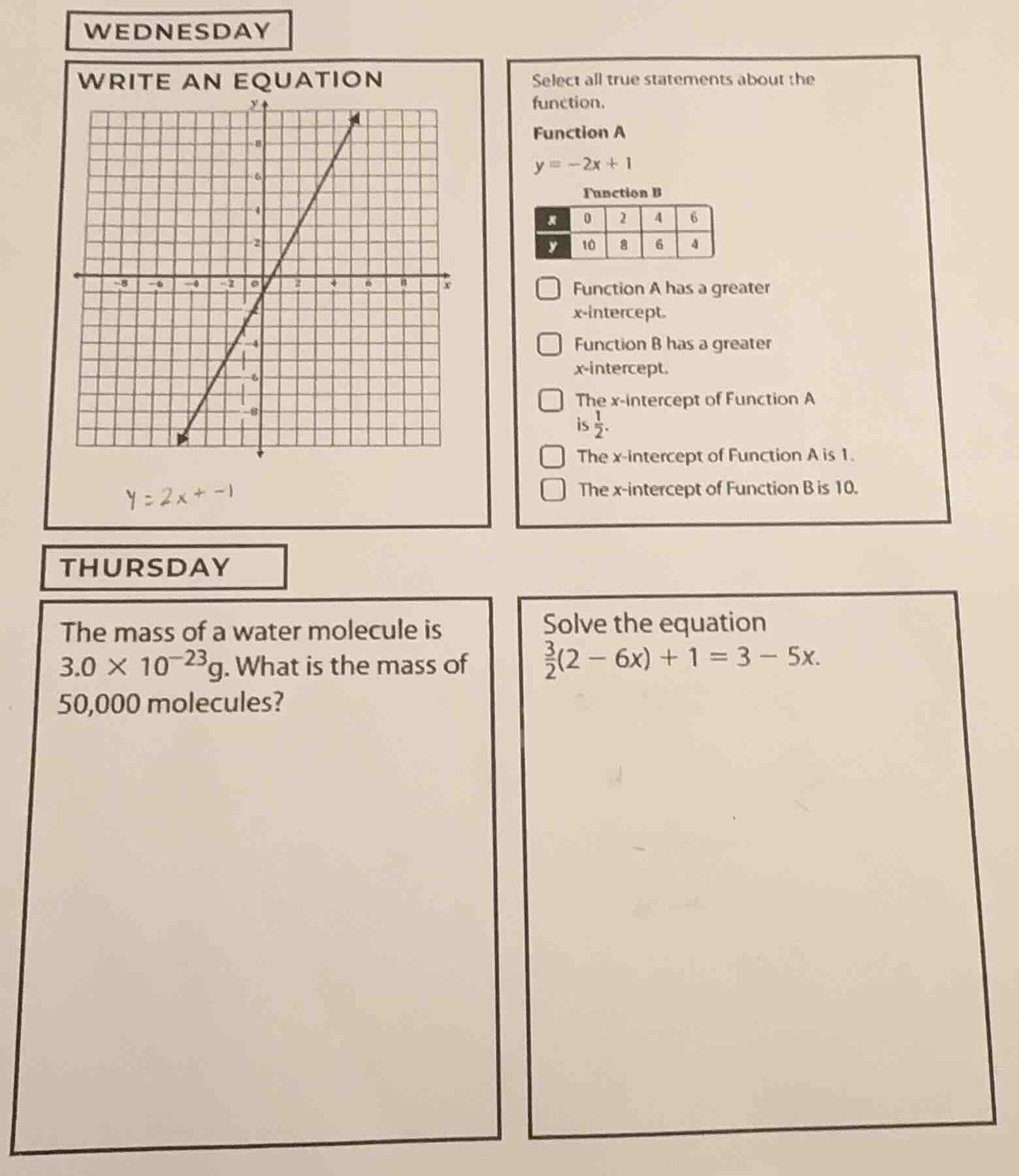
write an equation
graph of a line
y = 2x + -1
select all true statements about the
function.
function a
y = -2x + 1
function b
| x | 0 | 2 | 4 | 6 |
| y | 10 | 8 | 6 | 4 |
- function a has a greater x - intercept.
- function b has a greater x - intercept.
- the x - intercept of function a is 1/2.
- the x - intercept of function a is 1.
- the x - intercept of function b is 10.
thursday
the mass of a water molecule is 3.0 × 10⁻²³ g. what is the mass of 50,000 molecules?
solve the equation (3/2)(2 - 6x) + 1 = 3 - 5x.
Sub - question 1: Write an equation for the graph (Wednesday - Write an Equation)
Step 1: Identify the slope
The graph passes through the origin \((0,0)\) and another point, say \((1,2)\) (by looking at the grid). The slope \(m\) is calculated as \(\frac{y_2 - y_1}{x_2 - x_1}\). Using \((0,0)\) and \((1,2)\), \(m=\frac{2 - 0}{1 - 0}=2\).
Step 2: Identify the y - intercept
The line passes through \((0,0)\), so the y - intercept \(b = 0\).
Step 3: Write the equation
Using the slope - intercept form \(y=mx + b\), with \(m = 2\) and \(b=0\), the equation is \(y = 2x\). Wait, but the original hand - written equation is \(y = 2x-1\). Let's re - check. If we take two points, say \((0, - 1)\) and \((1,1)\), the slope \(m=\frac{1-(-1)}{1 - 0}=\frac{2}{1}=2\), and the y - intercept \(b=-1\). So the correct equation using slope - intercept form \(y = mx + b\) is \(y=2x - 1\).
First, find the x - intercept of Function A (\(y=-2x + 1\)):
Set \(y = 0\), then \(0=-2x + 1\), \(2x=1\), \(x=\frac{1}{2}\).
For Function B, we have the table:
| \(x\) | \(0\) | \(2\) | \(4\) | \(6\) |
|---|
The slope \(m\) of Function B: Using \((0,10)\) and \((2,8)\), \(m=\frac{8 - 10}{2 - 0}=\frac{-2}{2}=-1\). The equation of Function B is \(y-10=-1(x - 0)\), so \(y=-x + 10\).
To find the x - intercept of Function B, set \(y = 0\): \(0=-x + 10\), \(x = 10\).
Now let's analyze each statement:
- "Function A has a greater x - intercept": The x - intercept of A is \(\frac{1}{2}\), of B is \(10\). So this is false.
- "Function B has a greater x - intercept": Since \(10>\frac{1}{2}\), this is true.
- "The x - intercept of Function A is \(\frac{1}{2}\)": We found \(x=\frac{1}{2}\) when \(y = 0\) for \(y=-2x + 1\), so this is true.
- "The x - intercept of Function A is 1": We found it is \(\frac{1}{2}\), so this is false.
- "The x - intercept of Function B is 10": We found \(x = 10\) when \(y = 0\) for \(y=-x + 10\), so this is true.
Step 1: Recall the formula for total mass
The total mass \(M\) of \(n\) molecules is given by \(M=n\times m\), where \(n\) is the number of molecules and \(m\) is the mass of one molecule.
Step 2: Substitute the values
Given \(m = 3.0\times10^{-23}\space g\) and \(n = 50000=5\times10^{4}\).
\(M=(5\times10^{4})\times(3.0\times10^{-23})\)
Using the rule of exponents \(a^m\times a^n=a^{m + n}\), we have \(M=(5\times3.0)\times10^{4+( - 23)}=15\times10^{-19}=1.5\times10^{-18}\space g\)

Snap & solve any problem in the app
Get step-by-step solutions on Sovi AI
Photo-based solutions with guided steps
Explore more problems and detailed explanations
\(y = 2x-1\)