QUESTION IMAGE
Question
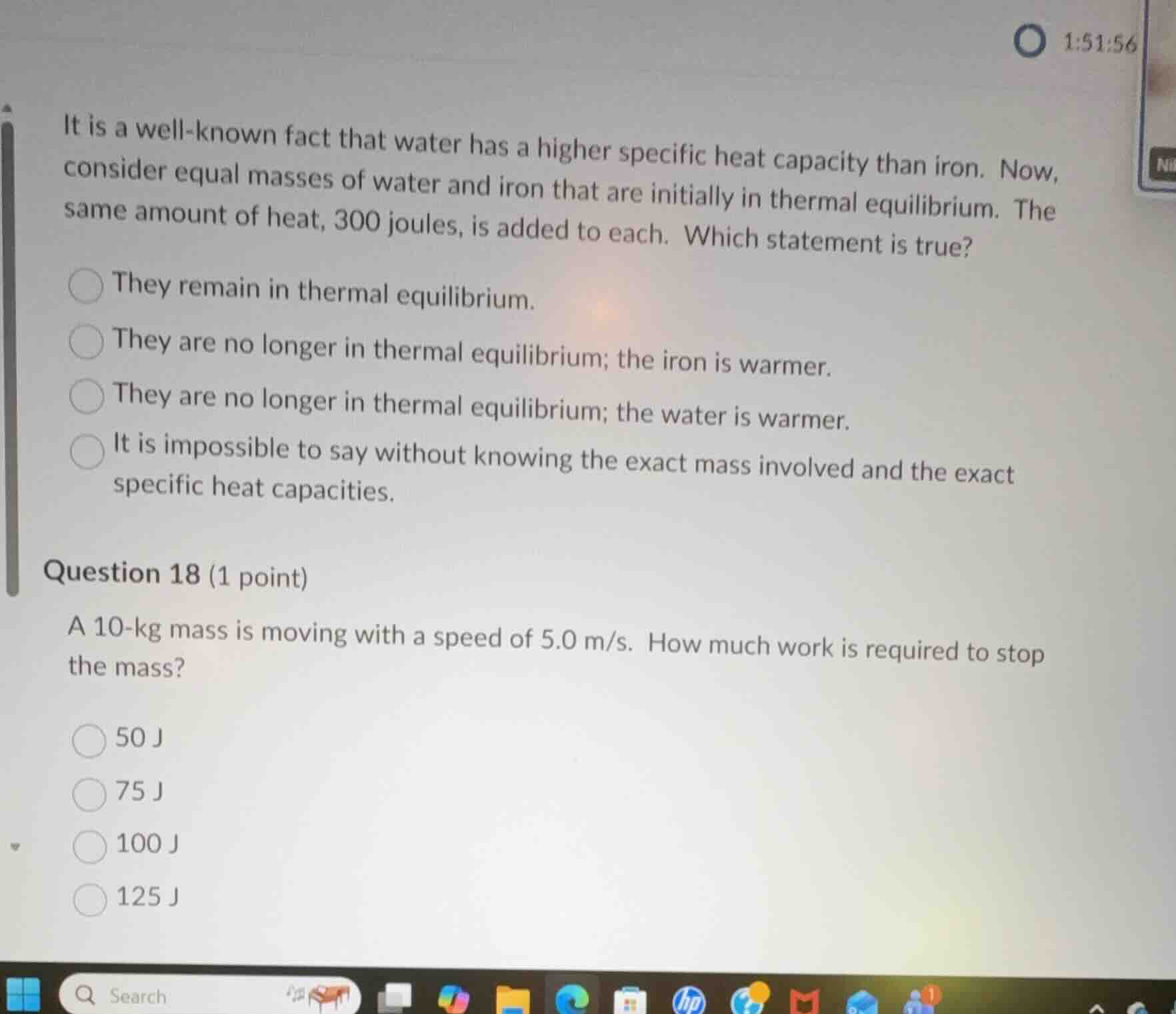
it is a well - known fact that water has a higher specific heat capacity than iron. now, consider equal masses of water and iron that are initially in thermal equilibrium. the same amount of heat, 300 joules, is added to each. which statement is true?
they remain in thermal equilibrium.
they are no longer in thermal equilibrium; the iron is warmer.
they are no longer in thermal equilibrium; the water is warmer.
it is impossible to say without knowing the exact mass involved and the exact specific heat capacities.
question 18 (1 point)
a 10 - kg mass is moving with a speed of 5.0 m/s. how much work is required to stop the mass?
50 j
75 j
100 j
125 j
First Question (Thermal Equilibrium)
The formula for heat transfer is \( Q = mc\Delta T \), where \( Q \) is heat, \( m \) is mass, \( c \) is specific heat capacity, and \( \Delta T \) is temperature change. Given equal mass (\( m \)) and equal heat (\( Q \)) added, \( \Delta T=\frac{Q}{mc} \). Since water has higher \( c \) than iron, \( \Delta T \) for iron is larger. Initially in equilibrium (same temperature), after heating, iron’s temperature rises more, so it’s warmer and they’re no longer in equilibrium.
Step1: Recall Work - Energy Theorem
The work - energy theorem states that the work done on an object is equal to the change in its kinetic energy. The formula for kinetic energy is \( KE=\frac{1}{2}mv^{2} \), and the work \( W \) required to stop the mass is equal to the negative of the initial kinetic energy (since we want to change the kinetic energy from \( \frac{1}{2}mv^{2} \) to 0). So \( W = \Delta KE=0 - \frac{1}{2}mv^{2}=-\frac{1}{2}mv^{2} \). The magnitude of the work is \( \frac{1}{2}mv^{2} \).
Step2: Substitute Values
We know that \( m = 10\space kg \) and \( v = 5.0\space m/s \). Substitute these values into the formula for kinetic energy (which is equal to the magnitude of the work needed to stop the mass):
\( W=\frac{1}{2}\times10\space kg\times(5.0\space m/s)^{2} \)
First, calculate \( (5.0\space m/s)^{2}=25\space m^{2}/s^{2} \). Then, \( \frac{1}{2}\times10 = 5 \). Then, \( 5\times25=125\space J \).

Snap & solve any problem in the app
Get step-by-step solutions on Sovi AI
Photo-based solutions with guided steps
Explore more problems and detailed explanations
They are no longer in thermal equilibrium; the iron is warmer.