QUESTION IMAGE
Question
wh
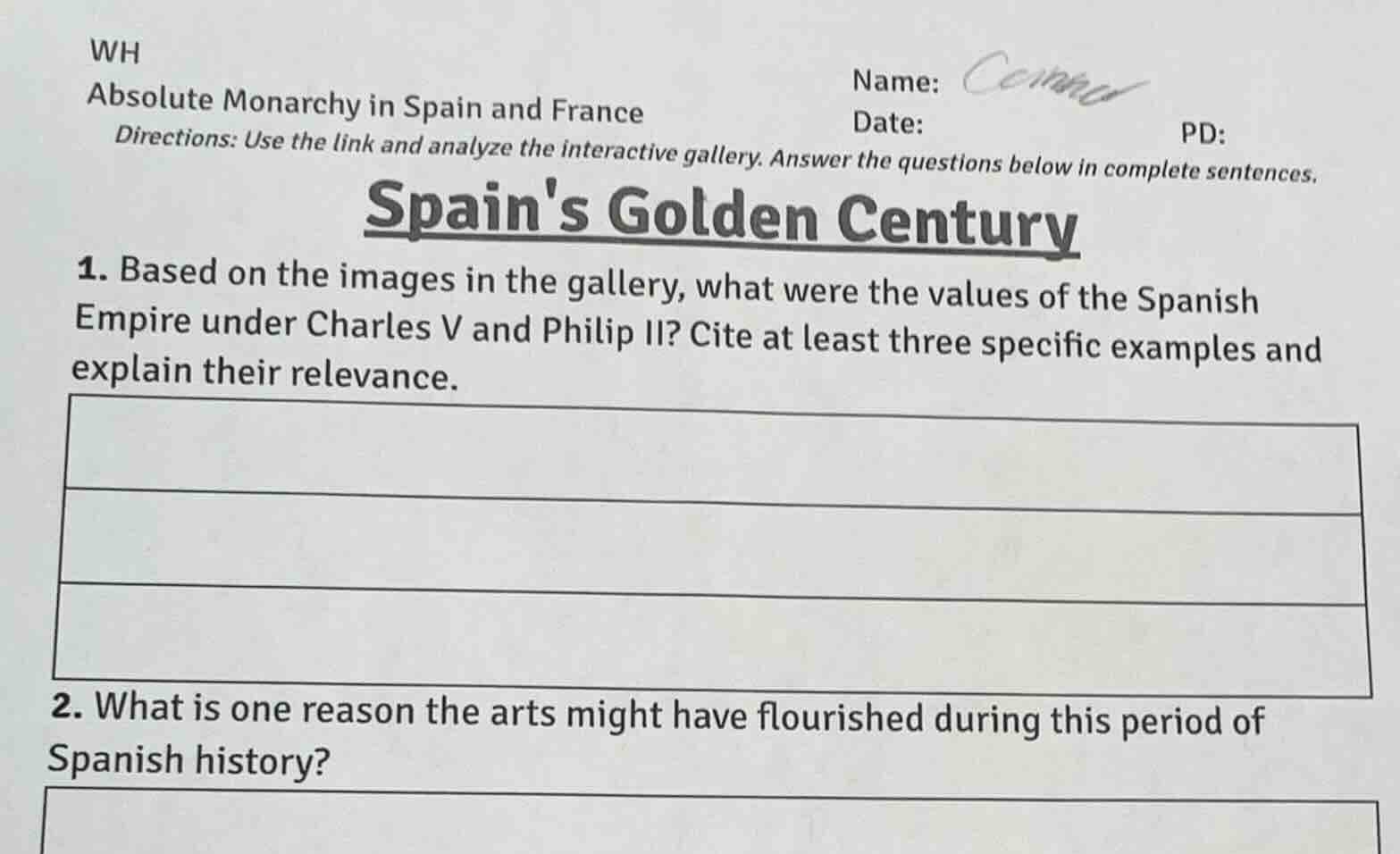
name:
absolute monarchy in spain and france
date: \t\t\t\t\t\t\tpd:
directions: use the link and analyze the interactive gallery. answer the questions below in complete sentences.
spains golden century
- based on the images in the gallery, what were the values of the spanish empire under charles v and philip ii? cite at least three specific examples and explain their relevance.
- what is one reason the arts might have flourished during this period of spanish history?
Brief Explanations
- For the first question, the core values of the Spanish Empire under Charles V and Philip II included strict religious orthodoxy, imperial military dominance, and royal absolutism:
- Religious Orthodoxy: Works like portraits of the monarchs with religious symbols (e.g., Charles V with a crucifix) reflect the empire's commitment to Catholicism, as they led the Counter-Reformation, suppressed Protestantism, and enforced religious unity across their territories.
- Imperial Military Power: Artworks depicting the Spanish Armada or Charles V's military campaigns highlight the value of military strength, which was used to expand and control their vast global empire, including territories in Europe, the Americas, and Asia.
- Royal Absolutism: Portraits showing the monarchs in elaborate, authoritative regalia (such as Philip II's formal court portraits) emphasize the value of centralized royal power, as the kings held absolute control over governance, lawmaking, and resource allocation across the empire.
- For the second question, a key reason for the flourishing arts was the patronage of the Spanish monarchy and wealthy nobility. Charles V and Philip II commissioned and supported artists, architects, and writers to create works that glorified the monarchy, promoted Catholic values, and celebrated the empire's power. This financial and institutional support provided artists with resources, stability, and a platform to create elaborate, influential works.

Snap & solve any problem in the app
Get step-by-step solutions on Sovi AI
Photo-based solutions with guided steps
Explore more problems and detailed explanations
- The Spanish Empire under Charles V and Philip II held three core values:
- Religious Orthodoxy: Portraits of the monarchs paired with Catholic symbols (like Charles V with a crucifix) reflect this value, as they led the Counter-Reformation to enforce Catholic unity and suppress Protestantism across their territories.
- Imperial Military Dominance: Artworks depicting the Spanish Armada or Charles V's military campaigns highlight this value, as military strength was used to expand and control their vast global empire spanning Europe, the Americas, and Asia.
- Royal Absolutism: Formal, authoritative portraits of Philip II in regal regalia emphasize this value, as the monarchs held absolute, centralized control over all governance, lawmaking, and resource distribution in the empire.
- One reason the arts flourished was the extensive patronage of the Spanish monarchy and wealthy elite. Charles V and Philip II provided financial and institutional support to artists, architects, and writers, commissioning works that glorified the monarchy, promoted Catholic values, and celebrated the empire's power, giving creators the resources and platform to produce influential, elaborate pieces.