QUESTION IMAGE
Question
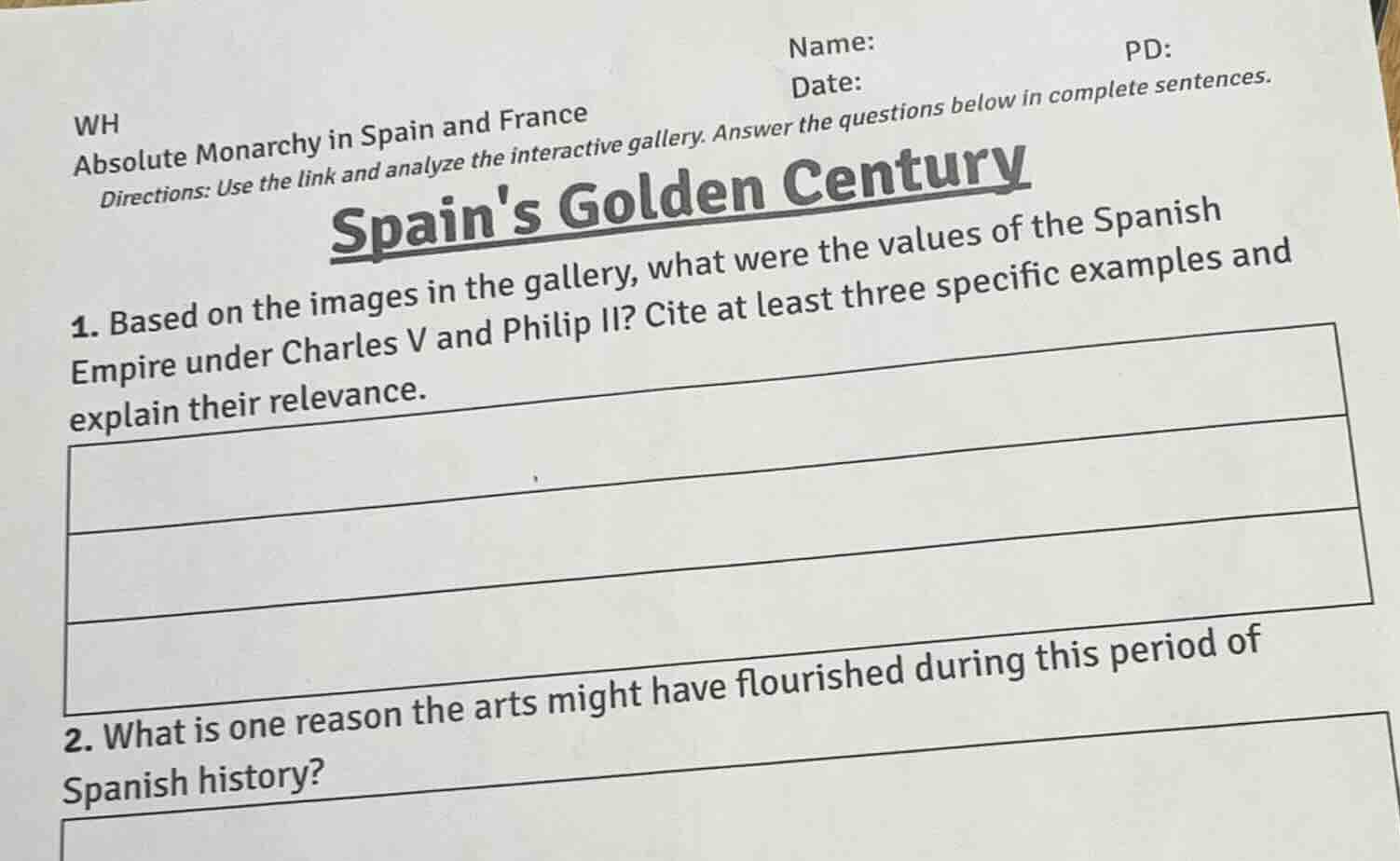
whabsolute monarchy in spain and francename:pd:date:directions: use the link and analyze the interactive gallery. answer the questions below in complete sentences.spains golden century1. based on the images in the gallery, what were the values of the spanish empire under charles v and philip ii? cite at least three specific examples and explain their relevance.2. what is one reason the arts might have flourished during this period of spanish history?
Brief Explanations
- For the first question, the core values of the Spanish Empire under Charles V and Philip II reflected in contemporary art/imagery include religious piety, imperial dominance, and royal authority:
- Religious Piety: Works like El Greco's The Burial of the Count of Orgaz (or imagery of the Spanish Inquisition) show the empire's commitment to Catholicism, which was used to unify the multi-ethnic empire and justify territorial expansion as a "holy mission."
- Imperial Dominance: Portraits or tapestries depicting Charles V's European and overseas conquests (e.g., his victory at Mühlberg) emphasized Spain's status as a global superpower, projecting control over vast territories across Europe, the Americas, and Asia.
- Royal Authority: Portraits of Philip II in elaborate regalia, or depictions of his palace El Escorial, communicated the absolute power of the monarch, framing the king as the unchallenged head of both state and church.
- For the second question, a key reason for artistic flourishing was the massive wealth flowing into Spain from its American colonies. This silver and gold allowed the monarchy and wealthy noble families to act as major patrons, commissioning works from leading artists (like El Greco, Diego Velázquez) to glorify the empire, the church, and the royal family.

Snap & solve any problem in the app
Get step-by-step solutions on Sovi AI
Photo-based solutions with guided steps
Explore more problems and detailed explanations
- The Spanish Empire under Charles V and Philip II was defined by three core values visible in contemporary imagery:
- Religious piety: Artworks like depictions of the Spanish Inquisition or El Greco's religious pieces reflected the empire's rigid commitment to Catholicism, which served to unify its diverse territories and justify expansion as a religious duty.
- Imperial dominance: Art showing Charles V's military victories (such as the Battle of Mühlberg) or maps of Spain's global territories highlighted the empire's status as the leading global superpower of the era, projecting control over lands across Europe, the Americas, and Asia.
- Royal authority: Portraits of Philip II in formal regalia and depictions of his grand palace El Escorial emphasized the absolute, unchallenged power of the monarch, framing the king as the sole head of both the state and the church.
- One major reason the arts flourished in Spain's Golden Century was the enormous wealth generated by the empire's American colonies. Silver and gold from the Americas flooded into Spain, allowing the monarchy, wealthy nobles, and the Catholic Church to act as generous patrons, commissioning works from renowned artists to glorify the empire, faith, and royal rule.