QUESTION IMAGE
Question
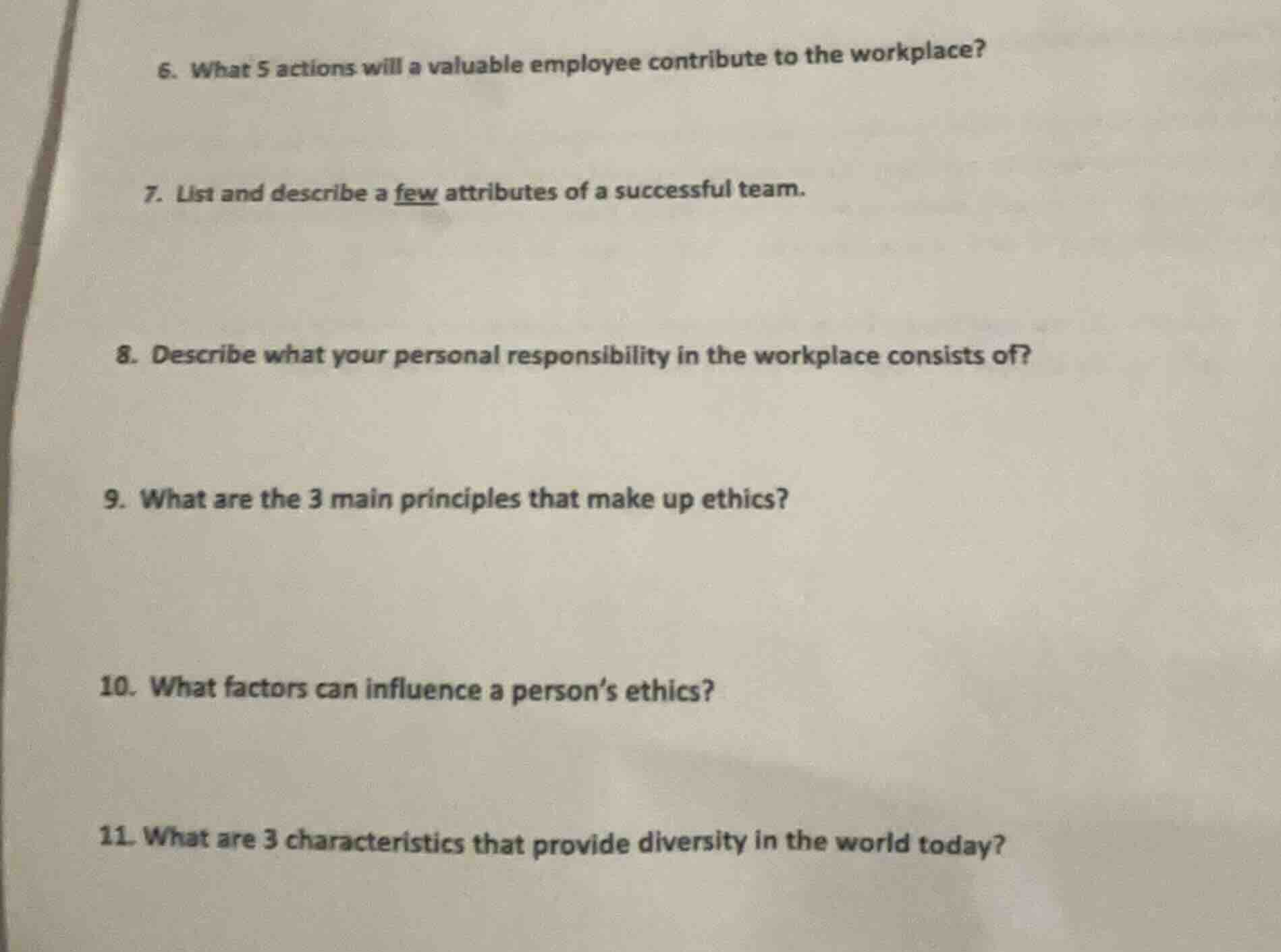
- what 5 actions will a valuable employee contribute to the workplace?
- list and describe a few attributes of a successful team.
- describe what your personal responsibility in the workplace consists of?
- what are the 3 main principles that make up ethics?
- what factors can influence a person’s ethics?
- what are 3 characteristics that provide diversity in the world today?
Brief Explanations
For Question 6:
Identified core actions high-value employees take, focused on workplace impact, collaboration, and accountability.
For Question 7:
Selected key team attributes with concise, workplace-relevant descriptions.
For Question 8:
Outlined core elements of workplace personal responsibility, centered on task ownership and conduct.
For Question 9:
Cited the three foundational, widely accepted principles of ethical frameworks.
For Question 10:
Listed primary, well-documented factors that shape individual ethical perspectives.
For Question 11:
Named distinct, impactful characteristics driving global diversity.

Snap & solve any problem in the app
Get step-by-step solutions on Sovi AI
Photo-based solutions with guided steps
Explore more problems and detailed explanations
- 1. Consistently meets or exceeds performance targets
- Proactively offers solutions to workplace challenges
- Collaborates effectively with cross-functional teams
- Mentors less experienced colleagues to build team capacity
- Maintains open, transparent communication with leadership
---
- 1. Clear shared goals: All members align on a common, measurable objective to avoid misdirection.
- Trust and psychological safety: Team members feel comfortable sharing ideas and admitting mistakes without judgment.
- Strong communication: Regular, respectful information exchange ensures everyone stays informed and aligned.
---
- Personal responsibility in the workplace includes:
- Fulfilling assigned tasks accurately and on schedule
- Taking accountability for mistakes and correcting them promptly
- Adhering to workplace policies, safety rules, and professional standards
- Contributing positively to team morale and a respectful work environment
- Continuously developing skills to improve job performance
---
- 1. Virtue ethics: Focuses on developing good character traits (e.g., honesty, integrity) to guide actions
- Deontology: Centers on following moral rules and duties, regardless of outcomes
- Consequentialism: Evaluates actions based on their overall positive or negative consequences
---
- 1. Cultural and family upbringing: Values learned from childhood and community norms
- Life experiences: Personal hardships, successes, or interactions with others
- Professional environment: Workplace policies, leadership behavior, and team culture
- Societal and legal norms: Laws, cultural expectations, and media influence
---
- 1. Cultural background: Diverse traditions, beliefs, and social practices
- Demographic traits: Age, gender, race, and physical abilities
- Cognitive and experiential diversity: Different education levels, career paths, and ways of thinking