QUESTION IMAGE
Question
1.
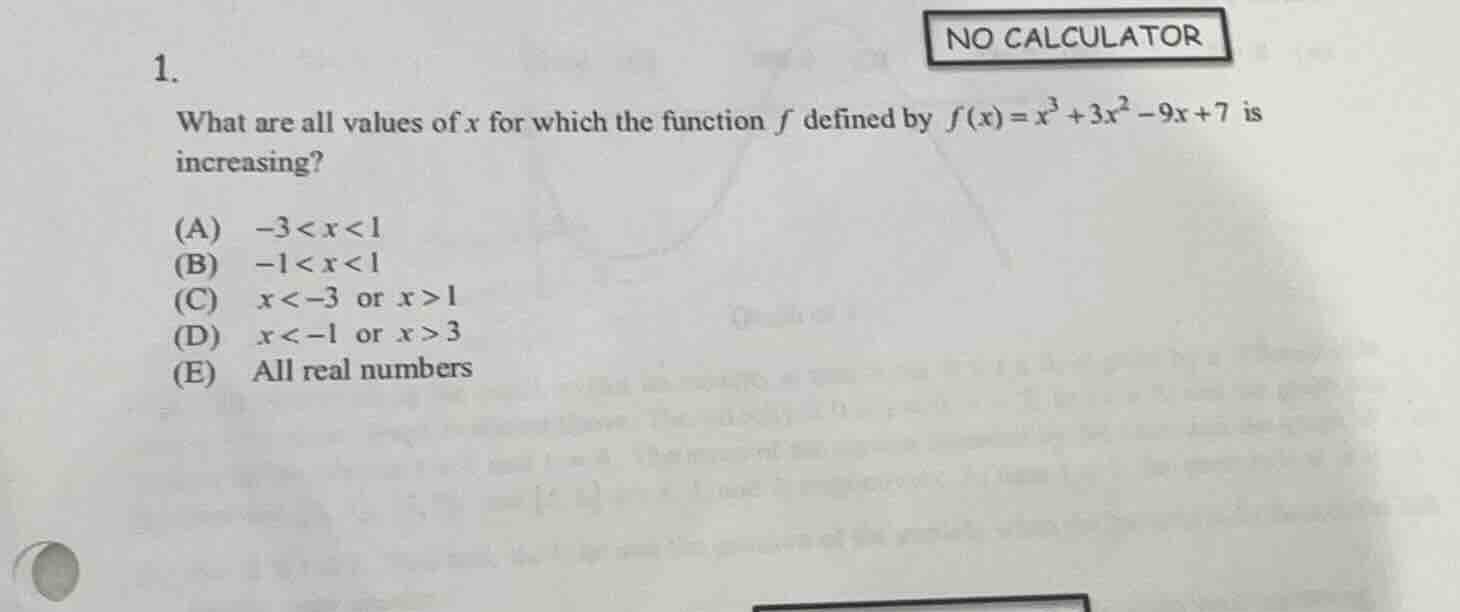
what are all values of x for which the function f defined by $f(x)=x^3 + 3x^2 - 9x + 7$ is increasing?
(a) $-3 < x < 1$
(b) $-1 < x < 1$
(c) $x < -3$ or $x > 1$
(d) $x < -1$ or $x > 3$
(e) all real numbers
Step1: Find the derivative of \( f(x) \)
To determine where a function is increasing, we first find its derivative. For \( f(x) = x^3 + 3x^2 - 9x + 7 \), using the power rule (\( \frac{d}{dx}x^n = nx^{n - 1} \)), the derivative \( f'(x) \) is:
\( f'(x)=3x^2 + 6x - 9 \)
Step2: Factor the derivative
Factor the quadratic expression. First, factor out a 3:
\( f'(x)=3(x^2 + 2x - 3) \)
Then factor the quadratic inside the parentheses: \( x^2 + 2x - 3=(x + 3)(x - 1) \), so \( f'(x)=3(x + 3)(x - 1) \)
Step3: Find critical points
Critical points occur where \( f'(x) = 0 \) or \( f'(x) \) is undefined. Since \( f'(x) \) is a polynomial, it's defined everywhere. Set \( f'(x)=0 \):
\( 3(x + 3)(x - 1)=0 \)
This gives \( x=-3 \) or \( x = 1 \)
Step4: Test intervals
We test the intervals determined by the critical points (\( (-\infty, -3) \), \( (-3, 1) \), \( (1, \infty) \)) to see where \( f'(x)>0 \) (since the function is increasing when the derivative is positive).
- For \( x < -3 \) (e.g., \( x=-4 \)): \( f'(-4)=3(-4 + 3)(-4 - 1)=3(-1)(-5)=15>0 \)
- For \( -3 < x < 1 \) (e.g., \( x = 0 \)): \( f'(0)=3(0 + 3)(0 - 1)=3(3)(-1)=-9<0 \)
- For \( x > 1 \) (e.g., \( x = 2 \)): \( f'(2)=3(2 + 3)(2 - 1)=3(5)(1)=15>0 \)
So \( f'(x)>0 \) when \( x < -3 \) or \( x > 1 \), meaning \( f(x) \) is increasing on \( (-\infty, -3)\cup(1, \infty) \)

Snap & solve any problem in the app
Get step-by-step solutions on Sovi AI
Photo-based solutions with guided steps
Explore more problems and detailed explanations
C. \( x < -3 \) or \( x > 1 \)