QUESTION IMAGE
Question
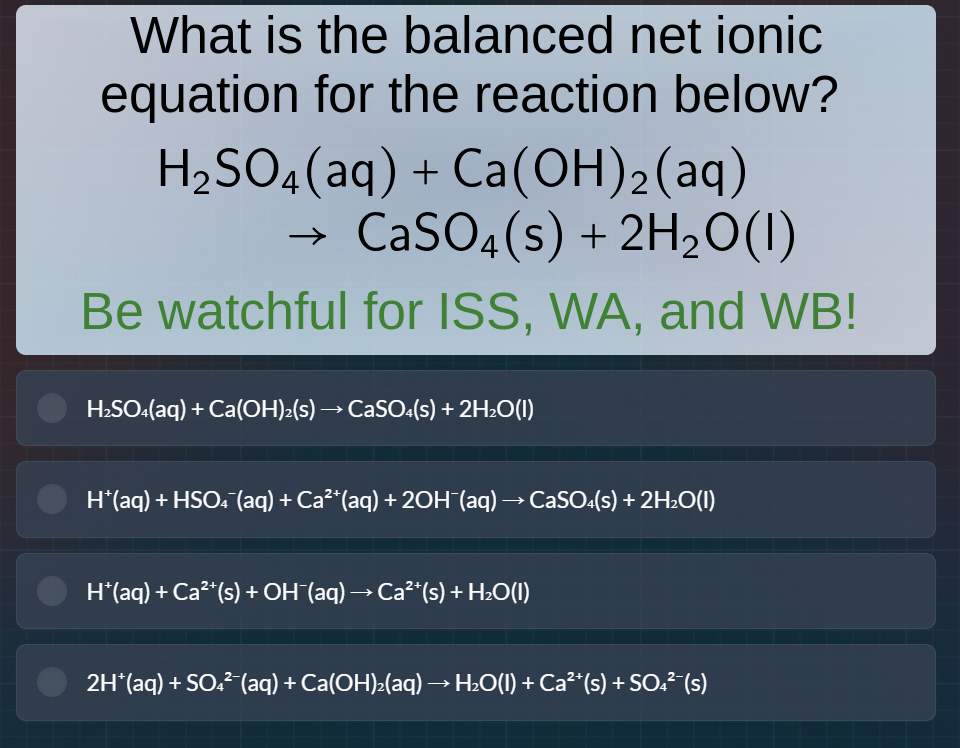
what is the balanced net ionic equation for the reaction below? h₂so₄(aq) + ca(oh)₂(aq) → caso₄(s) + 2h₂o(l) be watchful for iss, wa, and wb! h₂so₄(aq) + ca(oh)₂(s) → caso₄(s) + 2h₂o(l) h⁺(aq) + hso₄⁻(aq) + ca²⁺(aq) + 2oh⁻(aq) → caso₄(s) + 2h₂o(l) h⁺(aq) + ca²⁺(s) + oh⁻(aq) → ca²⁺(s) + h₂o(l) 2h⁺(aq) + so₄²⁻(aq) + ca(oh)₂(aq) → h₂o(l) + ca²⁺(s) + so₄²⁻(s)
Step1: Identify Strong/Weak Acids/Bases, Solids
- \( \ce{H2SO4} \) is a strong acid (WA? No, strong), dissociates as \( \ce{2H+ + SO4^{2-}} \) (first dissociation is complete, second: \( \ce{HSO4-} \) is a weak acid? Wait, no—for net ionic, when \( \ce{H2SO4} \) is in dilute solution, sometimes considered to dissociate into \( \ce{H+} \) and \( \ce{HSO4-} \) (since \( \ce{HSO4-} \) is a weak acid, but maybe in this context, the problem treats it as \( \ce{H+ + HSO4-} \) initially? Wait, no—let's check the reaction. The reactants are \( \ce{H2SO4(aq)} \) (strong acid, but first proton is strong, second is weak) and \( \ce{Ca(OH)2(aq)} \) (strong base, dissociates into \( \ce{Ca^{2+} + 2OH-} \)). Wait, no—\( \ce{Ca(OH)2} \) is a strong base, so in aqueous solution, it dissociates into \( \ce{Ca^{2+}(aq) + 2OH-(aq)} \). \( \ce{H2SO4} \): first dissociation is \( \ce{H2SO4 -> H+ + HSO4-} \) (complete), second \( \ce{HSO4- <=> H+ + SO4^{2-}} \) (partial). But in the reaction with a strong base, maybe we consider \( \ce{H2SO4} \) as \( \ce{H+ + HSO4-} \) (since \( \ce{HSO4-} \) is a weak acid, so it doesn't fully dissociate). \( \ce{Ca(OH)2(aq)} \) dissociates into \( \ce{Ca^{2+}(aq) + 2OH-(aq)} \). The product \( \ce{CaSO4(s)} \) is a solid (insoluble), \( \ce{H2O(l)} \) is a liquid.
Step2: Write Ionic Equations
- Dissociate strong electrolytes: \( \ce{H2SO4(aq)} \) → \( \ce{H+(aq) + HSO4-(aq)} \) (since \( \ce{HSO4-} \) is weak, we don't dissociate it further), \( \ce{Ca(OH)2(aq)} \) → \( \ce{Ca^{2+}(aq) + 2OH-(aq)} \). \( \ce{CaSO4(s)} \) and \( \ce{H2O(l)} \) stay as is.
Step3: Combine and Cancel Spectators
- The ionic equation would be \( \ce{H+(aq) + HSO4-(aq) + Ca^{2+}(aq) + 2OH-(aq) -> CaSO4(s) + 2H2O(l)} \). Now check the options:
- Option 1: \( \ce{Ca(OH)2} \) is (s), but original is (aq) → wrong.
- Option 2: \( \ce{H+(aq) + HSO4-(aq) + Ca^{2+}(aq) + 2OH-(aq) -> CaSO4(s) + 2H2O(l)} \) → matches the dissociation (H2SO4 as H+ + HSO4-, Ca(OH)2 as Ca2+ + 2OH-, product CaSO4(s) and H2O(l)).
- Option 3: Incorrect species (Ca2+ as solid, wrong dissociation) → wrong.
- Option 4: Incorrect dissociation (Ca(OH)2(aq) should dissociate, and SO4^2- as solid? No, CaSO4 is solid, not SO4^2- → wrong.

Snap & solve any problem in the app
Get step-by-step solutions on Sovi AI
Photo-based solutions with guided steps
Explore more problems and detailed explanations
\( \ce{H^{+}(aq) + HSO^{-}_{4}(aq) + Ca^{2+}(aq) + 2OH^{-}(aq) -> CaSO_{4}(s) + 2H_{2}O(l)} \) (the second option: \( \boldsymbol{\ce{H^{+}(aq) + HSO^{-}_{4}(aq) + Ca^{2+}(aq) + 2OH^{-}(aq) -> CaSO_{4}(s) + 2H_{2}O(l)}} \))