QUESTION IMAGE
Question
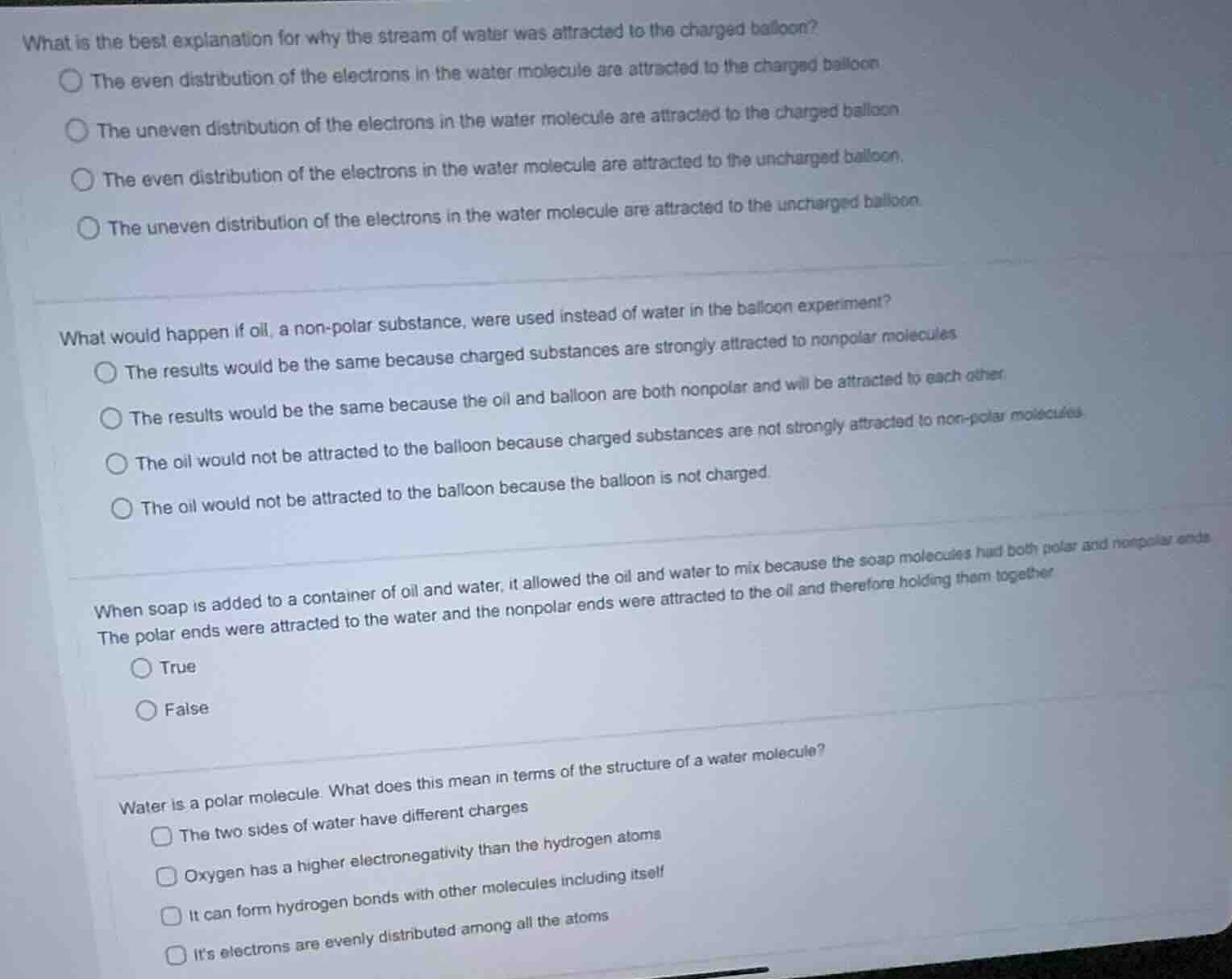
what is the best explanation for why the stream of water was attracted to the charged balloon?
the even distribution of the electrons in the water molecule are attracted to the charged balloon
the uneven distribution of the electrons in the water molecule are attracted to the charged balloon
the even distribution of the electrons in the water molecules are attracted to the uncharged balloon.
the uneven distribution of the electrons in the water molecule are attracted to the uncharged balloon.
what would happen if oil, a non - polar substance, were used instead of water in the balloon experiment?
the results would be the same because charged substances are strongly attracted to nonpolar molecules.
the results would be the same because the oil and balloon are both nonpolar and will be attracted to each other.
the oil would not be attracted to the balloon because charged substances are not strongly attracted to non - polar molecules.
the oil would not be attracted to the balloon because the balloon is not charged.
when soap is added to a container of oil and water, it allowed the oil and water to mix because the soap molecules had both polar and nonpolar ends. the polar ends were attracted to the water and the nonpolar ends were attracted to the oil and therefore holding them together
true
false
water is a polar molecule. what does this mean in terms of the structure of a water molecule?
the two sides of water have different charges
oxygen has a higher electronegativity than the hydrogen atoms
it can form hydrogen bonds with other molecules including itself
its electrons are evenly distributed among all the atoms
First Question:
Water is a polar molecule with an uneven electron distribution (oxygen is more electronegative, pulling electrons more). A charged balloon attracts the polar water molecule due to this uneven electron distribution. Other options are incorrect: even electron distribution is not true for water, and the balloon is charged, not uncharged.
Charged substances (like the balloon) interact strongly with polar molecules (like water) due to dipole interactions. Non - polar substances (like oil) do not have a dipole, so charged substances are not strongly attracted to them. The first two options say results would be the same, which is wrong. The fourth option is wrong as the balloon is charged.
Soap molecules are amphipathic, having a polar end (attracted to water, a polar substance) and a non - polar end (attracted to oil, a non - polar substance). This allows soap to act as an emulsifier, holding oil and water together. So the statement is true.

Snap & solve any problem in the app
Get step-by-step solutions on Sovi AI
Photo-based solutions with guided steps
Explore more problems and detailed explanations
The uneven distribution of the electrons in the water molecule are attracted to the charged balloon