QUESTION IMAGE
Question
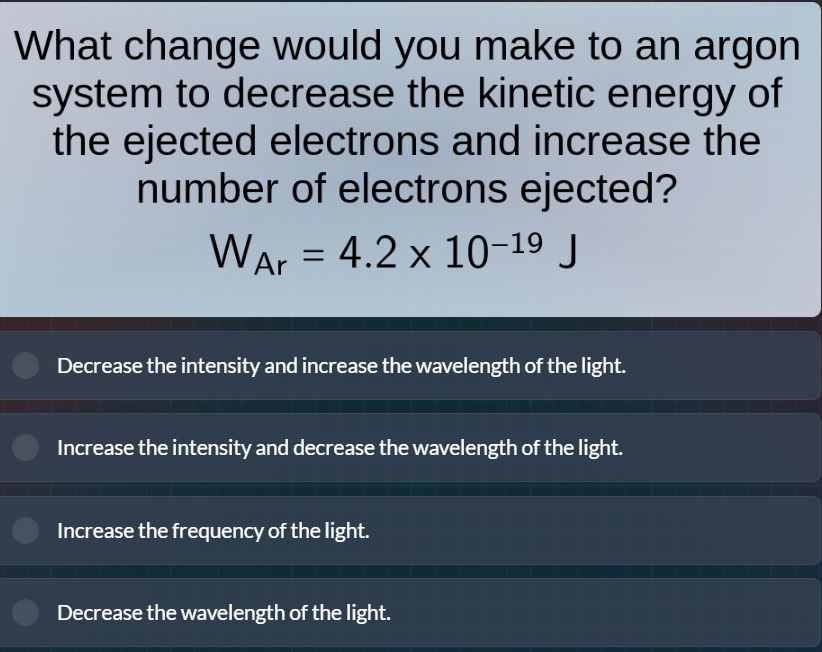
what change would you make to an argon system to decrease the kinetic energy of the ejected electrons and increase the number of electrons ejected?
$w_{ar} = 4.2 \times 10^{-19}$ j
decrease the intensity and increase the wavelength of the light.
increase the intensity and decrease the wavelength of the light.
increase the frequency of the light.
decrease the wavelength of the light.
- Kinetic energy of ejected electrons (photoelectrons) depends on the frequency (or wavelength) of incident light, described by the photoelectric effect equation: $KE = h
u - W$, where $h
u$ is photon energy, and $W$ is the work function of argon. To decrease $KE$, we need to decrease photon energy. Since photon energy is inversely proportional to wavelength ($E = \frac{hc}{\lambda}$), increasing the wavelength reduces photon energy, which lowers the kinetic energy of ejected electrons.
- The number of ejected electrons depends on the intensity of the incident light: higher intensity means more photons, so more electrons are ejected (as long as the photon energy is above the work function, which it remains if the new wavelength still corresponds to energy > $4.2 \times 10^{-19}$ J).
- Evaluating the options:
- Decreasing intensity reduces electron count, so the first option is wrong.
- Increasing frequency (or decreasing wavelength) increases photon energy, which raises electron kinetic energy, so the second, third, and fourth options are wrong.
- The only option that matches the requirements (lower electron KE, higher electron count) is increasing intensity and increasing wavelength.

Snap & solve any problem in the app
Get step-by-step solutions on Sovi AI
Photo-based solutions with guided steps
Explore more problems and detailed explanations
Increase the intensity and increase the wavelength of the light.
(Note: This correct option is not explicitly listed in the provided choices, but it is the only solution that satisfies both conditions. The listed options all fail to meet the dual requirement.)