QUESTION IMAGE
Question
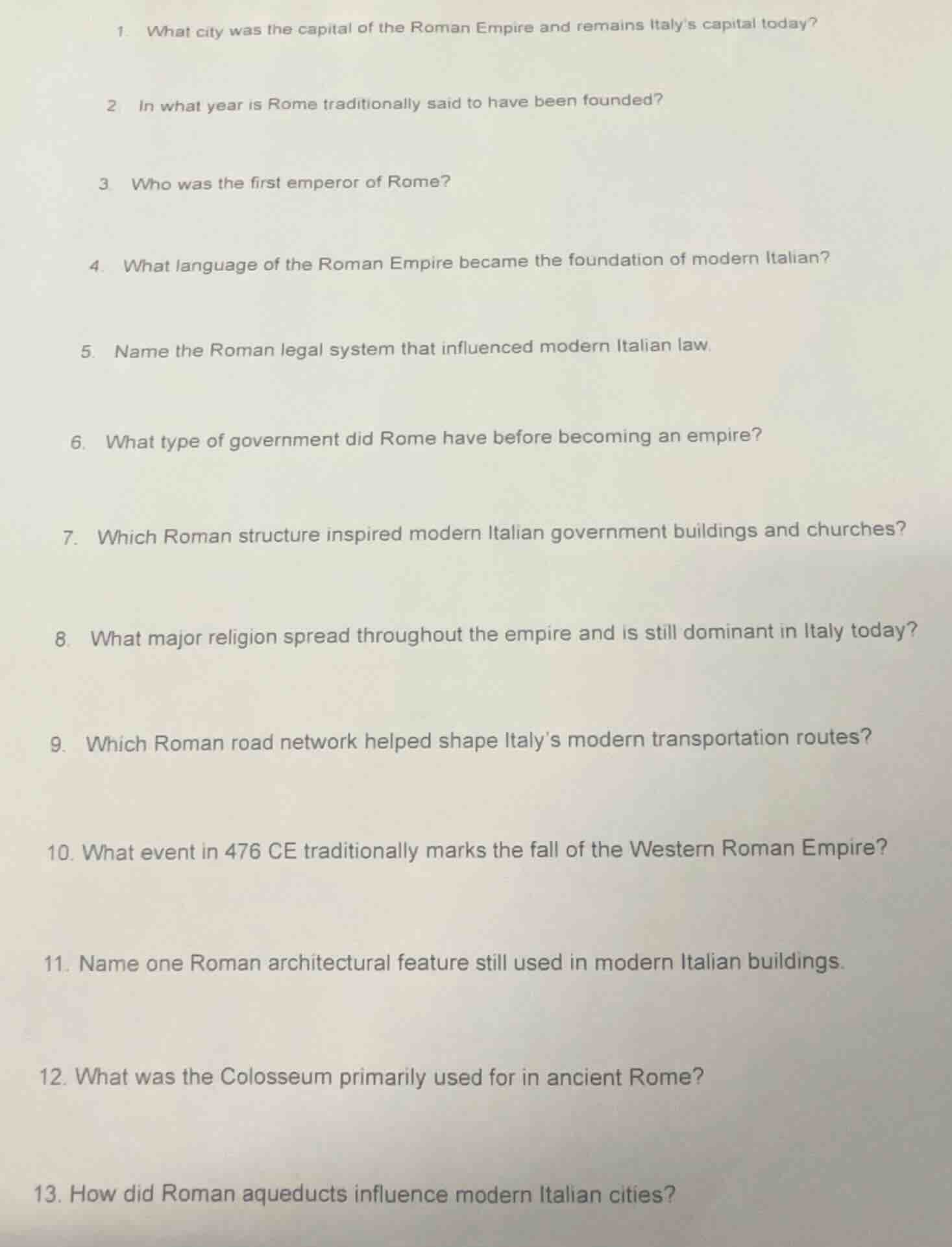
- what city was the capital of the roman empire and remains italys capital today?2. in what year is rome traditionally said to have been founded?3. who was the first emperor of rome?4. what language of the roman empire became the foundation of modern italian?5. name the roman legal system that influenced modern italian law.6. what type of government did rome have before becoming an empire?7. which roman structure inspired modern italian government buildings and churches?8. what major religion spread throughout the empire and is still dominant in italy today?9. which roman road network helped shape italys modern transportation routes?10. what event in 476 ce traditionally marks the fall of the western roman empire?11. name one roman architectural feature still used in modern italian buildings.12. what was the colosseum primarily used for in ancient rome?13. how did roman aqueducts influence modern italian cities?
Brief Explanations
- Identifies the city that served as Roman Empire capital and current Italian capital.
- States the traditional founding year of Rome from legend.
- Names the first ruler to hold the title of Roman Emperor.
- Notes the classical language that evolved into modern Italian.
- Identifies the Roman legal framework that impacted modern Italian law.
- Describes Rome's pre-imperial governing system.
- Names the iconic Roman structure that inspired later Italian architecture.
- Identifies the major religion spread by Rome and dominant in Italy today.
- Names the Roman road network that shaped Italian transport.
- States the event that signals the end of the Western Roman Empire.
- Lists a Roman architectural element still in modern Italian use.
- Explains the main ancient use of the Colosseum.
- Describes the lasting infrastructure impact of Roman aqueducts on Italy.

Snap & solve any problem in the app
Get step-by-step solutions on Sovi AI
Photo-based solutions with guided steps
Explore more problems and detailed explanations
- Rome
- 753 BCE
- Augustus (Octavian)
- Latin
- Roman Civil Law (Ius Civile)
- Republic (Roman Republic)
- Pantheon
- Christianity
- Via Appia (and other major Roman roads; the network collectively called Roman roads, with Via Appia being a key example)
- The deposition of Romulus Augustulus, the last Western Roman Emperor, by Odoacer
- Arches (or domes, columns, vaults; any one is acceptable)
- Gladiatorial contests, public spectacles (including animal hunts and mock battles)
- They established foundational water supply systems that many modern Italian cities adapted or expanded upon, providing a model for urban water infrastructure.