QUESTION IMAGE
Question
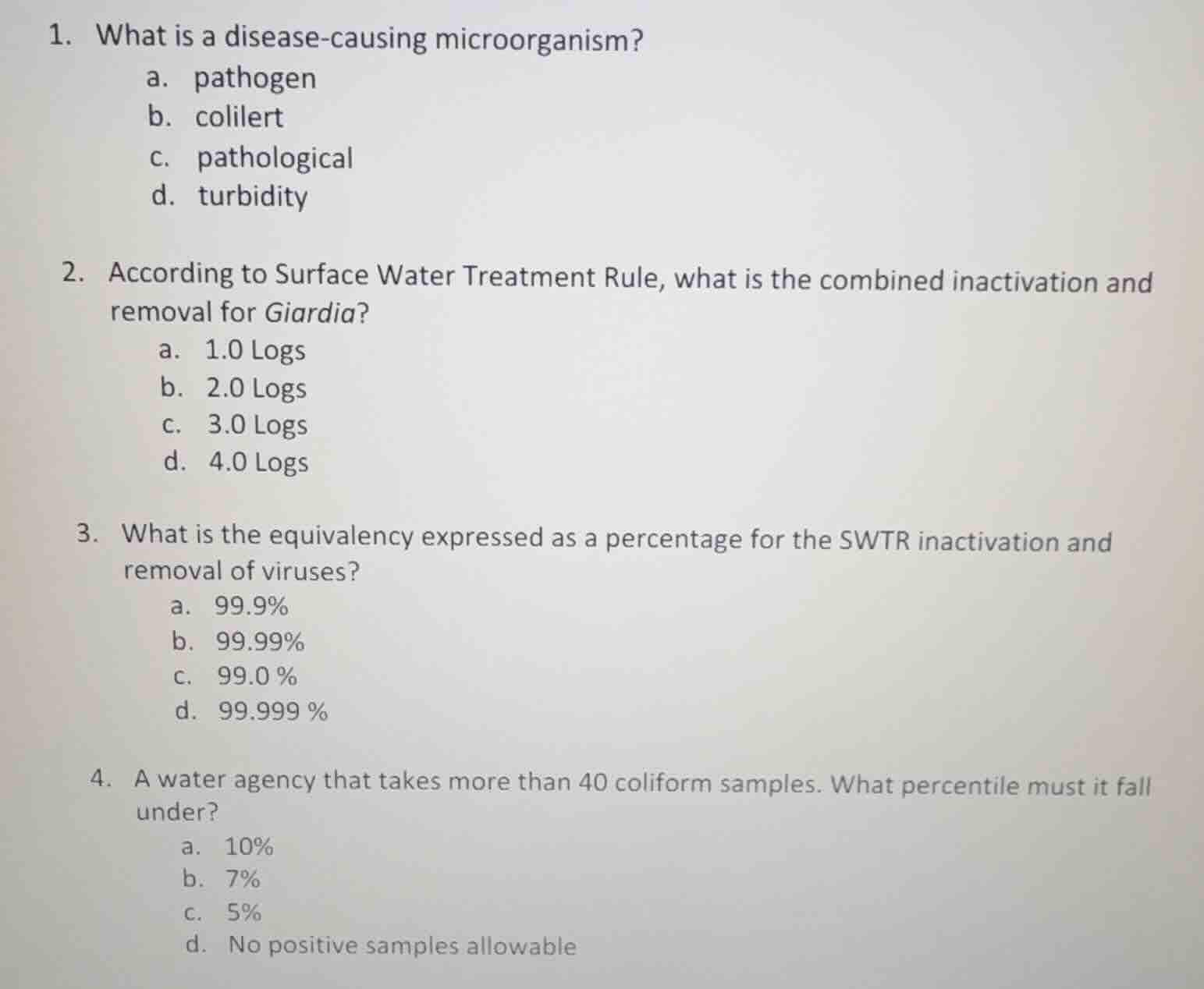
- what is a disease-causing microorganism?
a. pathogen
b. colilert
c. pathological
d. turbidity
- according to surface water treatment rule, what is the combined inactivation and removal for giardia?
a. 1.0 logs
b. 2.0 logs
c. 3.0 logs
d. 4.0 logs
- what is the equivalency expressed as a percentage for the swtr inactivation and removal of viruses?
a. 99.9%
b. 99.99%
c. 99.0 %
d. 99.999 %
- a water agency that takes more than 40 coliform samples. what percentile must it fall under?
a. 10%
b. 7%
c. 5%
d. no positive samples allowable
Brief Explanations
- A pathogen is defined as a microorganism that causes disease, while the other terms refer to a testing method, a disease-related adjective, and a water clarity measurement respectively.
- The Surface Water Treatment Rule (SWTR) requires a combined 3.0 Logs of inactivation/removal for Giardia.
- A 4.0 Log removal/inactivation (required for viruses under SWTR) equals a 99.999% reduction in viral particles.
- For water systems collecting over 40 coliform samples, regulatory standards mandate that positive samples must fall under the 5th percentile.

Snap & solve any problem in the app
Get step-by-step solutions on Sovi AI
Photo-based solutions with guided steps
Explore more problems and detailed explanations
- a. pathogen
- c. 3.0 Logs
- d. 99.999 %
- c. 5%