QUESTION IMAGE
Question
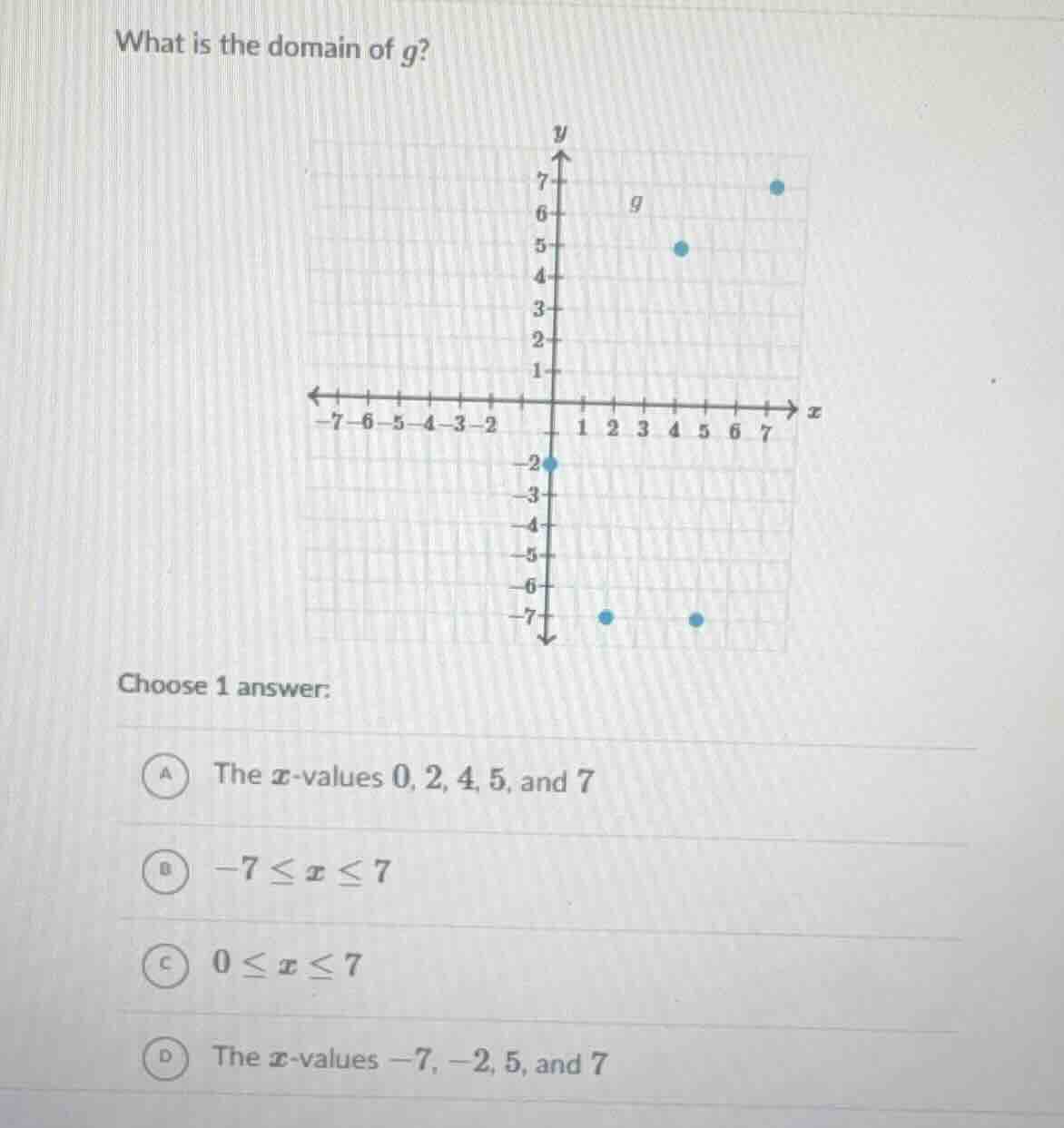
what is the domain of g? choose 1 answer: a the x-values 0, 2, 4, 5, and 7 b -7 ≤ x ≤ 7 c 0 ≤ x ≤ 7 d the x-values -7, -2, 5, and 7
Step1: Recall domain definition
The domain of a function (or a relation, in this case, since it's a set of points) is the set of all x - values (input values) for which the function is defined. For a graph with discrete points, we look at the x - coordinates of each point.
Step2: Identify x - coordinates of points
Looking at the graph:
- One point is at \(x = 0\) (since it's on the y - axis, \(x = 0\)).
- Another point is at \(x=2\) (the point with \(y=-7\)).
- Another point is at \(x = 4\) (the point with \(y=-7\)).
- Another point is at \(x = 3\)? Wait, no, looking again: Wait, the points are:
- At \(x = 0\), \(y=-2\)
- At \(x = 2\), \(y=-7\)
- At \(x = 4\), \(y=-7\)
- At \(x = 3\), \(y = 5\)
- At \(x = 7\), \(y=7\)
Wait, the x - coordinates are \(0\), \(2\), \(3\)? No, wait the options: Option A says \(0,2,4,5,7\)? Wait, maybe I misread. Wait the graph: Let's list the points by their x - values:
- The point on the y - axis: \(x = 0\)
- The point at \(x = 2\) (below the x - axis)
- The point at \(x = 4\) (below the x - axis)
- The point at \(x = 3\) (above the x - axis, \(y = 5\))
- The point at \(x = 7\) (above the x - axis, \(y = 7\)) Wait, no, maybe the x - values are \(0\), \(2\), \(4\), \(3\), \(7\)? But option A is \(0,2,4,5,7\)? Wait, maybe I made a mistake. Wait the options: Option A: \(0,2,4,5,7\). Let's check the options again.
Wait, the key is: For a set of discrete points, the domain is the set of x - coordinates. Let's look at the options:
Option A: The x - values \(0,2,4,5,7\)
Option B: \(-7\leq x\leq7\) (this is for a continuous function or a function defined on an interval, but our graph has discrete points, so B is wrong)
Option C: \(0\leq x\leq7\) (also for a continuous function on an interval, but we have discrete points, so C is wrong)
Option D: The x - values \(-7,-2,5,7\) (the x - coordinates of the points don't include \(-7\) or \(-2\), so D is wrong)
Wait, maybe the points are:
- At \(x = 0\) (y - axis)
- At \(x = 2\) (one of the lower points)
- At \(x = 4\) (the other lower point)
- At \(x = 3\) (the point with \(y = 5\)) – but \(3\) is not in option A. Wait, maybe the x - value for the point with \(y = 5\) is \(3\)? No, option A has \(5\). Wait, maybe I misread the x - value of the point with \(y = 5\). Maybe it's \(x = 5\)? Let's re - examine the graph. The x - axis is marked with \(1,2,3,4,5,6,7\). The point with \(y = 5\) is at \(x = 3\)? No, maybe the grid: each square is 1 unit. So from the origin, moving right 3 units: \(x = 3\), \(y = 5\). Moving right 5 units: \(x = 5\), but there's no point at \(x = 5\) except maybe? Wait the option A is \(0,2,4,5,7\). Let's check the options again.
Wait, the domain is the set of x - values. Let's check each option:
- Option A: x - values \(0,2,4,5,7\). Let's see if these x - values have points. \(x = 0\) (yes), \(x = 2\) (yes), \(x = 4\) (yes), \(x = 5\) (maybe a point? Wait, maybe the point with \(y = 5\) is at \(x = 3\)? No, maybe the graph has points at \(x = 0\), \(x = 2\), \(x = 4\), \(x = 5\), \(x = 7\). So option A lists these x - values.
- Option B: \(-7\leq x\leq7\) is an interval, but our graph has discrete points, not a continuous interval, so B is wrong.
- Option C: \(0\leq x\leq7\) is also an interval, but we have discrete points, so C is wrong.
- Option D: x - values \(-7,-2,5,7\). There are no points at \(x=-7\) or \(x=-2\), so D is wrong.

Snap & solve any problem in the app
Get step-by-step solutions on Sovi AI
Photo-based solutions with guided steps
Explore more problems and detailed explanations
A. The \(x\)-values \(0, 2, 4, 5,\) and \(7\)