QUESTION IMAGE
Question
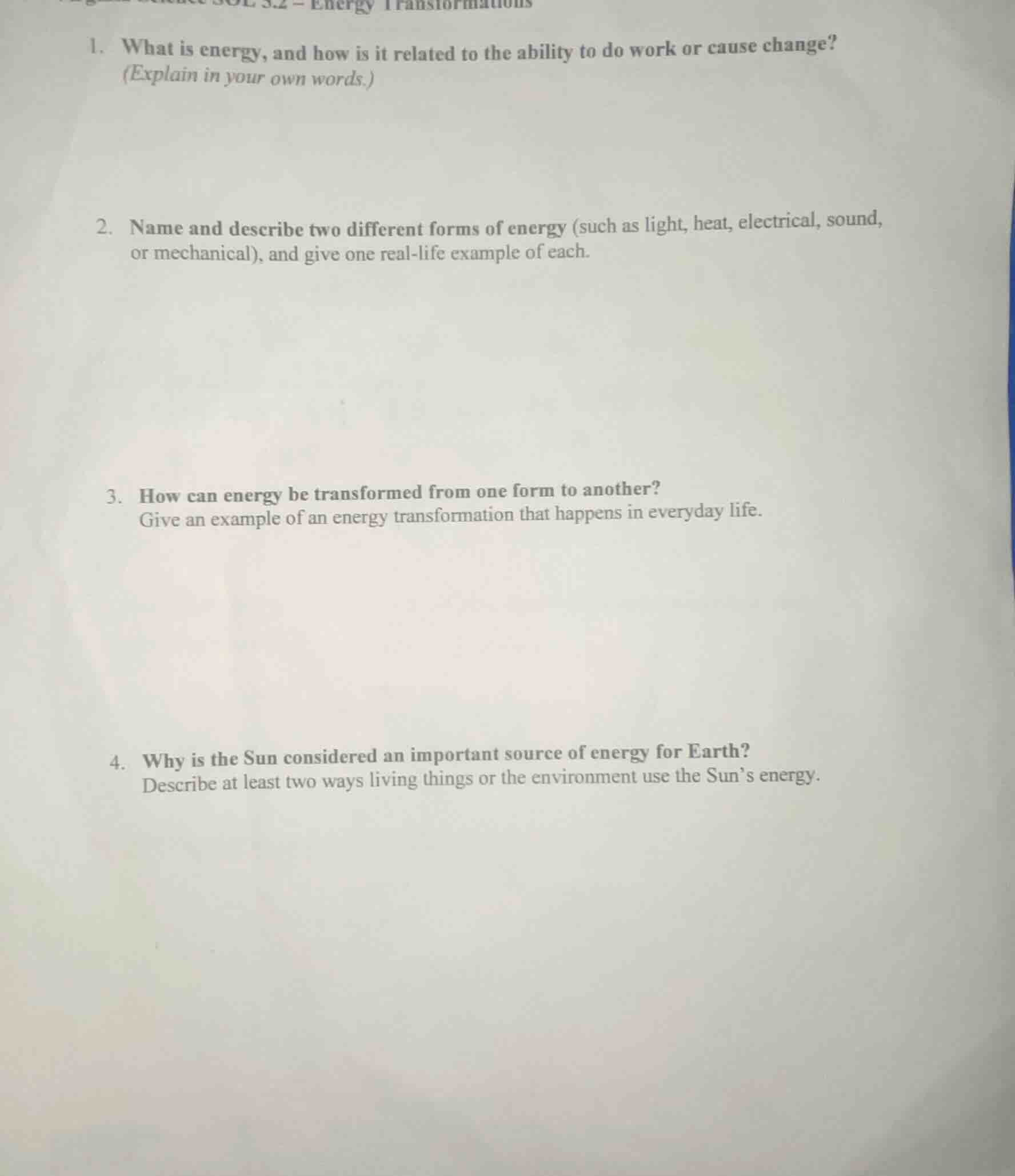
- what is energy, and how is it related to the ability to do work or cause change?
(explain in your own words.)
- name and describe two different forms of energy (such as light, heat, electrical, sound,
or mechanical), and give one real - life example of each.
- how can energy be transformed from one form to another?
give an example of an energy transformation that happens in everyday life.
- why is the sun considered an important source of energy for earth?
describe at least two ways living things or the environment use the sun’s energy.
Brief Explanations
- Defines energy as the capacity to act, links it directly to work/change.
- Identifies two energy forms, describes each, and provides real examples.
- Explains energy transformation via systems/devices, gives daily example.
- Outlines the Sun's role as Earth's primary energy source, details two usage pathways.

Snap & solve any problem in the app
Get step-by-step solutions on Sovi AI
Photo-based solutions with guided steps
Explore more problems and detailed explanations
- Energy is the capacity of a system or object to perform actions. It is directly tied to doing work (applying force to move an object) or causing change (like altering an object's temperature, state, or position); without energy, no work or change can occur.
- - Electrical energy: Energy carried by moving electric charges. Real-life example: A wall outlet supplying electricity to power a laptop.
- Thermal (heat) energy: Energy related to the motion of an object's molecules, which determines its temperature. Real-life example: A stove burner producing heat to boil water.
- Energy is transformed when a device or natural process converts it from one form to another, without creating or destroying it (per the law of conservation of energy). A daily example: A battery-powered flashlight transforms stored chemical energy in the battery into electrical energy, which is then converted into light and small amounts of thermal energy.
- The Sun is Earth's most important energy source because nearly all energy used by living things and Earth's systems originates from it.
- Photosynthesis: Plants use the Sun's light energy to convert carbon dioxide and water into glucose (chemical energy), which fuels their growth and provides energy for all animals that eat plants or other animals.
- Weather systems: The Sun's thermal energy heats Earth's surface unevenly, causing air to warm, rise, and circulate, creating winds and driving the water cycle (evaporation of water into vapor, which forms clouds and precipitates as rain or snow).