QUESTION IMAGE
Question
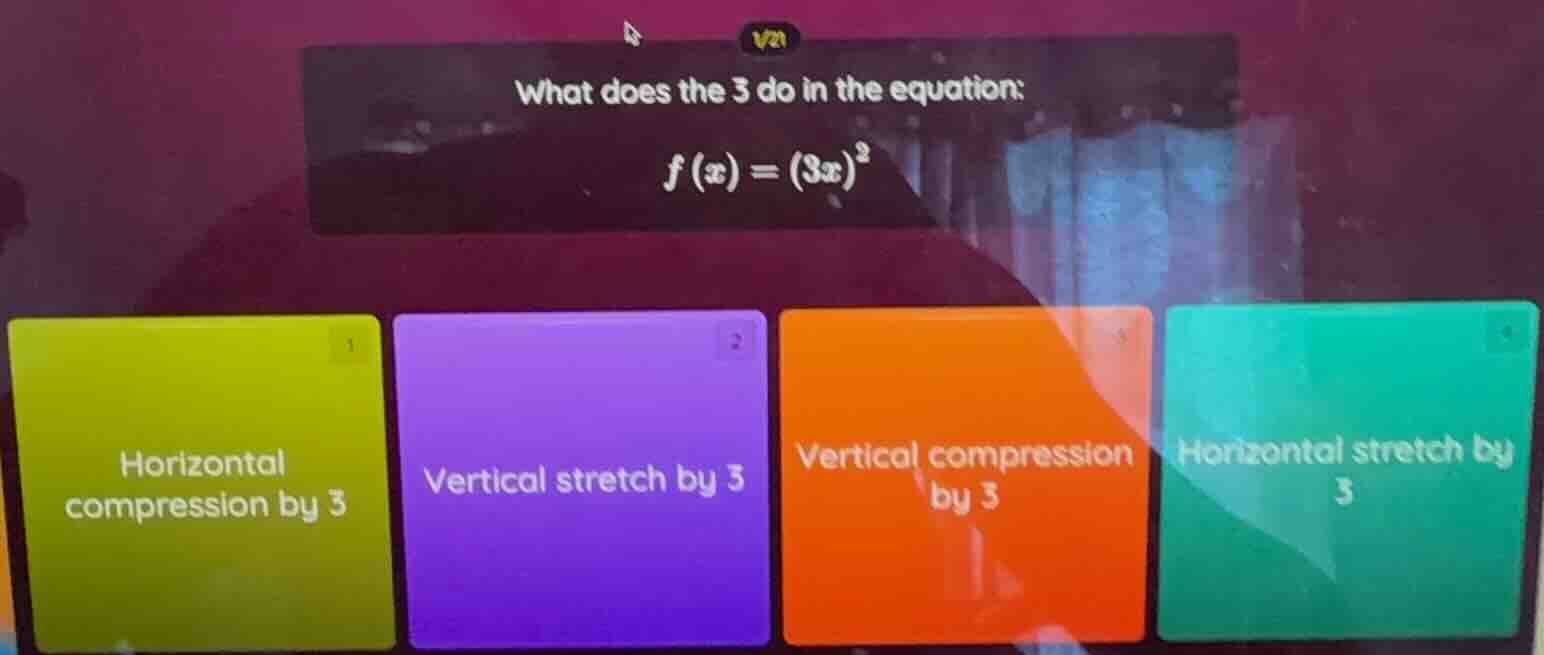
what does the 3 do in the equation: $f(x) = (3x)^2$
1 horizontal compression by 3
2 vertical stretch by 3
3 vertical compression by 3
4 horizontal stretch by 3
Step1: Recall function transformation rules
For a function \( y = f(kx) \), if \( |k|>1 \), it's a horizontal compression by a factor of \( \frac{1}{k} \); if \( 0<|k|<1 \), it's a horizontal stretch. For \( y=(kx)^n \), the coefficient \( k \) inside the function affects horizontal transformations.
Step2: Analyze \( f(x)=(3x)^2 \)
Compare with the form \( y=(kx)^2 \) (here \( k = 3 \), original function without \( k \) is \( y = x^2 \)). Since \( k = 3>1 \), the graph of \( y = x^2 \) is horizontally compressed by a factor of \( \frac{1}{3} \) (or said horizontal compression by 3, as compressing by factor \( \frac{1}{3} \) is equivalent to compressing by 3 in terms of the transformation's description of how the x - values are scaled). The other options: vertical stretch/compression would be if the 3 was outside the square, like \( f(x)=3x^2 \), so vertical options are wrong. Horizontal stretch by 3 would be for \( k=\frac{1}{3} \), so that's wrong.

Snap & solve any problem in the app
Get step-by-step solutions on Sovi AI
Photo-based solutions with guided steps
Explore more problems and detailed explanations
- Horizontal compression by 3