QUESTION IMAGE
Question
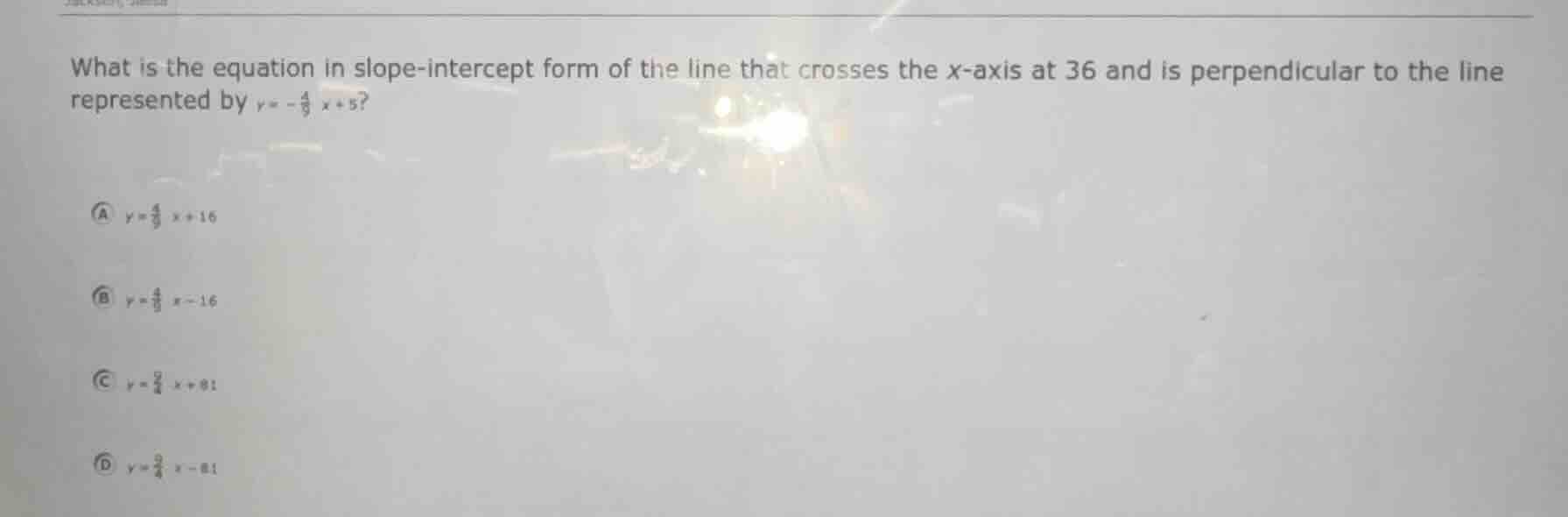
what is the equation in slope - intercept form of the line that crosses the x - axis at 36 and is perpendicular to the line represented by ( y = -\frac{4}{9}x + 5 )?
a ( y=\frac{4}{9}x + 16 )
b ( y=\frac{4}{9}x - 16 )
c ( y=\frac{9}{4}x + 81 )
d ( y=\frac{9}{4}x - 81 )
Step1: Find the slope of the perpendicular line
The given line is \( y = -\frac{4}{9}x + 5 \), so its slope \( m_1 = -\frac{4}{9} \). The slope of a line perpendicular to it, \( m_2 \), satisfies \( m_1 \times m_2=- 1 \). So \( -\frac{4}{9}\times m_2=-1 \), solving for \( m_2 \) gives \( m_2=\frac{9}{4} \). Wait, no, wait. Wait, the reciprocal and opposite sign. Wait, perpendicular slope is negative reciprocal? Wait no, if the slope of a line is \( m \), the slope of the line perpendicular to it is \( -\frac{1}{m} \) when \( m
eq0 \). Wait, no, the product of slopes of two perpendicular lines is - 1. So if \( m_1 = -\frac{4}{9} \), then \( m_2=\frac{9}{4} \)? Wait, no: \( (-\frac{4}{9})\times m_2=-1\Rightarrow m_2=\frac{9}{4} \)? Wait, no, let's calculate: \( m_2=\frac{-1}{m_1}=\frac{-1}{-\frac{4}{9}}=\frac{9}{4} \)? Wait, no, that's not right. Wait, the original line is \( y = -\frac{4}{9}x + 5 \), so slope \( m_1 = -\frac{4}{9} \). Then the perpendicular slope \( m_2 \) should satisfy \( m_1\times m_2=-1 \). So \( (-\frac{4}{9})\times m_2=-1\Rightarrow m_2=\frac{9}{4} \)? Wait, but looking at the options, the slopes are \( \frac{4}{9} \) or \( \frac{9}{4} \). Wait, maybe I made a mistake. Wait, the problem says "perpendicular to the line \( y = -\frac{4}{9}x + 5 \)". Wait, maybe the original line is \( y=-\frac{4}{9}x + 5 \), so the slope is \( -\frac{4}{9} \). Then the perpendicular slope is the negative reciprocal, which is \( \frac{9}{4} \)? Wait, no, negative reciprocal of \( -\frac{4}{9} \) is \( \frac{9}{4} \)? Wait, \( -\frac{4}{9} \) reciprocal is \( -\frac{9}{4} \), then negative of that is \( \frac{9}{4} \). Yes. So the slope of the required line is \( \frac{9}{4} \).
Step2: Find the point where the line crosses the x - axis
The line crosses the x - axis at \( x = 36 \), so the point is \( (36,0) \) (since on x - axis, \( y = 0 \)).
Step3: Use point - slope form to find the equation
The point - slope form is \( y - y_1=m(x - x_1) \), where \( (x_1,y_1)=(36,0) \) and \( m=\frac{9}{4} \). So \( y-0=\frac{9}{4}(x - 36) \).
Step4: Simplify to slope - intercept form
\( y=\frac{9}{4}x-\frac{9}{4}\times36 \). Calculate \( \frac{9}{4}\times36 = 9\times9 = 81 \). So \( y=\frac{9}{4}x - 81 \). Wait, but looking at the options, option D is \( y=\frac{9}{4}x - 81 \). Wait, but let's check again. Wait, maybe I messed up the slope. Wait, the original line is \( y = -\frac{4}{9}x+5 \), so slope \( m_1 = -\frac{4}{9} \). Then the perpendicular slope is \( \frac{9}{4} \), because \( (-\frac{4}{9})\times\frac{9}{4}=-1 \). Then the line passes through \( (36,0) \). So using point - slope: \( y - 0=\frac{9}{4}(x - 36) \), which simplifies to \( y=\frac{9}{4}x-81 \), which is option D. Wait, but let's check the options again. Option D is \( y=\frac{9}{4}x - 81 \). So that's the answer.

Snap & solve any problem in the app
Get step-by-step solutions on Sovi AI
Photo-based solutions with guided steps
Explore more problems and detailed explanations
D. \( y=\frac{9}{4}x - 81 \)